The Legend of Zelda: Ocarina of Time Remake Now Available for Pre-Order — $10 Off at Walmart
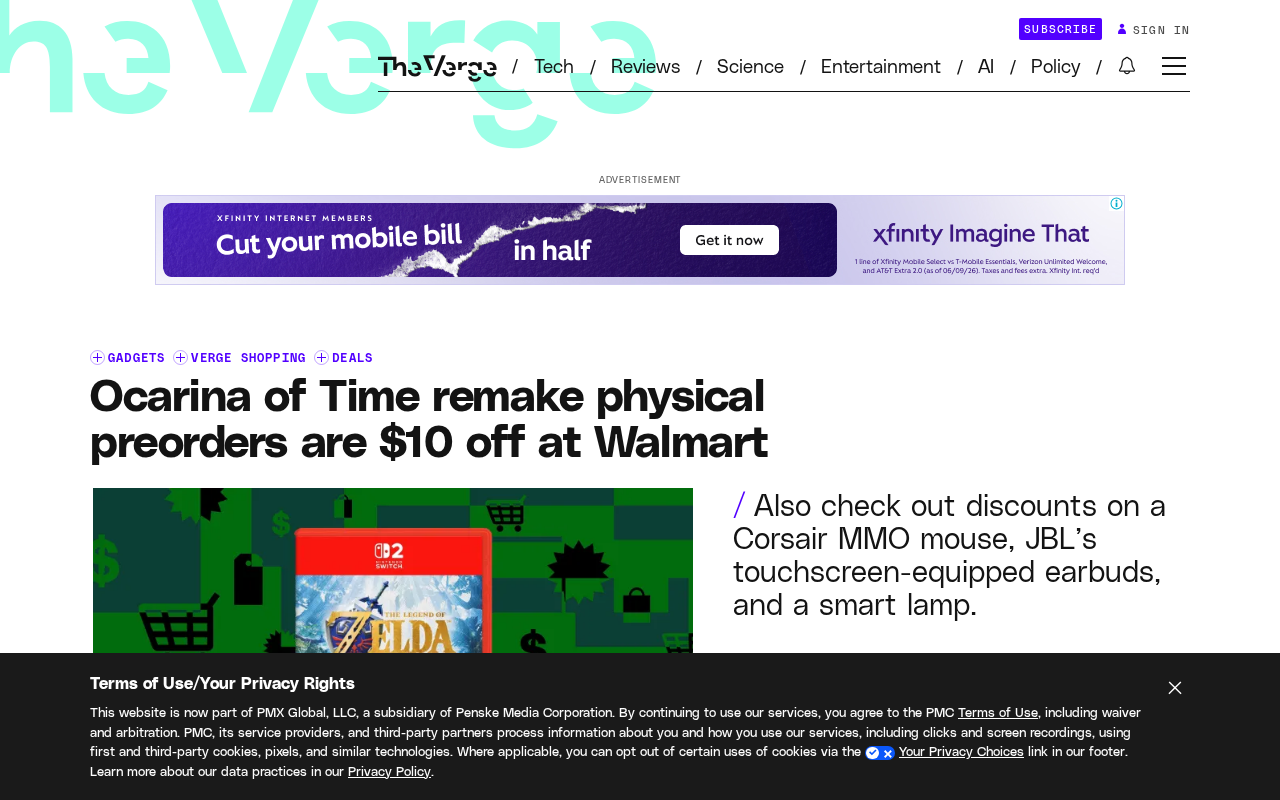
Zelda: Ocarina of Time Switch 2 remake opens pre-orders; Walmart offers $10 off at $59.88.
Nintendo's The Legend of Zelda: Ocarina of Time remake for Switch 2 is now available for pre-order, with Walmart offering the physical edition at $59.88 — $10 below the standard $69.99 retail price. As a Switch 2 launch title, this Remake-level project promises modernized visuals powered by next-gen hardware. The classic N64 title, still holding Metacritic's all-time high score of 99, aims to attract both longtime fans and new players to the series.
Nintendo revealed several new titles during its September Direct, and the most anticipated announcement was undoubtedly The Legend of Zelda: Ocarina of Time, remade for Switch 2. The return of this classic N64 game has sparked enthusiastic discussion among players, and Walmart has already opened pre-orders for the physical edition at $59.88 — $10 less than the $69.99 standard price at other retailers.
The Value of Remaking a Classic IP
The Legend of Zelda: Ocarina of Time originally launched in 1998 on the Nintendo 64 and is widely regarded as one of the greatest games ever made. The Nintendo 64 was Nintendo's fifth-generation home console, released in 1996. Powered by a 64-bit MIPS processor, it was one of the most technically advanced consoles of its era. The N64 was the first console to include an analog stick as a standard controller feature, laying the groundwork for 3D game controls. Ocarina of Time achieved a groundbreaking leap from 2D to 3D on this platform — its open Hyrule overworld, real-time day-night cycle, and seamlessly connected dungeon designs were nothing short of revolutionary in 1998. The game still holds the all-time highest score on Metacritic at 99, a record that remains unmatched in the entire gaming industry.
This title was the first to bring the Zelda series into 3D, establishing the design paradigm for 3D action-adventure games that followed. From the core time-travel mechanic to the Z-targeting lock-on system, many of Ocarina of Time's innovations continue to influence game design to this day. Z-targeting was a groundbreaking control mechanic introduced in Ocarina of Time — by pressing the Z button on the N64 controller, the camera would automatically lock onto a target enemy or NPC, and the character's movement and attacks would orient around that target. This design elegantly solved the core pain points of early 3D games: chaotic camera control and spatial disorientation. Nearly every 3D action game since has adopted a similar lock-on mechanic — from the classic lock-on combat in the Dark Souls series to the target-switching systems in Devil May Cry, God of War, and beyond, all of which can be traced back to Z-targeting's design philosophy. It's no exaggeration to say this mechanic is one of the cornerstones of playability in 3D action games.
Being remade for Switch 2 means this classic will be presented with modernized visuals and performance. As Nintendo's next-generation console, Switch 2 is widely expected to feature a custom next-gen NVIDIA Tegra chip, possibly based on the Ampere or Ada Lovelace architecture, delivering graphics processing capabilities several times greater than the original Switch (which used a Tegra X1 chip based on the 2015 Maxwell architecture). The original Switch could only output 720p resolution in handheld mode, with performance roughly equivalent to a mobile GPU from around 2012. Switch 2 is expected to support DLSS (Deep Learning Super Sampling) technology, using AI algorithms to upscale lower-resolution images to near-4K output quality, achieving visual results far beyond the hardware's native capabilities within limited power constraints. Given the technical prowess Nintendo demonstrated in Breath of the Wild and Tears of the Kingdom, the remake's visual quality and optimization are worth looking forward to.
It's worth noting that in the gaming industry, Remaster, Remake, and Reboot are three frequently confused terms with distinctly different meanings. A Remaster typically refers to surface-level improvements like resolution upscaling and texture optimization while retaining the original game engine and assets — such as the 2011 3DS version Ocarina of Time 3D. A Remake means rebuilding the game from the ground up with a new engine, potentially involving comprehensive overhauls to graphics, controls, and even some gameplay elements — such as 2020's Final Fantasy VII Remake. A Reboot is a complete reinterpretation of a series, often changing the world-building and narrative direction. Nintendo's wording and the generational hardware leap of Switch 2 suggest this is more likely a true Remake-level project rather than a simple Remaster.
Walmart Pre-Order Deal Analysis
Walmart's pre-order pricing offers a clear competitive advantage. The $59.88 price tag is approximately 14% below the standard retail price, making it a solid opportunity for players who want to own the physical edition. Note that this discount currently applies only to the physical version — no digital edition discount has been announced.
Physical games offer the advantages of resale value and collectibility, and Zelda titles in particular tend to hold their value well over time. In an increasingly digital-dominated gaming market, physical editions have formed a unique collector economy. Nintendo first-party physical titles have an industry-leading value retention rate — Breath of the Wild still commands near-original pricing on the secondhand market seven years after launch, with some limited editions even selling at significant premiums. This stands in stark contrast to Sony and Microsoft platform titles, which often see steep price drops within months of release. The reason lies in Nintendo's rare practice of deeply discounting first-party titles (the so-called "Nintendo tax"), combined with a higher proportion of collectors among their platform user base. Walmart's below-standard-retail pre-order pricing is a retailer-driven strategy to attract foot traffic, common among major retailers. For players who want to secure a copy at launch, pre-ordering also ensures they'll have the game in hand on release day.
Switch 2 Launch Lineup Strategy
The Ocarina of Time remake as one of Switch 2's launch titles demonstrates Nintendo's commitment to its new console. Launch titles are games released simultaneously or near-simultaneously with a new console, and their quality directly impacts the platform's early market performance and user base development. Historically, the most successful launch title examples include: Wii Sports for the Wii in 2006, which single-handedly defined the motion-gaming era, and Breath of the Wild for the Switch in 2017, whose universal acclaim drove first-year sales beyond expectations.
Remaking classic IPs can both draw longtime fans back and introduce a new generation of players to series staples. This strategy has proven reliable across the gaming industry — Sony's The Last of Us remake and Demon's Souls remake both achieved commercial success. Sony's Demon's Souls remake for PS5, developed by Bluepoint Games, paired near-zero gameplay modifications with next-gen visuals and became the industry benchmark for "faithful remakes," selling over 1.4 million copies in its first year. Nintendo's choice of Ocarina of Time as a Switch 2 launch title aims to simultaneously activate nostalgia-driven purchasing power among veteran players and curiosity among series newcomers.
Looking at Nintendo's release cadence, they are building a robust game lineup for Switch 2. Beyond remaking classics, new original IPs and series entries are also in development. This blend of old and new can reach player demographics across different age groups and preferences.
Unanswered Questions About the Remake
Nintendo has yet to reveal detailed technical specifications for the remake, such as resolution, frame rate, and the extent of visual enhancements. Another question on players' minds is whether the remake will include gameplay adjustments or be limited to a visual upgrade. Given that the original game was already remarkably polished in many respects, excessive changes could prove controversial.
Switch 2's backward compatibility is also a major point of interest for players. If the new console can run Switch games, the library transition will be much smoother. The release timing for the Ocarina of Time remake will be closely tied to Switch 2's launch date, and players may need to wait a while before they can actually get their hands on this title.
Key Takeaways
Related articles
Security Guide for AI/BI Dashboard Embedding: Multi-Tenant Data Isolation and Access Control in Practice
Explore security challenges in AI/BI dashboard embedding, covering multi-tenant data isolation, row-level security, identity propagation, and defense-in-depth architecture for embedded analytics.
Xbox Classic Startup Animations Return: Personalization and Cloud Gaming Experience Get Major Upgrades
Microsoft rolls out classic console startup animations, badge customization, cloud gaming background downloads, and more for Xbox Insiders. Remote Play quality and voice chat also improved.
AI-Assisted Programming Goes Mainstream: A Paradigm Shift in Software Development
How AI tools are reshaping software development: from FAANG adoption to workflow transformation. Explore AI coding assistants, intelligent code review, and the future of human-AI collaboration.