The "Memory" Debate in AI Agents: Three Problems Being Conflated

The AI agent memory vs. documentation debate persists because "memory" conflates three entirely separate engineering problems.
The endless debate over whether AI agents need a "memory layer" stems from one root cause: the word "memory" obscures three distinct engineering problems — in-session state persistence, cross-session long-term memory, and context window management. The documentation camp argues about the third; the memory-layer camp focuses on the second. They use the same term to defend different goals, which is why the debate never converges. Of the three, the first two have relatively mature solutions, while cross-session memory remains genuinely unsolved — store bloat drives up global token costs, and stale entries lack clean eviction mechanisms. The most practical advice for developers: identify which layer your problem belongs to before reaching for a solution.
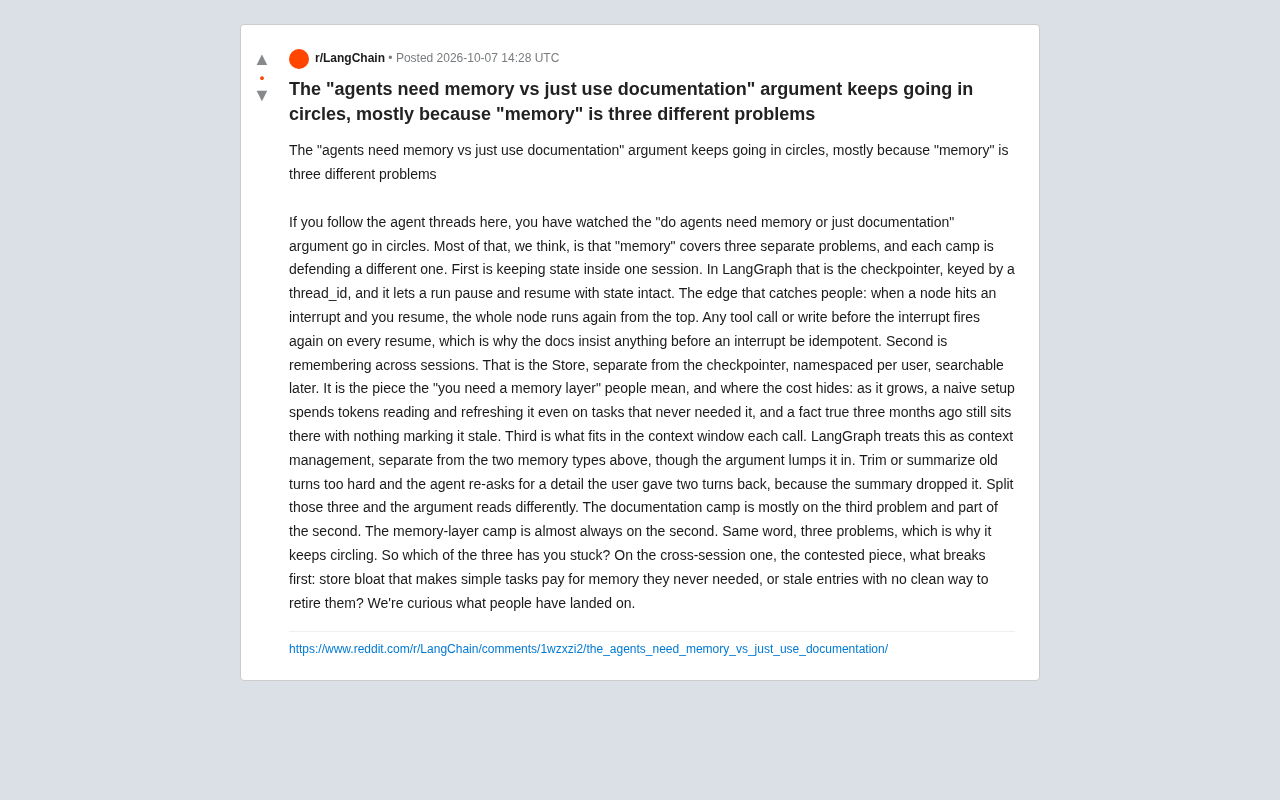
The debate over whether AI Agents actually need "memory" or can get by with just documentation keeps spinning in circles across technical communities with no resolution in sight. A Reddit discussion thread offered a particularly illuminating explanation: the reason this argument goes nowhere is that the word "memory" actually obscures three completely different problems, and each side is defending a different one — which is why neither can convince the other.
Breaking "Memory" Into Three Distinct Problems
To understand this debate, you first need to decompose the vague concept of "memory." Using a framework like LangGraph as an example, what we call "memory" involves at least three independent mechanisms, each solving fundamentally different problems.
Problem 1: State Persistence Within a Single Session
The first type is maintaining state within a single conversation session. In LangGraph, this is handled by the checkpointer, keyed by thread_id, allowing a run to pause and resume with its state intact.
There's a common pitfall here: when a node triggers an interrupt and then resumes, the entire node reruns from the beginning. This means any tool calls or write operations that occurred before the interrupt will be executed again on every resume. This is exactly why the official documentation repeatedly emphasizes that "operations before an interrupt must be idempotent" — otherwise a single resume could trigger duplicate orders, duplicate database writes, and other unintended side effects.
Idempotency is a foundational concept in distributed systems: an operation that produces the same result regardless of how many times it's executed. The classic example is an HTTP GET request (no side effects, repeated requests don't change server state) versus a POST request (each call may create a new record). In LangGraph's interrupt/resume scenario, if a node has already called a "send email" or "write to database" tool before the interrupt, resuming will rerun the node from scratch and trigger those operations again. Common approaches to designing idempotent operations include: generating a unique idempotency key for each operation for downstream deduplication, moving write operations to after the interrupt point, or checking whether the target state already meets expectations before executing. This constraint isn't unique to LangGraph — any system where workflows can be replayed from a checkpoint requires idempotency as a core engineering discipline.
Problem 2: Long-Term Memory Across Sessions
The second type is memory that persists across sessions, handled by the Store. It operates independently from the checkpointer, partitions data by user namespace, and supports later retrieval.
This is what the "you need a memory layer" camp is actually talking about — and it's also where the hidden costs lie. As the Store grows, a naive implementation will spend tokens reading and refreshing memory on every task, even tasks that have no need for it. Even more troubling is the staleness problem: a fact that was true three months ago sits quietly in storage with no indication that it has since expired.
Problem 3: Context Window Management
The third type is what gets loaded into the context window on each call. LangGraph separates this into its own category — context management — distinct from the previous two, even though it's routinely lumped together in debates.
The risk here is over-trimming: if old conversation turns are compressed or summarized too aggressively, the agent will turn around and ask the user for information they provided just two turns ago, because the summary discarded that detail. The "amnesia" feeling users experience often comes from this layer being mishandled, not from any real failure in long-term memory.
Context window refers to the maximum number of tokens a language model can receive in a single inference call. Early models typically supported only 4K–8K tokens, while newer models like GPT-4o and Claude 3.5 have expanded to 128K or beyond — but larger windows come with linearly increasing inference cost and latency. In multi-turn conversations, message history accumulates with each turn. Common management strategies include: sliding window truncation (keeping only the last N turns), summarization compression (using the model to condense old conversation into a paragraph that's fed back into the window), and vector retrieval (storing history in a vector database and retrieving it on demand by relevance). Each strategy has trade-offs: truncation loses detail, summarization introduces information loss, and retrieval depends on recall quality. The "amnesia" effect mentioned in the article is typically the result of overly aggressive summarization — the model generating the summary can't anticipate which details will still matter five turns later, so information entropy loss is unavoidable.
Why the Debate Keeps Going in Circles
Once you separate the three problems, the shape of the entire debate becomes clear.
The documentation camp is primarily arguing about the third problem, with some overlap into the second — their point is that many supposed "memory" requirements can actually be covered by well-organized context and external document retrieval.
The memory-layer camp is almost always talking about the second problem — they care about persistent knowledge across sessions and tasks.
Same word, three problems. Both sides use identical terminology while defending entirely different goals — and that's the real reason the argument loops endlessly without converging. This kind of "false disagreement caused by terminological confusion" is actually quite common in AI engineering. Many seemingly fierce position conflicts, when broken down to their underlying concepts, reveal that people are simply discussing different things.
Cross-Session Memory: The Problem That Remains Unsolved
The first and third problems have relatively mature engineering solutions: in-session state is handled through idempotent design, and context window management is addressed through trimming and summarization trade-offs. The genuinely contentious and thorny issue is the second — long-term cross-session memory.
The question raised in the original post is representative: when it comes to cross-session memory, which problem hits first?
One is store bloat: the storage keeps growing, forcing tasks that are simple and don't need memory at all to pay token costs for reading and maintaining that memory. In other words, memory becomes a global cost burden rather than an on-demand resource.
The other is stale entries: memory accumulates large amounts of information that was once true but is no longer valid, with no clean mechanism to retire or evict those entries. Over time, the agent may make incorrect decisions based on outdated facts.
These two problems point to the core tension in long-term memory design: the more you remember, the higher the cost and noise; the slower you clean up, the worse the accuracy. The industry has no standard answer to this yet — which is precisely why the original post opened the discussion and solicited practical experience from others.
A few categories of mitigation approaches currently being explored are worth knowing. For store bloat, one approach is "tiered memory": partitioning memory by importance and access frequency into hot and cold storage, where only hot-tier entries participate in retrieval by default and cold-tier entries are awakened on demand. For stale entries, a common approach borrows from cache systems — attaching a TTL (Time-To-Live) to each memory entry, or running periodic "memory audit" tasks where the agent self-evaluates entry reliability. Another direction draws inspiration from cognitive science's forgetting curve: entries accessed less frequently have their weights decay over time, naturally lowering their ranking during retrieval. These approaches each involve trade-offs and remain experimental — none have yet been standardized into a mainstream framework the way checkpointers have.
Implications for Agent Developers
The value of this discussion isn't in providing conclusions — it's in offering a clear classification framework. For developers building agent systems, a few practical takeaways are worth noting:
- First identify which layer you're stuck on. In-session state, cross-session memory, and context management are three separate things. Use the corresponding mechanism for each — don't expect a single "memory layer" to handle everything.
- Operations before an interrupt must be idempotent. Whenever you use a pauseable, resumable workflow, this is non-negotiable engineering discipline.
- Treat long-term memory as a resource with costs. Don't default to loading all memory for every task — consider on-demand retrieval, and design expiration markers and eviction mechanisms for memory entries.
- Be cautious with context summarization. Over-compression causes agent amnesia; preserving critical details requires deliberate strategy.
The next time the question "do agents need memory or documentation" comes up, try asking first: which of the three problems is the "memory" you're referring to?
Related articles

How Big Can Stars Really Get? The Physical Limits of the Largest Stars
Red supergiants are the largest stars by volume, with radii up to 2,000 times the Sun, engulfing the inner solar system. But there is no precise upper limit on stellar size—models predict up to 15,000 solar radii. The most massive blue stars are far smaller than red supergiants—biggest and heaviest are two different things.

Apple HomeView Smart Display Full Feature Breakdown: Wall-Mount or Desktop, $299
Apple launches HomeView, a $299 smart display with wall-mount and desktop options, 12MP camera for facial recognition, smart home control, music playback, and recipe step-by-step cooking. Full breakdown of watch faces, apps, privacy, and cooking integration.

Where Did the Promised New Studio Go? Craft Computing Answers After Five Years
Craft Computing's host responds to viewer questions: the new studio promised five years ago was shelved as construction costs soared from $30,000 to $75,000, and was replaced by a 168-square-foot garage conversion.