The Million-Dollar Navier-Stokes Problem: AI-Assisted Proof of Finite-Time Blowup
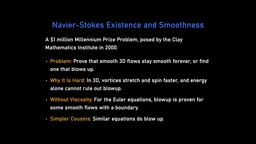
Interview explores the Navier-Stokes Millennium Problem, where an AI-assisted proof constructs a finite-time blowup counterexample with smooth external forcing.
Based on a mathematician interview, this article explores the Navier-Stokes Millennium Problem. It explains the physical meaning of viscosity, pressure, and convection terms, using the ODE \dot{x}=x^2 as an analogy for blowup. It highlights an AI-assisted proof that constructs a special vortex for the 3D equations with smooth forcing, exploiting vortex stretching to achieve infinite local vorticity in finite time while energy stays finite. This counterexample defies the intuition that viscous diffusion suppresses blowup, a phenomenon absent in 2D. The proof doesn't solve the no-forcing version but offers new insights into regularity and AI's potential in constructing complex counterexamples.
Introduction: A Million-Dollar Fluid Dynamics Mystery
The Navier-Stokes equations are the core equations describing fluid motion, indispensable from weather forecasting to aircraft design. However, whether these equations always yield smooth solutions for all time is one of the Clay Mathematics Institute's Millennium Prize Problems, carrying a million-dollar reward. Recently, an interview with a mathematician delved into the mathematical formulation of this problem and how an AI-assisted proof constructed a counterexample of finite-time blowup.
According to the interview, the core question is: in three-dimensional space, do there exist initial conditions such that the fluid velocity tends to infinity in finite time—i.e., a "blowup" occurs? The proof of such a counterexample challenges long-held expectations based on physical intuition.
The Millennium Prize Problems are seven unsolved mathematical problems selected by the Clay Mathematics Institute in 2000, each carrying a $1 million prize for its solution. The existence and smoothness problem for the Navier-Stokes equations is one of them. The problem asks: in three-dimensional space, given any smooth initial velocity field, do the Navier-Stokes equations always possess a global smooth solution? Or conversely, does there exist a smooth initial condition such that the solution develops infinite velocity (i.e., "blowup") in finite time? This problem has attracted numerous mathematicians since its proposal, but no one has fully solved it to date.
The Navier-Stokes Equations: From Tornadoes to the Viscosity of Honey
Physical Intuition in the Equations
The interviewer uses a tornado as an example: a tornado is a velocity field that varies rapidly in space and time, with low pressure in the core region, and the pressure field drives the motion of the velocity field. The Navier-Stokes equations quantify the fluid's momentum, internal friction (viscosity), and external forces (such as heating, pressure, gravity) as terms in the equation. Honey has greater internal resistance than water, and water greater than air—this is the intuitive manifestation of the viscosity term.
Quadratic Nonlinearity and a Simple Analogy for Finite-Time Blowup
To explain blowup, the mathematician introduces an ordinary differential equation analogy: ( \dot{x} = x^2 ). This equation blows up to infinity in finite time, whereas ( \dot{x} = x ) (like rabbit population growth) only exhibits exponential growth and never reaches infinity in finite time. The key lies in the quadratic nonlinear feedback. The convective term in the Navier-Stokes equations is precisely quadratic nonlinearity, similar to ( \dot{x} = x^2 ), but with an additional viscous diffusion term.
Finite-time blowup refers to the solution of a differential equation tending to infinity at some finite time, rather than diverging only as time tends to infinity. For example, ( \dot{x} = x^2 ) has the solution ( x(t) = x_0 / (1 - x_0 t) ), and as ( t \to 1/x_0 ), the denominator tends to zero, so the solution blows up at finite time ( T = 1/x_0 ). In contrast, the linear equation ( \dot{x} = x ) has the solution ( x(t) = x_0 e^t ), which, although growing rapidly, never reaches infinity in finite time. This distinction is key to understanding the possibility of blowup in the Navier-Stokes equations: quadratic nonlinearity provides a positive feedback mechanism that may overwhelm the dissipative effect of viscosity.
AI-Assisted Proof: Constructing a Special Vortex Counterexample
What Was Proven
According to the interview, what was proven is the "version with smooth external forcing": there exists a smooth external forcing that can precisely cancel the terms in the equation, thereby forming a special vortex that ultimately leads to finite-time blowup. This proof can only hold in three dimensions; two and three dimensions are fundamentally different.

Three-Dimensional Vortex Stretching Mechanism
Three-dimensional turbulence typically manifests as large vortices breaking into smaller ones, eventually diffusing molecularly into heat. But in two dimensions, an inverse cascade occurs: small vortices merge into large ones, which is also the reason hurricanes form. The vortex constructed in the AI-assisted proof exploits three-dimensional stretching and thinning: like a figure skater pulling in their arms to accelerate, the vortex radius continuously shrinks, energy remains finite, but local vorticity tends to infinity, achieving blowup.
Vortex stretching is an important mechanism in vorticity dynamics in three-dimensional fluids. Vorticity ( \boldsymbol{\omega} = \nabla \times \mathbf{u} ) describes the rotation of fluid parcels. In three dimensions, the vorticity equation contains a term ( (\boldsymbol{\omega} \cdot \nabla) \mathbf{u} ), which indicates that when a vortex tube is stretched by the velocity field, the vorticity is enhanced—similar to conservation of angular momentum: as the rotation radius decreases, the rotation speed increases. This mechanism does not exist in two dimensions because the vorticity of two-dimensional flow is perpendicular to the plane and cannot be stretched. It is precisely three-dimensional vortex stretching that makes it possible for local vorticity to grow without bound while energy remains bounded, thereby providing a physical picture for finite-time blowup.
Conflict Between Physical Intuition and Mathematical Counterexample
The interviewer admits that an engineer's intuition is that viscous diffusion should always suppress blowup—accelerating fluid should immediately diffuse to its neighbors, thereby curbing growth. But the mathematical proof shows that there exist carefully orchestrated initial conditions that allow the fluid to accelerate to infinity in finite time. This counterexample is highly counterintuitive physically.

Mathematicians only began seriously considering searching for counterexamples about 15 years ago, rather than seeking global solutions. This reflects one direction of AI-assisted mathematical discovery: challenging deeply entrenched physical intuition and exploring possibilities under extreme conditions.
Significance and Outlook
This proof does not solve the entire Millennium Problem, but rather provides a blowup counterexample for the "version with external forcing." It reveals that the three-dimensional fluid equations may fail under specific smooth external forces, offering a new perspective for understanding the regularity of the Navier-Stokes equations. The role of AI in constructing complex counterexamples also demonstrates the potential of human-machine collaboration at the frontiers of mathematics. In the future, whether blowup also exists in the version without external forcing remains an open question.
One-line Summary
An interview explores the Navier-Stokes Millennium Problem, where an AI-assisted proof constructs a finite-time blowup counterexample with smooth external forcing.
Paragraph Summary
Based on an interview with a mathematician, this article delves into the mathematical formulation and latest progress on the Navier-Stokes Millennium Prize Problem. It first introduces the physical meaning of viscosity, pressure, and convective terms in the equations, and uses the ODE ( \dot{x}=x^2 ) as an analogy for finite-time blowup caused by quadratic nonlinearity. It then focuses on an AI-assisted proof: for the three-dimensional Navier-Stokes equations with smooth external forcing, a special vortex is constructed that exploits the three-dimensional vortex stretching and thinning mechanism, causing local vorticity to tend to infinity in finite time while energy remains finite. This counterexample contradicts the physical intuition that viscous diffusion should suppress blowup, and no analogous phenomenon exists in two dimensions. Finally, it notes that the proof does not solve the Millennium Problem for the version without external forcing, but provides a new perspective for understanding the regularity of the equations and demonstrates AI's potential in constructing complex counterexamples.
Related articles

WorkBuddy in Practice: How Tencent's AI Agent Is Reshaping Office Workflows
An in-depth analysis of Tencent WorkBuddy AI agent: it reads local files, executes multi-step tasks, runs on schedules, and supports remote control—how is it fundamentally different from conversational AI? This article combines practical cases to help you understand its core capabilities and use cases.

Codex App Complete Guide: From Installation to Hands-On Practice — AI Automatically Organizes Files and Builds Reports
Codex App complete guide: install from the app store, configure everyday work mode, and use real coffee shop data to practice file organization, Excel reports, and visual dashboards. Learn Plan Mode and the little pet feature — master Codex's AI automation workflow in one episode.

Getting Started with Langfuse: Building a Financial Analysis Agent and Evaluation Platform
A Langfuse tutorial: explore the core capabilities and boundaries of this open-source AI Engineer platform, and learn how to build an enterprise-grade log tracing, evaluation, and observability platform for a Harness-architecture financial analysis multi-agent system, covering prompt management, token cost analysis, and integration with frameworks like LangChain.