The More AI Does for You, the Weaker Your Judgment Gets?

Delegating execution to AI agents may quietly erode the repetitive work that builds human judgment.
A knowledge worker who offloaded repetitive tasks to AI agents discovered an unsettling side effect: judgment is built precisely through that "boring" repetitive work. The ability to spot bad analysis or instinctively evaluate strategy comes from countless hours of hands-on practice and learning from failure. When AI takes over execution, that path to experience gets cut off. The article proposes a deliberate balance: automate what you've already mastered, but consciously keep quality judgment, strategic decisions, and failure debriefs in human hands.
When You Hand Execution to AI, an Unsettling Question Emerges
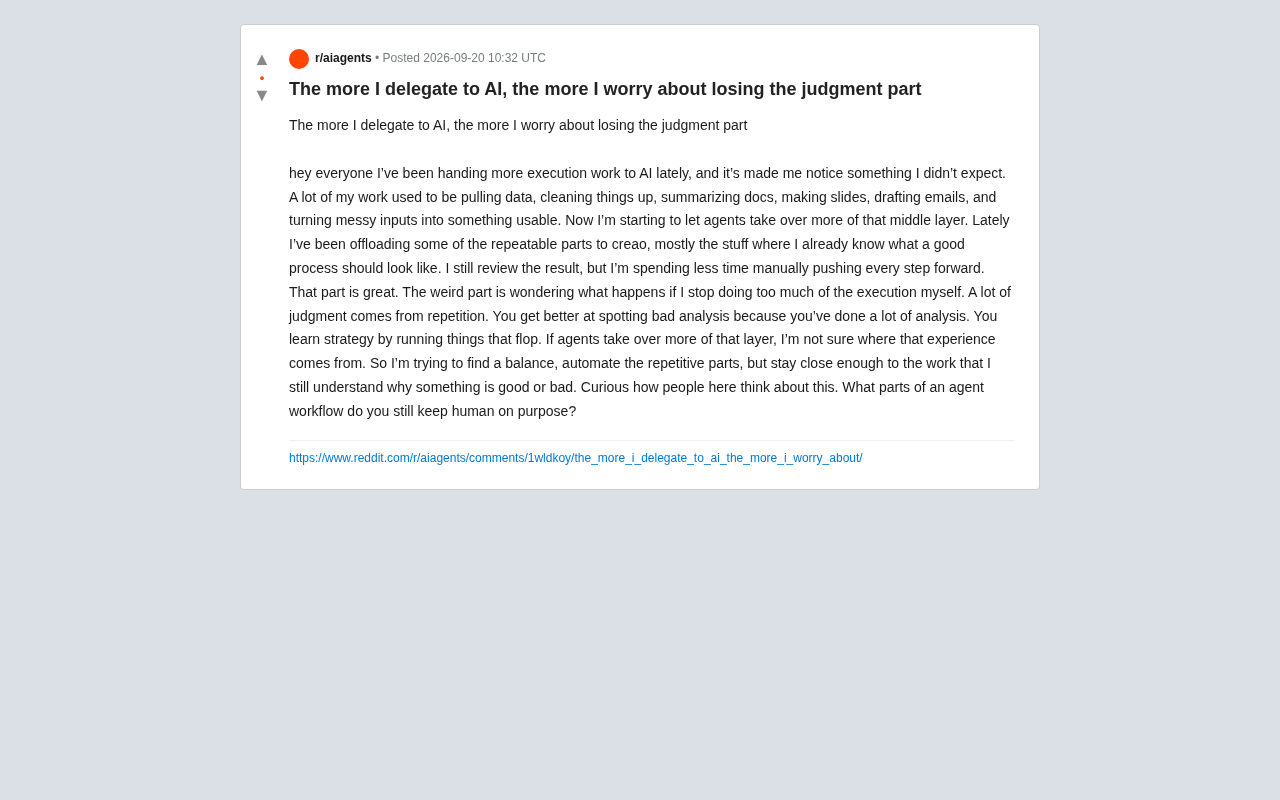
A Reddit user shared a genuine dilemma after adopting AI agents into their workflow — and it resonated with a lot of people. Their day-to-day job used to be filled with repetitive tasks: pulling data, cleaning and organizing it, summarizing documents, building slide decks, drafting emails, and turning messy inputs into usable outputs.
They've since started handing more and more of this "middle layer" work to AI agents. They mentioned using tools like Creao to outsource the repeatable parts — the steps where they already know what a good process looks like. They still review the final output, but no longer have to manually push each step forward.
The efficiency gains are obvious. But what really unsettled them was a different question entirely: What do you lose when you stop doing the execution yourself?
Judgment Comes from Repetition
The author surfaced something easy to overlook — a lot of good judgment is forged through repetitive work.
"You can spot bad analysis because you've done a lot of analysis yourself. You develop strategic instincts because you've personally run projects that failed."
In other words, professional intuition doesn't appear out of nowhere. It's built through repeated hands-on work, mistakes, and reflection. When AI agents take over the execution layer, the author's worry is: Where does future experience come from?
This isn't the tired old question of "will AI replace humans?" It's a more subtle form of self-examination: when we outsource the very process of sharpening our skills, can we still maintain the ability to judge what's good and what isn't? If even our ability to evaluate AI-generated output atrophies, then the "human review" safeguard becomes little more than theater.
A Real Paradox
There's a circular trap here:
- You feel confident handing execution to AI because you already know what a good process looks like;
- You know what a good process looks like because you've done it yourself;
- But if newcomers rely on AI from day one, they'll never have the chance to build that knowledge.
For experienced practitioners, this might just be an efficiency upgrade. But for the broader transmission of capability across an industry, it could be a crack worth watching carefully.
Cognitive science calls this kind of judgment distilled from experience expert intuition. Psychologist Gary Klein's research shows that experts facing complex situations often don't analyze step by step — they rely on pattern recognition to directly "see" the answer. This ability is built through thousands of hours of real practice, mistakes, and corrections. Nobel laureate Daniel Kahneman frames it as an advanced form of System 1 thinking: intuition only becomes reliable after enough feedback loops in a "regular environment." The critical point is that these feedback loops must be lived through to be internalized — reading case studies or watching an AI work through a problem doesn't produce the same neural encoding. When AI agents take over the execution layer, practitioners receive far fewer real feedback signals, and the "training data" for their judgment grows thin.
Finding the Balance: Automate the Repetitive, Preserve the Judgment
The author's own answer is to seek a balance — automate the repetitive parts, while staying close enough to the work to still understand why something is good or bad.
This is a pragmatic approach. It acknowledges the value of AI for execution efficiency while protecting the foundation of core capability. The question isn't whether to use AI, but deliberately deciding which steps should remain in human hands.
What's Worth "Intentionally Keeping Human"
Drawing from the author's discussion, a few categories of work are worth keeping:
- Quality judgment: Who ultimately decides whether AI output is "good enough"? Giving up this checkpoint carries the most risk.
- Strategic decisions: Choices about direction, trade-offs, and priorities depend on deep contextual understanding of the business — not something to fully outsource.
- Failure debriefs: Real growth comes from reflecting on what went wrong. If AI skips past failures, there's no experience to accumulate.
- Process definition: Defining what a good process looks like is itself an expression of judgment — worth keeping in your own hands.
Put another way: AI is well-suited to take over repetitive work you've already mastered, not the core areas you're still learning or need to keep judging.
This Isn't Just Personal Anxiety — It's an Industry-Wide Issue
This Reddit user's unease touches on a broader question for the AI era. As more and more knowledge workers hand execution to AI agents, avoiding the "hollowing out" of capability is becoming a real challenge.
Efficiency and capability look like a win-win in the short term, but may carry genuine tension over time. Tools help you move faster — but if your own ability to walk atrophies, the moment a tool fails or a truly critical judgment is required, you may find you no longer have the confidence to act.
The question the author posed to their community is one worth everyone asking themselves: In your AI workflow, which parts have you consciously kept for humans? There's no single right answer, but thinking seriously about it is itself a way of protecting your judgment.
This concern isn't without precedent from other waves of technological substitution. After autopilot systems were introduced in aviation, "skill degradation" in manual flying became a documented problem — multiple accident investigations found that crew members couldn't take back control when automation failed. In radiology, the spread of AI-assisted diagnosis has prompted similar concerns about declining independent reading skills. Education has long debated whether calculators erode students' number sense. These precedents show that "capability hollowing" isn't paranoia — it's a structural risk that repeatedly surfaces when automation penetrates professional domains. What's different now is that AI agents are penetrating faster, reaching deeper cognitive layers, and leaving the industry with far less time to self-correct.
Related articles

Chain of Thought Isn't Just for AI: How Humans Can Use CoT to Improve Thinking Quality
Chain of Thought isn't just a prompt trick for large models. Starting from a Hacker News discussion, this article analyzes why CoT works for human thinking too, breaks down actionable ways to transfer it, and highlights the key differences between human CoT and machine CoT.
Cloudflare Teams Up with OpenAI: Closi…
Cloudflare Teams Up with OpenAI: Closing the Loop from Vulnerability Discovery to Defense with AI
Cloudflare uses OpenAI Daybreak to investigate security vulnerabilities and generate reviewable remediation plans, while developers use Codex to boost coding efficiency and quality.

Orca Multi-Agent Orchestration in Practice: A Guide to Parallel Collaboration with Claude and Codex
Orca is Stable AI's free open-source agent workbench supporting 34 agents like Claude Code and Codex in parallel. Learn its Git worktree isolation, multi-model orchestration, and mobile management.