The Most Brutal Review Ever: Paper Accused of Being Entirely AI-Generated
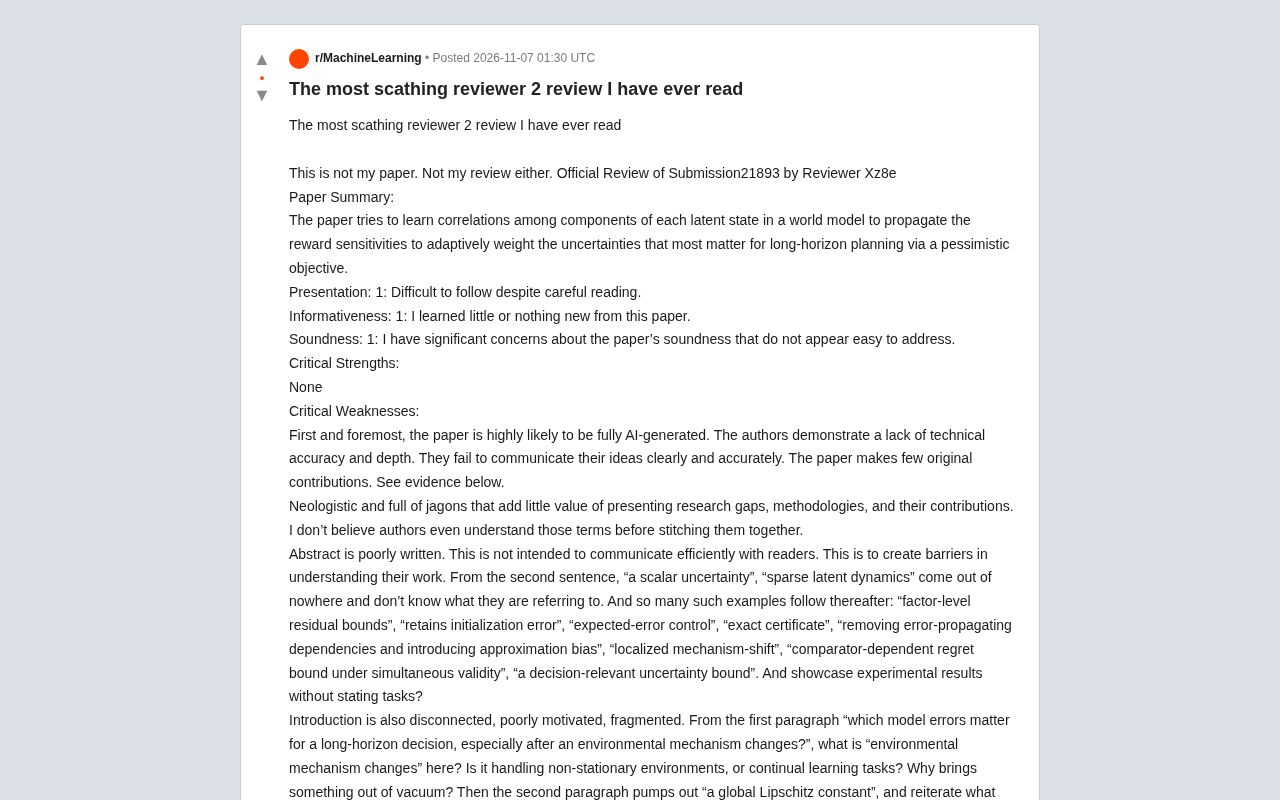
A harsh review accuses a world model paper of being entirely AI-generated, sparking reflection on academic writing quality in the AI era.
A review of a world model paper circulating on Reddit drew attention for its unusually harsh wording. The reviewer gave the lowest score of 1 across Presentation, Informativeness, and Soundness, and explicitly rejected the paper. The core accusation was that the paper was "very likely entirely AI-generated," based on jargon stacking, lack of technical depth, and minimal original contribution. The review criticized the abstract, introduction, methods, and experiments section by section, pointing out numerous undefined terms and notational confusion, and noted that the experimental section reported no random seeds, task descriptions, or metric explanations. The incident touches on the widespread concern that AI-generated content is permeating academic writing, and distills lessons such as terminology should serve expression, methods should define symbols, and experiments should be reproducible.
When Reviewers Stop Being Polite: A "Devastating" Review That Sparked Discussion
In academia, peer review is typically conducted in a restrained, constructive tone—even rejections leave room for improvement. But a review recently circulating on Reddit broke this convention with unusually harsh wording. This review of a paper on world models not only gave all lowest scores but also directly accused the paper of being "very likely entirely AI-generated," systematically dismantling its jargon stacking and logical gaps.
This review was shared by a Reddit user and is not their own paper or review. The reviewer, identified as Xz8e, reviewed submission 21893. In the scoring section, the reviewer gave 1 (the lowest score) for Presentation, Informativeness, and Soundness, and wrote "None" directly in the "Key Strengths" field. The final score was 1 (clear rejection), with a confidence of 4 (extensive direct research experience on the topic).
Core Accusation: AI Generation and Jargon Abuse
The reviewer opened with the harshest accusation: "First and foremost, this paper is very likely entirely AI-generated." The basis for this claim was the authors' lack of technical accuracy and depth, inability to clearly convey ideas, and minimal original contribution.
The review listed numerous "newly coined terms and jargon," arguing that these terms did nothing to present the research gap, methods, or contributions. "I don't believe the authors truly understood these words before stringing them together," the reviewer wrote. For example, expressions suddenly appearing in the abstract—"scalar uncertainty," "sparse latent dynamics," "factor-level residual bounds," "exact certificates," "local mechanism shifts"—were all presented without clear definitions or context.
What frustrated the reviewer further was that the paper presented experimental results without specifying what the tasks actually were. This style of "using jargon to create comprehension barriers" was seen by the reviewer as a waste of readers' and reviewers' time.
"World model" is an active direction in machine learning in recent years, with the core idea of enabling agents to internally build a predictive simulator of environment dynamics to support planning, reasoning, and decision-making. Typical works include Ha & Schmidhuber's World Models (2018) and the Dreamer series. Since this direction involves multiple sub-problems such as state representation, latent dynamics, and uncertainty modeling, papers often contain many technical terms; but the use of terms should be premised on clear definitions and verifiable experiments, otherwise they easily devolve into the "jargon salad" criticized by the reviewer. Understanding this background helps explain why the review was particularly sensitive to jargon stacking.
Section-by-Section Breakdown: Comprehensive Doubts from Abstract to Experiments
The review critiqued the paper section by section following its structure. The abstract was called "poorly written," with the second sentence introducing unexplained concepts like "scalar uncertainty" and "sparse latent dynamics," followed by a stack of terms including "factor-level residual bounds," "preserved initialization error," "expected error control," and "exact certificates"—without stating the experimental tasks.
The introduction was similarly criticized as "disjointed, weakly motivated, and fragmented." The reviewer questioned whether "environment mechanism changes" in the first paragraph referred to non-stationary environments or continual learning tasks, and noted that the second paragraph suddenly introduced "global Lipschitz constants" before jumping to uncertainty—without clarifying whether epistemic or aleatoric uncertainty was the focus.
The methods section was called "terrible" by the reviewer, who raised multiple specific questions in succession: What is a "sufficient latent state"? It is nearly impossible to find sufficient statistics for approximate models. What is z_t^(pa_e(i)) in Gaussian transition models? What is the difference between z_(t+1)^i and ẑ_(t+1)^i? What is "nominal imagination"? Where does "sparsity" come from? What is a "DAG within time"? Additionally, the notation for the parameter posterior q(θ|D) was confused with the state posterior, and the training objective lacked motivation.
The experimental section was called "unscientific": no random seeds reported, no task descriptions, and no explanation of metrics.
The "Lipschitz constant" mentioned by the reviewer is a mathematical quantity measuring the upper bound on a function's rate of change: if a function f satisfies |f(x)-f(y)| ≤ L|x-y|, then L is its Lipschitz constant. In deep learning theory, it is often used to analyze model stability, generalization bounds, or adversarial robustness. The reviewer questioned why the paper suddenly introduced this concept in the introduction without explaining its relevance to the research motivation—precisely because Lipschitz constants typically require specific assumptions (such as network architecture or loss functions) to be meaningful, and throwing out the term in isolation makes it hard for readers to judge whether the authors truly understand its role.
Resonance and Reflection in Academia
This review gained attention on Reddit not only for its harsh language but also because it touched on a growing concern: AI-generated content is permeating academic writing, and is the review system prepared to handle it?
The reviewer concluded: "This paper is an insult to scientific research and reviewers' time." This statement may be overly sharp, but the underlying issue is worth pondering. When large language models can quickly generate seemingly professional text, how can peer review identify "jargon salad" lacking substantive contribution? How can reviewers effectively convey dissatisfaction with low-quality submissions while maintaining professionalism?
From this review, at least a few lessons valuable to both authors and reviewers can be extracted: terminology must serve clear expression, not create barriers; method descriptions need to define key symbols and assumptions; experimental reports should include reproducible details. And for reviewers, specifically pointing out problems is far more constructive than simply rejecting—even if the tone is less than polite.
This "most brutal review ever" may well be a collective wake-up call from the academic community about writing quality in the AI era.
Epistemic uncertainty and aleatoric uncertainty are a fundamental distinction in Bayesian deep learning: the former arises from the model's ignorance of data or parameters and can be reduced with more data or more thorough inference; the latter arises from inherent noise in the data itself and cannot be eliminated by adding data. The reviewer's point that the paper did not specify which type of uncertainty was being discussed is not nitpicking—the two types correspond to different modeling approaches (e.g., Bayesian neural networks vs. heteroscedastic noise modeling) and different evaluation metrics, and conflating them undermines the basis for method design and experimental interpretation.
One-line Summary
A harshly worded review accuses a world model paper of being entirely AI-generated, sparking reflection on academic writing quality in the AI era.
Paragraph Summary
A review of a world model paper circulating on Reddit drew attention for its unusually harsh wording. The reviewer gave the lowest score of 1 across Presentation, Informativeness, and Soundness, and explicitly rejected the paper. The core accusation was that the paper was "very likely entirely AI-generated," based on jargon stacking, lack of technical depth, and minimal original contribution. The review criticized the abstract, introduction, methods, and experiments section by section, pointing out numerous undefined terms (such as "scalar uncertainty" and "sparse latent dynamics") and notational confusion, and noted that the experimental section reported no random seeds, task descriptions, or metric explanations. The incident touches on the widespread concern that AI-generated content is permeating academic writing, and distills lessons such as terminology should serve expression, methods should define symbols, and experiments should be reproducible.
Related articles
 Tech Frontiers
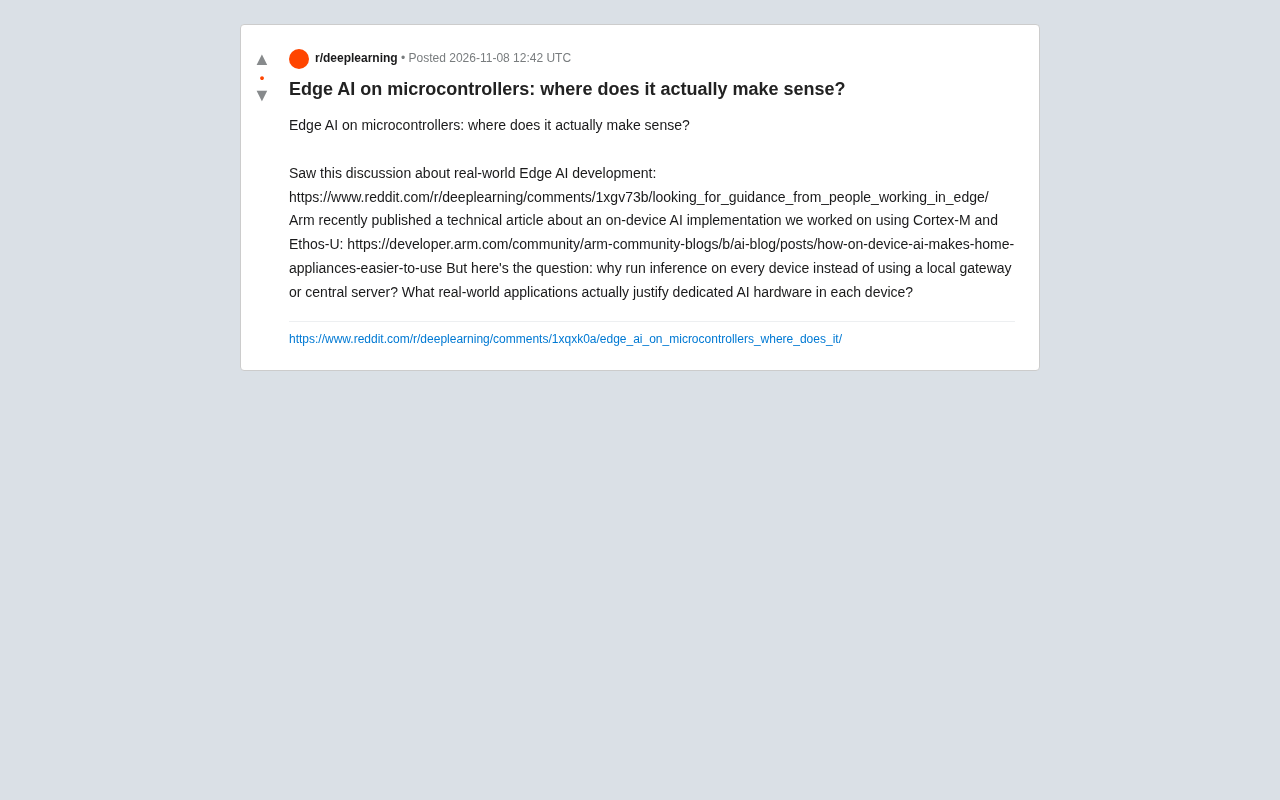
Edge AI on Microcontrollers: When Is It Actually Worth Deploying?
Drawing on Reddit discussions and Arm case studies, this article analyzes the real-world use cases for edge AI on microcontrollers: when each device needs independent inference, when a gateway or cloud is more reasonable, and the costs and boundaries of specialized hardware.
 Tech Frontiers
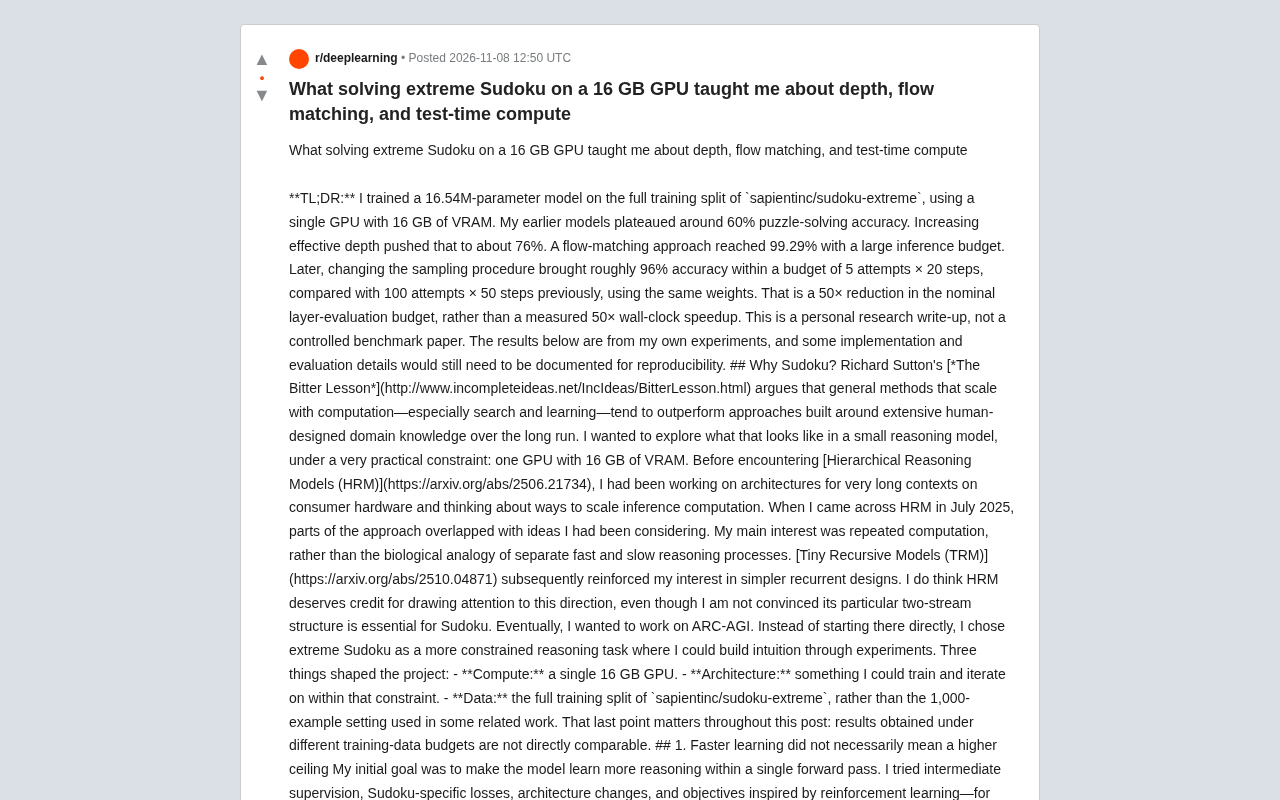
Pushing the Limits of Extreme Sudoku on a 16GB GPU: Insights from Depth and Flow Matching
A researcher trained a 16.54M-parameter model on a 16GB GPU to solve extreme Sudoku, finding effective depth breaks the 60% plateau and flow matching with improved sampling pushes accuracy past 99% with ~50× lower layer-evaluation budget.
 Tech Frontiers
AI Agent Approval Workflows: Why Human Confirmations Always Get Mindlessly Clicked
Why do AI agent approval workflows always get mindlessly clicked? A Reddit discussion shows that separating rules from keys, low-frequency high-risk approvals, and GitHub Environments-style gates are the keys to effective approvals.