The Most Comprehensive AI Agent Tutorial on Bilibili: From Zero to Practice in Seven Days

Breaking down the three-stage course structure of Bilibili AI Agent tutorial, analyzing its design philosophy, target audience, and real learning outcomes.
Based on the public introduction of Bilibili's "AI Agent Intelligent Agent Development Tutorial," this article breaks down this course claiming to be "the most comprehensive and detailed." It first points out the polarization problem of most Agent tutorials—either empty concept talk or direct code dumping—then explains the tutorial's "experience first, understand later" strategy. The course has three stages: cognition part uses everyday analogies to build fundamental understanding of ReAct, planning and reasoning, memory mechanisms, and runs the first Demo; advanced part covers LangChain and AutoGen frameworks, multi-agent collaboration, Function Calling, RAG hybrid architecture, and evaluation, debugging, and security boundaries; practice part implements through three enterprise-level projects: intelligent customer service, automated data analysis, and multi-agent collaboration production line. The article also introduces supporting source code, courseware, and learning roadmap, and notes the tutorial suits zero-foundation beginners, developers wanting quick framework mastery, and technical leaders needing business implementation, while reminding that "expert in seven days" is marketing talk and actual results depend on hands-on effort.
AI Agent is undoubtedly one of the hottest technical directions right now, but tutorials that truly explain what it is, how to use it, and how to implement it are rare. There's a series on Bilibili called "AI Agent Intelligent Agent Development Tutorial," claiming to be "the most comprehensive and detailed on Bilibili," promising to take you from beginner to expert in seven days with job-ready skills. Is this tutorial really reliable? What does it actually cover? Based on the tutorial's public introduction, this article breaks down its course structure and design philosophy, and analyzes what kind of learners it suits.
Why Are Most Agent Tutorials Not Useful?
According to the uploader, before creating the course, he scoured almost all Agent-related content on Bilibili and YouTube, from technical blogs to GitHub open-source projects. He concluded that over 90% of Agent tutorials fall into two extremes: either they pile up concepts, repeating big words like autonomous planning and tool calling without ever getting hands-on; or they throw code directly at learners who haven't even figured out what problem Agent solves, already calling APIs.
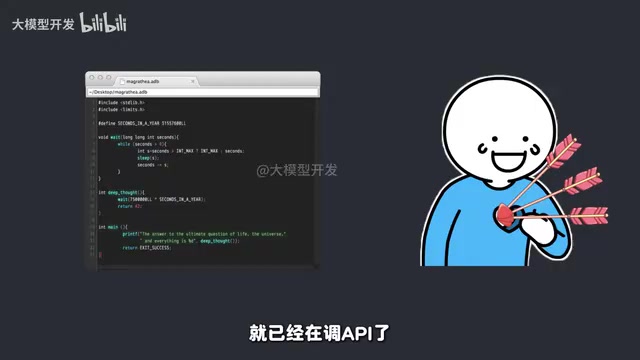
This observation hits a pain point for many beginners. Agent does involve quite a few concepts—ReAct framework, planning and reasoning, memory mechanisms, Function Calling, multi-agent collaboration—if it's just terminology explanations, you still don't know how to start after listening; but if you jump straight into code, you easily fall into the trap of "it runs but I don't understand." This tutorial's strategy is: first use everyday analogies to help you understand how Agent thinks, then step by step build a truly usable intelligent agent.
ReAct framework (Reasoning + Acting) is the classic paradigm for Agent's "think-act" loop. It lets the large model output reasoning process at each step (Reasoning), then decide which tool to call (Acting), and feeds the tool's return result as input for the next reasoning step, looping until task completion. The significance of ReAct is that it breaks down the large model's "black box" decision-making into observable, debuggable steps, and is fundamental to understanding Agent's autonomous planning and tool calling.
Function Calling is a key capability of large models: developers register a set of available functions to the model in a structured description, and the model automatically determines whether to call, which function to call based on user intent during conversation, and generates call parameters conforming to the Schema. It enables Agent to interact with the external world safely and controllably, and is the mainstream implementation for tool calling.
Three-Stage Course Design: From Cognition to Implementation
The uploader spent four months breaking down core Agent knowledge points into three chapters. This structure itself is noteworthy because it embodies the learning path of "first build a cognitive framework, then master tools, finally implement projects."
Part One: Cognition—Building Fundamental Understanding of Agent
The cognition part addresses: What's the difference between Agent and large model conversation? What are the essences of intimidating concepts like ReAct framework, planning and reasoning, memory mechanisms? According to the uploader, this part uses everyday analogies to help learners quickly understand these concepts, while guiding everyone through their first Agent Demo to personally experience how intelligent agents work.
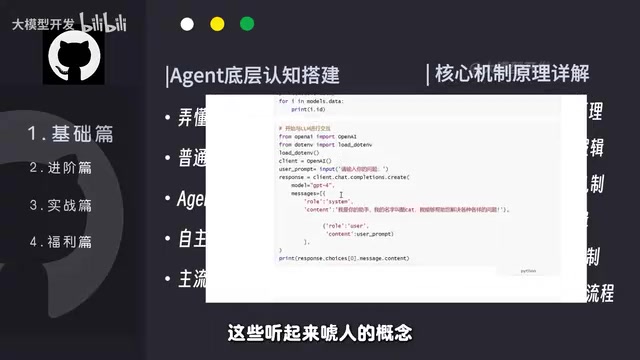
For zero-foundation learners, running a Demo first before going back to understand principles is often more effective than grinding through theory first. This "experience first, understand later" order lowers the entry barrier.
Part Two: Advanced—Framework Practice and Engineering Capabilities
The advanced part ramps up intensity, covering LangChain and AutoGen framework practice, multi-agent collaboration, Function Calling tool invocation, hybrid architecture of RAG and Agent, as well as evaluation, debugging, and security boundaries. Each section comes with supporting code and courseware, all packaged and provided.
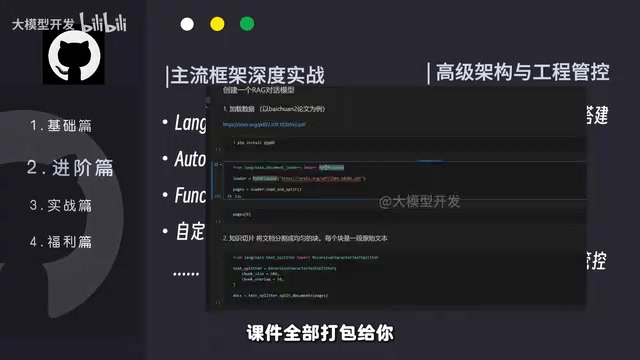
Several points are worth noting here. LangChain and AutoGen are currently the two most mainstream frameworks in Agent development—the former excels at chain invocation and tool integration, the latter focuses on multi-agent dialogue collaboration. Teaching them together helps learners understand the applicable scenarios of different frameworks. The section on evaluation, debugging, and security boundaries is especially critical—many tutorials only teach how to make Agent run, but not how to judge whether it runs correctly or might cause problems. The hybrid architecture of RAG and Agent is also an unavoidable topic in real projects, because relying purely on model parameter memory for knowledge is unreliable; retrieval augmentation is almost standard.
RAG (Retrieval-Augmented Generation) is a technical architecture combining external knowledge retrieval with large model generation. The system first retrieves fragments related to the question from vector databases or document libraries, then feeds these fragments as context to the large model to generate answers. For Agent, RAG solves problems like outdated model parameter memory, lack of private domain knowledge, and susceptibility to hallucinations, enabling Agent to answer based on real-time or proprietary data, thus often combined with tool calling and planning capabilities into hybrid architectures.
LangChain is a development framework for building large model applications, with core abstractions including Chain, Tool, Memory, and Retriever, suitable for orchestrating multiple steps into reusable pipelines. AutoGen focuses on multi-agent collaboration, defining multiple Agents with different roles and system prompts to divide tasks through dialogue, and supports human participation and code execution. Their positioning differs: LangChain excels at component integration and process orchestration, AutoGen excels at negotiation and collaboration among Agents.
Part Three: Practice—Enterprise-Level Project Implementation
The practice part includes three projects: intelligent customer service Agent system, from intent recognition to automatic ticket flow; automated data analysis Agent, upload Excel to automatically generate reports and charts; multi-agent collaboration production line, letting multiple intelligent agents divide and collaborate like a team.
These three projects cover the three most common scenarios of Agent applications: dialogue services, data processing, and process orchestration. Intelligent customer service corresponds to external services, data analysis to internal efficiency tools, and multi-agent collaboration to complex business processes. After completing these three projects, learners can at least understand how Agent is used in real business.
Supporting Resources and Target Audience
According to the uploader, the course provides all source code, courseware, Prompt templates, and an AI Agent developer learning roadmap, available free by commenting.
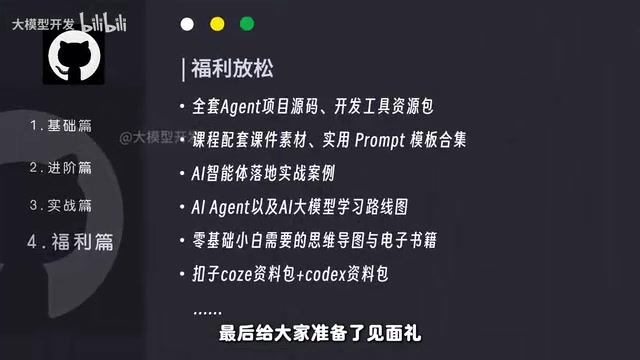
From the course design perspective, this tutorial suits three types of people: first, complete beginners who want to systematically understand Agent—the cognition part has a low enough barrier; second, developers with some programming foundation who want to quickly get started with LangChain and AutoGen—the advanced part's framework practice can save a lot of exploration time; third, technical leaders who need to implement Agent in business—the practice part's project breakdown has reference value.
Note that "from beginner to expert in seven days" is marketing talk; actual learning results depend on time invested and hands-on practice. Agent development involves coding, debugging, and understanding business scenarios—quick mastery is unrealistic. But as a free tutorial with complete structure covering the full chain from concept to project, its cost-effectiveness is indeed high.
Final Thoughts
The learning curve for AI Agent isn't gentle, but not as steep as imagined. The key is choosing the right path: first understand how Agent thinks, then master framework tools, finally polish in real projects. The value of this Bilibili tutorial lies in providing a relatively clear path and opening up source code and courseware. If you're planning to start Agent development, consider it as a starting point, but remember—there's a lot of hands-on practice between understanding and doing.
One-line Summary
Breaking down the three-stage course structure of the Bilibili AI Agent tutorial, analyzing its design philosophy, target audience, and real learning outcomes.
Paragraph Summary
Based on the public introduction of Bilibili's "AI Agent Intelligent Agent Development Tutorial," this article breaks down this course claiming to be "the most comprehensive and detailed." It first points out the polarization problem of most Agent tutorials—either empty concept talk or direct code dumping—then explains the tutorial's "experience first, understand later" strategy. The course has three stages: cognition part uses everyday analogies to build fundamental understanding of ReAct, planning and reasoning, memory mechanisms, and runs the first Demo; advanced part covers LangChain and AutoGen frameworks, multi-agent collaboration, Function Calling, RAG hybrid architecture, and evaluation, debugging, and security boundaries; practice part implements through three enterprise-level projects: intelligent customer service, automated data analysis, and multi-agent collaboration production line. The article also introduces supporting source code, courseware, and learning roadmap, and notes the tutorial suits zero-foundation beginners, developers wanting quick framework mastery, and technical leaders needing business implementation, while reminding that "expert in seven days" is marketing talk and actual results depend on hands-on effort.
Related articles

Will GitHub Die? Open Source Maintainer Burnout and the Collaboration Crisis in the AI Era
Lex Fridman podcast discussion on open source maintainer burnout and GitHub's predicament: massive pull requests overwhelm core maintainers, and AI worsens code bloat. Using math journal peer review and Poincaré conjecture verification as analogies, the article analyzes why verification in knowledge production must be deliberately slow, and how open source communities can avoid the failure mode of maintainers exiting.

Stop Building Cookie-Cutter AI Websites: 3 Tools That Transform Your Coding Agent
Three tools that boost AI coding agents: FFmpeg skill for local video editing in Claude Code and Cursor, Hallmark's 50 design themes to fix cookie-cutter AI sites, and Jailbreaks' 25+ model prompts.

How America's Gerontocracy Squeezes the Younger Generation
Americans over 55 hold nearly three-quarters of national wealth, alongside an 80-year-old president and elderly congressional leaders. The Atlantic's Idrees Kahloon explains how gerontocracy drives up housing costs, squeezes opportunities for the young, and explores zoning reform and child poverty reduction as practical fixes.