The Most Comprehensive Coze AI Beginner's Course on Bilibili: From Zero to Practical Mastery in Seven Days

Breaking down the content structure, technical depth, and target audience of Bilibili's 748-episode Coze tutorial.
The article provides a rational breakdown of the 748-episode Coze AI beginner's course on Bilibili. It unfolds in three stages: Fundamentals (prompt engineering, Transformer architecture), Advanced (RAG, private deployment, fine-tuning), and Practical (Agent development, digital humans, enterprise knowledge bases, medical large models). The author notes the key value lies in bridging "using Coze" to "understanding the large model logic behind it," and reminds readers to view "job-ready upon completion" claims rationally—748 episodes is both an advantage and a barrier.
In an era where AI tools emerge endlessly, Coze has become the first stop for many people getting into AI application development, thanks to its low-barrier conversational workflow building capabilities. This 748-episode Coze AI beginner's course on Bilibili claims to cover the complete path from underlying principles to enterprise-level project deployment. Setting aside the "seven-day guru" marketing language, it's worth taking a closer look at what it actually teaches and who it's really for.

Course Structure: The Progressive Logic of Three Major Sections
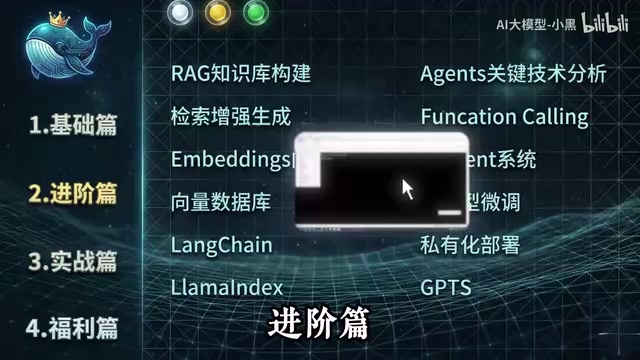
According to the creator, the entire course took three months to reorganize the AI large model knowledge system, divided into three major sections: Fundamentals, Advanced, and Practical. The Fundamentals section starts from the core principles of large models, covering AI development environment setup, prompt engineering, Transformer architecture, and pre-training mechanisms. The Advanced section delves into RAG, private deployment, model training, and fine-tuning. The Practical section directly implements intelligent Agent development, digital human applications, enterprise knowledge base Q&A, and medical large model scenarios.
This three-stage structure of "principles—capabilities—deployment" is nothing new, but 748 episodes means there's ample room to expand each segment. For beginners, the difficulty often isn't the knowledge itself but the connections between different pieces of knowledge. Whether the course truly bridges the gap from "knowing how to use Coze" to "understanding the large model logic behind Coze" is the key to judging its value.
Prompt Engineering and Transformer: The Core of the Fundamentals Section
In the Fundamentals section, prompt engineering and Transformer architecture are the two main threads. Prompt engineering determines what you can make AI "do," while Transformer architecture determines why AI "can do it." The creator emphasizes explaining pre-training mechanisms in "the most accessible way"—which is precisely the part most crash courses avoid. Many people can call APIs and write prompts but can't explain the basic principles of attention mechanisms.
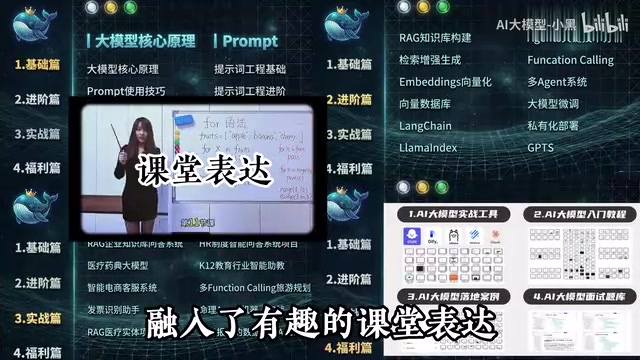
The course includes abundant hands-on examples, which is evident from the repeated emphasis on "hands-on" and "practical" in its promotional language. For visual workflow tools like Coze, pure theoretical explanation has very low marginal returns. Only by repeatedly practicing node connections, variable passing, and plugin calls can you develop muscle memory.
Transformer architecture is a neural network structure proposed by Google in the 2017 paper "Attention Is All You Need," and it's the foundation for almost all mainstream large models including GPT, Claude, and Gemini. Its core is the Self-Attention mechanism: when processing a sentence, the model lets each word "attend" to all other words in the sentence and assigns weights based on relevance, thereby capturing long-range dependencies. Compared to RNN's word-by-word sequential processing, Transformer can compute in parallel, which allows it to train efficiently on massive corpora. Pre-training involves training the model on large-scale general text through tasks like "predicting the next word" to learn language patterns, after which fine-tuning or prompt engineering adapts it to specific tasks. Understanding these two concepts is essential to grasp why prompt wording affects output—it's essentially guiding the distribution of the model's attention weights.
Advanced Section: The Practical Value of RAG and Private Deployment
The Advanced section covers RAG (Retrieval-Augmented Generation), private deployment, model training, and efficient fine-tuning—core capabilities for enterprise-level AI applications. RAG addresses the "hallucination" and knowledge timeliness issues of large models, while private deployment addresses data security and cost control. According to the creator, this content targets "the core capabilities needed for enterprise-level practical implementation."
From a technology trend perspective, the boundary between RAG and fine-tuning is blurring, with more and more teams adopting a hybrid "fine-tuning + RAG" approach. If the course can clearly explain the applicable scenarios and cost differences of these two approaches, it would be far more helpful to developers than mere operational demonstrations. Of course, the depth of the Advanced section also determines the course's ceiling—if it only superficially demonstrates the deployment process, it's not much different from reading official documentation.
RAG (Retrieval-Augmented Generation) works in three steps: first, enterprise documents are chunked and converted into vectors stored in a vector database. When a user asks a question, the most relevant segments are retrieved, then these segments are inserted as context into the prompt for the large model to generate an answer. Its value lies in letting the model "temporarily look up reference materials," thereby mitigating hallucinations, supporting knowledge updates, and requiring no model retraining. Fine-tuning involves continuing to train model parameters with domain data, allowing the model to internalize specific styles or capabilities—higher cost but deeper effects. Private deployment refers to deploying model weights on a company's own servers or dedicated cloud, keeping data within the internal network to meet compliance requirements in finance, healthcare, and other industries. These three are often used in combination: RAG manages knowledge, fine-tuning manages capabilities, and private deployment manages security—this is also the mainstream architecture for enterprise AI implementation today.
Practical Section: Agents, Digital Humans, and Enterprise Knowledge Bases
The Practical section covers four directions: intelligent Agent development, digital human applications, enterprise knowledge base and Q&A systems, and medical large models. These four scenarios essentially cover the current hot tracks in AI deployment. Agent development tests workflow orchestration and tool-calling capabilities, digital humans involve multimodal interaction, enterprise knowledge bases are a typical RAG application, and medical large models have higher requirements for accuracy and compliance.
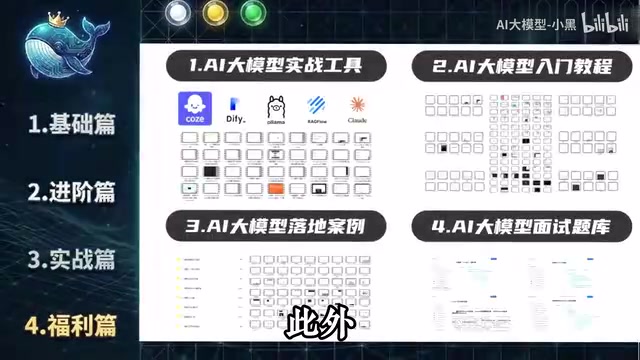
The creator also provides a learning roadmap, courseware, and e-books as supporting materials. For a 748-episode course, it's easy to get lost in details without a roadmap. To some extent, the quality of supporting materials determines learning outcomes more than the videos themselves.
Who Should Watch: Different Benefits for Beginners and Advanced Learners
This course is positioned for both "complete beginners and developers looking to systematically improve." But these two groups have very different needs: beginners need to build overall awareness and quickly get started building simple applications with Coze; developers need to understand underlying mechanisms and master enterprise-level deployment and optimization capabilities. A single course satisfying both requires layered content design—which episodes can be skipped, which must be studied carefully—and the roadmap plays a key role here.
The claim of "job-ready upon completion" should be viewed rationally. As a tool platform, Coze indeed has a low barrier to entry, but what companies look for in hiring is the ability to use AI to solve real business problems. This requires accumulated project experience, not something you can gain just by finishing a tutorial. Treating the course as a starting point for systematic learning rather than an endpoint will give you a more balanced mindset.
Rationally Viewing the "Most Comprehensive and Detailed" Self-Positioning
The creator mentions having "watched every related video on Bilibili and studied YouTube guru tutorials," finding that 90% of content is "a mixed bag" or "only theory without practice," and therefore decided to create a course that is "the most original, most intuitive, and purest." This competitive positioning approach is common in tutorial content, and actual quality still needs to be verified by learners themselves.
The 748-episode volume is both an advantage and a barrier. The advantage is that knowledge points are covered in sufficient detail; the barrier is the long learning cycle and the ease of giving up midway. It's recommended to first watch the first few episodes of the Fundamentals section to judge whether the teaching style suits you, then decide whether to invest time in complete study. Ultimately, a tutorial's value doesn't depend on the number of episodes but on what you can independently create after finishing it.
One-line Summary
Breaking down the content structure, technical depth, and target audience of Bilibili's 748-episode Coze tutorial.
Paragraph Summary
The article provides a rational breakdown of the 748-episode Coze AI beginner's course launched on Bilibili. The course unfolds in three stages: Fundamentals covers prompt engineering and Transformer architecture, Advanced focuses on RAG, private deployment, and model fine-tuning, and Practical covers four directions—Agent development, digital humans, enterprise knowledge bases, and medical large models. The author points out that the key value of such courses lies in whether they can bridge the gap from "knowing how to use Coze" to "understanding the large model logic behind it," and whether the advanced content truly explains the applicable scenarios of technical approaches. Regarding the positioning of "suitable for both beginners and advanced learners" and the "job-ready upon completion" marketing, the article reminds readers to view it rationally—748 episodes is both an advantage and a barrier. It's recommended to first watch the Fundamentals section to judge the style before deciding on investment, treating the course as a starting point rather than an endpoint.
Related articles

Understanding DeepSeek in 3 Minutes: The Rise from a Quant Hedge Fund to an Open-Source AI Leader
DeepSeek's history in 3 minutes: from High-Flyer Quant's compute build-up to V2's MLA inference cost cuts, V3's $5.576M training bill, R1's open-source global shock, and V4 with a $7B Series A.

Local Creative Writing Model Showdown: Fine-tuned Qwen3.8 27B Wins, DeepSeek v4.1 Underwhelms
Bilibili creator tests seven local creative writing models: Hemingway and HumanLike Chat based on Qwen3.8 27B perform best, DeepSeek v4.1 is plain, Dongfang Shuo ranks last with confused characters. Includes three test prompts, scores, and usage advice.

Liang Wenfeng's Three Big Bets: Why Did DeepSeek Open-Source Its 82% Gross Margin?
Why did DeepSeek open-source DeepInfer, its 82% gross margin inference framework, and then launch a hundred-billion funding round? An analysis of Liang Wenfeng's three big bets and the open-source strategy.