The Mystery of Chiral Molecules Solved? A Deep Dive into the Nobel Prize in Chemistry

The 2026 Nobel Prize in Chemistry honors Kagan and Soai for pioneering work on chiral nonlinear effects and autocatalytic amplification.
This article centers on the 2026 Nobel Prize in Chemistry, introducing Kagan and Soai's contributions to molecular chirality, nonlinear effects, and autocatalysis. Chiral molecules exist as mirror-image enantiomers, and the preference of biological systems for a single chiral form is called homochirality. Kagan revealed nonlinear effects—tiny chiral differences can be amplified into large ones; Soai demonstrated through an autocatalytic reaction that the product can act as its own catalyst, amplifying an initial imbalance of about 2% to about 87%. These findings help explain homochirality and the origin of life, and have significant applications in pharmaceuticals, the chemical industry, fragrances, and materials.
Our left and right hands are mirror images of each other, yet they cannot be perfectly superimposed. A similar phenomenon exists in the molecular world—the same molecule can take on two forms, a left-handed one and a right-handed one. This seemingly tiny difference has profound implications for life, medicine, and even the origin of life itself. The 2026 Nobel Prize in Chemistry was awarded to Henry B. Kagan and Kenzo Soai (names transliterated from the video and may contain inaccuracies) for their pioneering work on nonlinear effects, autocatalysis, and molecular chirality.
What Is Chirality? The Left and Right Hands of the Molecular World
Chirality is essentially the "handedness" of a molecule. Just as a left hand and a right hand are mirror images of each other, certain molecules can exist in two mirror-image forms known as enantiomers. They contain the same atoms but differ in how those atoms are arranged in space.
The key point: although these molecules look almost identical, they are not exactly the same. At the chemical level, their effects in biological systems can be drastically different. For example, many amino acids in living systems exist primarily in the L-form, while sugars exist primarily in the D-form. This preference for a single molecular form is called "homochirality."
Scientists have long pursued a central question: how did one molecular form come to dominate in the first place?

The molecular basis of enantiomers and chiral centers. Enantiomers exist because molecules contain what are called "chiral centers"—most commonly a carbon atom bonded to four different groups (a chiral carbon). When the four substituents on a carbon atom are all different, its spatial arrangement can take two mirror-image forms that cannot be superimposed by rotation or flipping, corresponding to the left-handed (L-form) and right-handed (D-form). Beyond carbon, atoms such as sulfur, phosphorus, and nitrogen can also become chiral centers under certain conditions. Enantiomers share nearly all physical properties in achiral environments (such as ordinary solvents and conventional spectroscopy), differing only in "chirality-sensitive" properties like the direction of polarized light rotation and reaction rates with chiral reagents.
Homochirality and the significance of biomolecular preference. Homochirality refers to the fact that living organisms use almost exclusively a single chiral form of molecules: amino acids in proteins are predominantly L-form, and sugars in nucleic acids are predominantly D-form. This is not imposed by chemical laws but is the result of evolutionary selection. Because enzymes and receptors are themselves chiral, only the matching enantiomer can be efficiently recognized and catalyzed—so homochirality is the foundation for the efficient operation of life's molecular machinery. One enantiomer may be a therapeutically effective drug, while the other may be ineffective or even toxic—this is the core lesson of historical tragedies like thalidomide. Understanding enantiomers and homochirality is the prerequisite for understanding why Kagan and Soai's work matters.
Kagan's Contribution: Nonlinear Effects
Henry B. Kagan's work revealed the importance of "nonlinear effects." In simple terms, a tiny difference in initial chirality can sometimes produce a much larger difference in subsequent processes—not "small difference brings small difference," but "small asymmetry is amplified into large asymmetry."
This discovery matters because it challenges the traditional assumption that reaction systems always follow simple linear relationships, and it helps scientists better control asymmetric chemical synthesis. According to the video, Kagan's work provided a key theoretical framework for understanding chiral amplification.
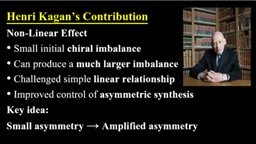
The chemical meaning of nonlinear effects. In asymmetric catalysis, it is commonly assumed that the chiral purity of the catalyst and the chiral purity of the product have a linear relationship: if the catalyst has an ee value (enantiomeric excess, a measure of chiral purity) of 50%, the product's ee value is also about 50%. Kagan discovered that in certain systems this is not the case: using a catalyst with low ee can yield a product with high ee, or even exhibit a "positive nonlinear effect"—a small amount of chiral catalyst can induce a large amount of chiral product. The molecular mechanism is often related to catalyst molecules forming dimers or oligomers in solution: homochiral dimers (L-L or D-D) are highly active, while heterochiral dimers (L-D) are less active. Therefore, when a small amount of the major chiral form is present in the system, it preferentially forms highly active dimers, thereby amplifying a tiny chiral bias into significant product selectivity. This theory provided a quantitative framework for understanding chiral amplification and guided the design of highly efficient asymmetric catalysts.
Soai's Contribution: Autocatalysis and Chiral Amplification
Kenzo Soai's work is closely related to autocatalysis. Its core idea is quite fascinating: the product of a chemical reaction can itself serve as a catalyst, helping to produce more of the same product. This creates a self-amplifying cycle—the product catalyzes the generation of more product.
This process can strongly amplify one chiral form, offering a possible mechanism to explain how one molecular form can come to dominate. The famous Soai reaction reported in 1995 became a landmark experiment: the chiral product can act as its own catalyst, amplifying an initial imbalance of about 2% to about 87%. A negligible starting difference can ultimately become a massive difference—this is the power of autocatalytic chiral amplification.
The specific mechanism of autocatalysis and the Soai reaction. Autocatalysis refers to the process in which the reaction product itself acts as a catalyst to accelerate its own formation. In the Soai reaction reported in 1995, diisopropylzinc adds to an aldehyde to produce a chiral secondary alcohol; this chiral secondary alcohol can then react with diisopropylzinc to form a catalytically active zinc alkoxide, which continues to catalyze subsequent reactions. The key is that when one enantiomer is in excess in the product, the catalyst it forms preferentially generates the same enantiomer, creating a positive feedback loop. Experiments show that even with an initial ee of only about 2%, after multiple rounds of autocatalytic amplification, the product ee can rise to about 87% or even higher. This reaction not only validated autocatalytic chiral amplification but also became an important model system for studying the origin of chirality, demonstrating that tiny random biases in nature can be gradually amplified into a dominant chiral form.
Why Does This Research Matter?
The significance of this work manifests on multiple levels.
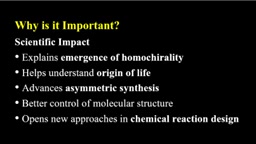
Understanding the origin of homochirality. It helps scientists understand how homochirality emerged in living systems.
Clues to the origin of life. Imagine a tiny random imbalance in the early chemical stage, amplified through nonlinear effects and autocatalysis, with one form gradually becoming dominant, ultimately leading to the molecular chirality we see in living systems today. Of course, this is an important scientific question—not a complete explanation of the origin of life.
Practical application value. Controlling molecular structure is extremely important in chemistry and medicine. In the pharmaceutical field, scientists need to selectively produce specific molecular forms of drugs to improve efficacy and safety. In the chemical industry, efficient asymmetric synthesis can reduce the generation of unwanted molecular forms. Additionally, chirality affects fragrances and flavorings (different enantiomers may have different properties) as well as advanced materials design.
Profound Impact on the Pharmaceutical Field
This point is especially important for medicine. Two enantiomers may look very similar, but the human body can react to them in completely different ways. One form may provide the desired therapeutic effect, while the other may be less effective or even harmful. This is why selective synthesis is so critical in pharmaceutical chemistry.
By better controlling chirality, scientists can more precisely control chemical reactions, thereby developing safer and more effective drugs.
Chiral drugs and regulatory requirements. If a drug molecule contains a chiral center, its two enantiomers may bind to different receptors, enzymes, or transporters in the body, leading to differences in efficacy, metabolism, and toxicity. For example, one enantiomer of thalidomide has sedative effects, while the other carries teratogenic risk; although the two can interconvert in the body, this event greatly elevated awareness of chiral drug safety. Modern regulatory agencies (such as the U.S. FDA and the European EMA) require that both enantiomers of a chiral drug be evaluated separately for pharmacology and toxicology, and encourage the development of single-enantiomer drugs. Technologies such as asymmetric catalysis, chiral resolution, and chiral chromatography have thus become core tools in the pharmaceutical industry. Kagan and Soai's fundamental discoveries provided theoretical guidance and experimental paradigms for designing efficient, highly selective chiral synthesis methods, directly advancing the production of safer and more effective drugs.
From Basic Science to the Grand Picture of the Origin of Life
From understanding chirality in basic chemistry, to better controlling molecules, to drug development and the chemical industry, and ultimately to a deeper understanding of life—this is a beautiful scientific journey.
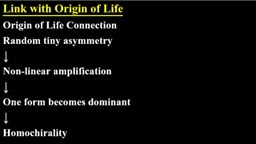
The importance of basic science lies precisely here: a seemingly small and theoretical question can, over time, spawn numerous technologies and applications. Kagan helped us understand how small molecular asymmetries can be amplified through nonlinear effects, while Soai demonstrated the extraordinary role of autocatalysis in amplifying chirality. Together, their work helps scientists understand how chirality originated, how it functions in pharmaceutical chemistry, and provides possible clinical and scientific knowledge.
As the video concludes: any molecular asymmetry can be amplified into a dominant molecular chirality.
One-line Summary
Related articles

Cursor Can Now Control Your Computer: AI Agents Can Drive Desktop Apps for Testing
Cursor adds desktop control: AI agents can drive desktop apps like the iOS Simulator to test their own features. We analyze the impact on dev workflows, possible technical approaches, and reliability concerns.

Vibecoding a Custom Inference Engine: High Hopes, Harsh Reality
A Reddit developer shares the real experience of vibecoding a custom inference engine: running GGUF Q4 models in the browser with WebGL2 and GLSL, only to fall into tokenizer debugging hell. This article analyzes the engineering challenges of browser-side LLM inference and why cloning llama.cpp is the more rational choice.

How High Are Anthropic's Early Investor Paper Returns Ahead of IPO?
Anthropic's early investor paper returns draw attention ahead of IPO. This article analyzes sources of book gains, capital structure, pre-IPO games and risks, and implications for the AI startup ecosystem.