The Mystery of Mac M5 Ultra 256GB Local LLM Benchmarks: Why the Community Is Demanding Rigorous Testing

The local LLM community demands rigorous Mac M5 Ultra benchmarks using 70B+ models, not superficial 8B demos.
After the Apple Mac M5 Ultra (256GB) launched, the local LLM community found that nearly all available reviews only tested 8B models — useless for a machine whose core value proposition is running 70B+ models locally. The article examines the Apple unified memory vs. Nvidia GPU debate, noting that "can run" and "runs well" are different claims requiring real data on quantization quality, inference throughput, and software support. High-end hardware faces a structural review gap: few buyers means few expert testers, while influencer content masks core performance questions with shallow demos.
A Reddit Post That Sparked a Broader Conversation
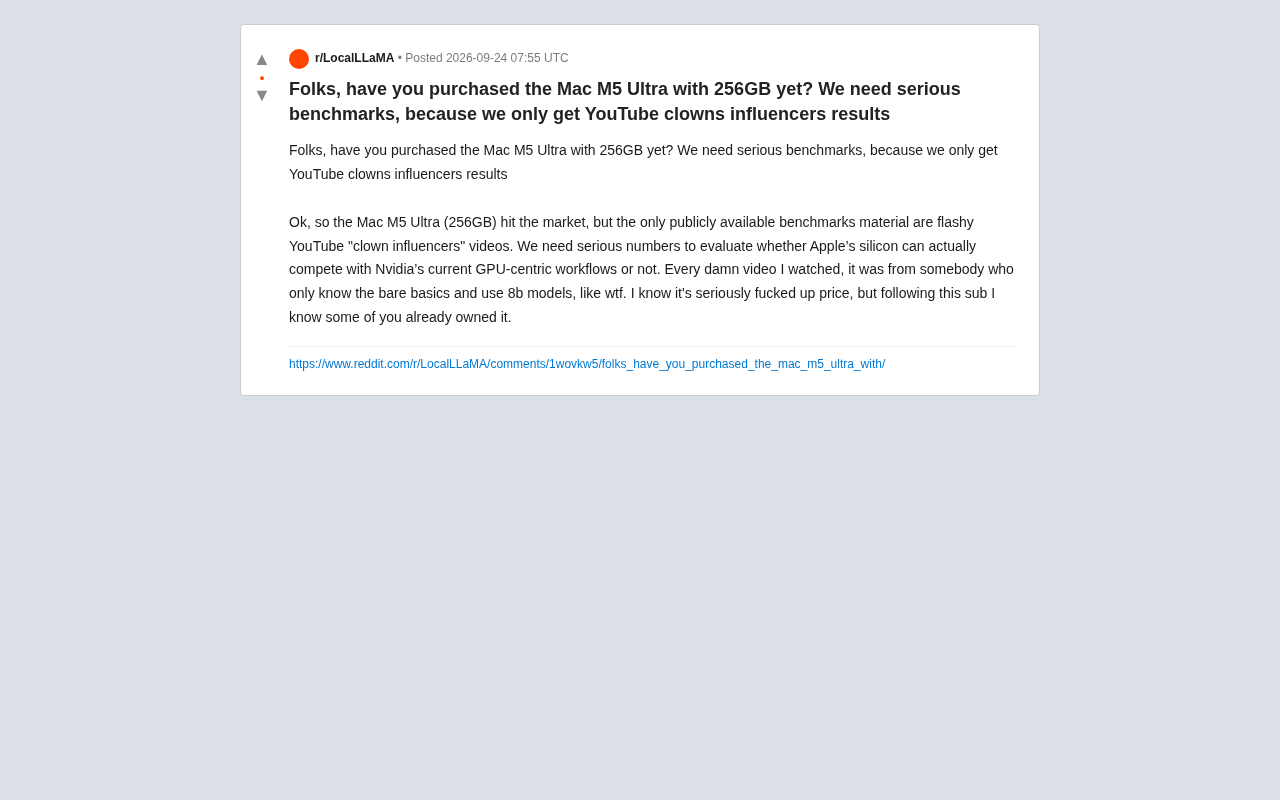
After the Apple Mac M5 Ultra (256GB RAM) launched, a telling voice emerged from the local large model enthusiast community. One Reddit user made no effort to hide their frustration: virtually all publicly available benchmarks for this machine came from "flashy YouTube influencer videos" with no genuinely useful data to speak of.
"Every video I've watched is made by people who barely know what they're doing — just running 8B models. What's the point?" This complaint cuts to a widely felt pain point in AI hardware evaluation: the real-world performance of high-end hardware designed for local LLM deployment is routinely obscured by superficial content.
Why 8B Model Benchmarks Tell You Nothing
For a Mac M5 Ultra with 256GB of unified memory, testing it with an 8B (8-billion-parameter) model is essentially like bringing a sledgehammer to crack a nut. Models this small run smoothly on consumer-grade GPUs and even some laptops — they simply cannot showcase the core advantage of a high-memory machine.
The biggest selling point of Apple's high-end chips for local AI use cases is precisely the large unified memory architecture. 256GB of memory can theoretically hold 70B models or even larger quantized variants — something a single consumer Nvidia GPU (capped at 24GB or 32GB of VRAM) simply cannot do on its own. Meaningful benchmarks should therefore focus on large-parameter models (e.g., 70B and 120B quantized versions), including load times, inference throughput (tokens/sec), and long-context performance.
Benchmarking with small models is like testing a supercar's fuel efficiency in city traffic — the numbers may be accurate, but they're completely divorced from the machine's intended purpose and the real needs of buyers.
Quantization is a key concept for understanding how large models run locally. Raw large models typically store weights in FP16 or BF16 format — a 70B-parameter model requires roughly 140GB of memory. Quantization compresses each weight to 4 bits (Q4) or lower, reducing a 70B model's memory footprint to around 40GB, making it feasible to run on a 256GB unified memory machine. Common quantization tools include llama.cpp's GGUF format and GPTQ. Quantization does introduce some accuracy loss — a Q4-quantized 70B model will generally show a perceptible quality drop compared to full precision on complex reasoning tasks, but it still far outperforms a smaller-parameter model. Inference throughput is typically measured in tokens/sec (t/s); for local chat use cases, 15–30 t/s is widely considered the threshold for a smooth experience, and this is precisely the core metric that 256GB machines need to be validated against.
Apple Silicon vs. Nvidia: Two Competing Approaches to Local Inference
Behind this Reddit post lies a deeper industry question: can Apple's unified memory approach genuinely challenge Nvidia's GPU-centric workflow?
Both approaches involve trade-offs. Nvidia holds a dominant position in training and high-throughput inference thanks to its CUDA ecosystem, mature inference frameworks, and strong memory bandwidth. But VRAM capacity is a hard constraint for consumer products — running very large models typically requires multi-GPU setups, which drives up cost and power consumption sharply.
Apple's M5 Ultra takes a different path: trading some peak compute performance and ecosystem maturity for massive unified memory capacity and extremely low power consumption. For individual users who simply want to run a 70B model locally for inference, a single machine like this may be far more practical and power-efficient than stacking multiple GPUs.
But "can run" and "runs well" are two different things. Enough memory is just the entry ticket. The real questions — actual usable inference speed, accuracy degradation after quantization, and the maturity of the software ecosystem (llama.cpp, the MLX framework, etc.) — all require rigorous empirical data to answer. And that's exactly what the community is currently lacking.
Apple's Unified Memory Architecture (UMA) fundamentally differs from traditional discrete VRAM: the CPU and GPU share the same physical memory pool, eliminating the bandwidth bottleneck of transferring data between main memory and GPU memory. The M5 Ultra, formed by interconnecting two M5 Max dies, delivers over 800GB/s of memory bandwidth. While this is lower than the Nvidia H100's 3.35TB/s, it significantly exceeds consumer GPUs (e.g., the RTX 4090 at roughly 1TB/s). In local inference scenarios, memory bandwidth — not raw compute — is often the key bottleneck for tokens/sec, which gives Apple's high-end chips genuine competitive standing when running large quantized models. MLX, Apple's machine learning framework purpose-built for Apple Silicon, is optimized specifically for unified memory and has become one of the two dominant software paths for local inference alongside llama.cpp.
The Mismatch Between Expensive Hardware and Available Reviews
The original poster also acknowledged that the machine is "ridiculously expensive." Precisely because of the steep price, very few people buy it — and even fewer among them are equipped to conduct professional-grade evaluations. This creates a structural content supply problem:
The high-end products that most need rigorous benchmarking are the ones least likely to receive it. Influencers chase views and engagement; running an 8B model and showing off a smooth-looking UI is enough to rack up plays. Deep evaluations, by contrast, require domain expertise, significant time investment, and a genuine understanding of target use cases — with no guarantee of proportional reward.
This is also a reminder for prospective buyers: before spending serious money on high-end AI hardware, rather than trusting a polished promotional video, actively seek out firsthand feedback in professional communities (such as technical forums dedicated to local LLM deployment), or reach out directly to existing owners with specific test requests — for example, "Can you run Llama 70B Q4 quantized and tell me how many tokens per second you're getting?"
Final Thoughts
What looks like an emotional Reddit rant actually reflects the increasingly rational and professional demands of the local AI deployment community. As AI hardware moves from data centers to personal desktops, users' expectations for benchmark quality have risen accordingly — they no longer want flashy demos; they want hard data that can actually guide purchasing decisions.
For products like the Mac M5 Ultra, the answers will likely only emerge gradually as more professional users complete real large-model testing. Until then, staying rational and resisting the pull of "influencer benchmarks" is the right stance for anyone seriously considering local LLM deployment.
Related articles

Workbuddy for Absolute Beginners: How a Desktop AI Agent Fits Into Real Workflows
A beginner's guide to the Workbuddy desktop AI agent: installation, claiming credits, file management, and building automated workflows—compared with CodeX for fit and cost, helping professionals shift from AI question-askers to AI managers.

OpenAI's New Agent Stack: Computer Use, Decisions API, and Ultra-Fast Workflows
OpenAI Dev Day unveiled a new agent stack: Computer Use outperforms humans, Decisions API delivers ultra-low-latency classification via Luna, Agents API opens the same Computer Use capabilities, and GPT-6.1 Sol costs only one-seventh of Astra. Core updates, benchmark data, and developer insights.

Liang Wenfeng Open-Sources DeepInfo Inference Framework, Takes On U.S. Ban
DeepSeek open-sources its DeepInfo inference framework after its models, featuring GPU/CPU cross-pipelining, small-model prediction with large-model verification, and full Huawei Ascend and NVIDIA chip support—facing the U.S. federal ban head-on. This article analyzes its significance for AI deployment and open-source strategy.