The New Software Engineer Roadmap for the AI Era: Knowing How to Code Is No Longer Enough
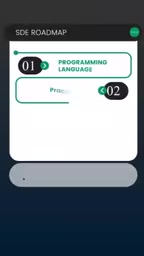
The software engineer roadmap has been rebuilt for the AI era: from coding to system design, AI collaboration, and continuous growth.
The core argument: AI isn't replacing programmers — it's phasing out those who only write mediocre code. The old path of learning a language, grinding DSA, building projects, and landing an offer has lost much of its value now that AI can auto-generate code and fix bugs. Companies have shifted their focus from "can you code?" to system design ability, real-world problem-solving, and the capacity to leverage AI for 10x productivity. The updated roadmap covers programming foundations, DSA, real projects, AI tools, system design, and continuous learning — with the conclusion that the future belongs to engineers who build with AI, not against it.
If you're still following the software engineer growth roadmap from a few years ago, you're probably already falling behind. AI hasn't just changed programming itself — it has reshaped the entire career path. The core argument here is straightforward: AI isn't replacing programmers. It's replacing programmers who only write mediocre code.
Why the Old Roadmap No Longer Works
The traditional growth path was fairly simple and linear: learn a programming language, grind data structures and algorithms (DSA), build a few projects, then land an offer. This approach worked well before AI tools became widespread, because writing code was itself a scarce skill.
But reality has shifted. AI can auto-generate code, write functions, fix bugs, and even produce documentation. When the act of "writing code" is increasingly handled by tools, the value of knowing syntax and basic algorithms is rapidly diluting. Naturally, what companies look for when hiring has shifted as well.
What Companies Are Actually Evaluating
Companies are no longer asking just "can you write code?" in interviews — they want to see whether you can solve real-world problems.

Specifically, the evaluation dimensions now include: Can you design a scalable system? Can you solve complex problems in real-world scenarios? Can you accurately understand what users actually need?

There's also an increasingly critical capability: can you use AI to multiply your own productivity by 10x? In other words, AI has gone from being a "competitor" to a "capability amplifier." The gap between those who know how to leverage AI and those who don't is widening fast. This is precisely why the era of competing purely on raw code-writing speed is passing.
The New Growth Roadmap for the AI Era
Here's an updated roadmap — not a replacement of the old one, but an extension and restructuring of it:
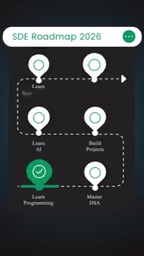
1. Learn a Programming Language
Foundational programming skills remain the bedrock. You need to genuinely understand code logic — not hand everything off to an AI black box.
2. Master Data Structures and Algorithms
DSA hasn't been made obsolete. It trains your problem-solving mindset, which is precisely the part AI can't do for you — you need to know what a good solution looks like in order to evaluate whether AI's output is actually good.
3. Build Real Projects
Move beyond toy projects toward projects that genuinely solve problems. Real projects force you to confront unclear requirements, edge cases, and performance bottlenecks.
4. Learn AI Tools
This is the critical new addition. Get proficient with AI coding assistants and treat them as collaborators, not cheat codes. Knowing how to use these tools is itself a core competency.
5. Understand System Design
System design ability determines whether you can move from "building features" to "building architecture." This is a domain that AI currently struggles to replace — and it's where senior engineers derive much of their value.
6. Keep Evolving
Technology moves extremely fast. The endpoint of this roadmap isn't a static set of skills — it's the capacity for continuous learning and growth.
The Core Takeaway: Build With AI, Don't Compete Against It
The final point is worth sitting with: AI isn't replacing programmers — it's phasing out mediocre code. The future belongs to those who learn to "build with AI," not those who try to go head-to-head against it.
This has real, practical guidance for every developer on a growth path. Instead of worrying about whether AI will take your job, focus your energy on two things: first, strengthen the foundational capabilities that can't be easily replaced (algorithmic thinking, system design, problem definition); second, genuinely integrate AI into your workflow and become someone whose productivity is amplified 10x. A strong foundation plus a powerful amplifier — that's the complete toolkit for software engineers in this era.
Background: Key Concepts Explained
System Design refers to the process of planning an entire software architecture before writing specific code — including how to decompose services, how data is stored and flows, how to handle high concurrency, and how to ensure availability and scalability. Typical system design questions include things like "How would you design a URL shortener supporting tens of millions of users?" or "How would you build a real-time messaging system?" It tests not syntax knowledge, but your judgment on trade-offs: relational database or NoSQL? Message queue or direct API calls? Which layer does the cache sit on? These decisions determine whether a system holds up under real load. AI can generate code snippets, but it has a hard time replacing the engineer's global architectural judgment in scenarios with ambiguous requirements and complex constraints — which is also the core source of senior engineers' salary premium.
Data Structures and Algorithms (DSA) are foundational topics in computer science, covering how data is organized (arrays, linked lists, trees, graphs, hash tables) and how problems are solved (sorting, searching, dynamic programming, graph traversal). Before AI tools became widespread, DSA was the standard gatekeeping question in big tech interviews — a test of whether candidates had engineering fundamentals. Even in the AI era, DSA's value hasn't disappeared. When AI produces a block of code, you need to be able to judge whether its time complexity is reasonable, whether its memory usage is excessive, and whether edge cases are covered. Without algorithmic intuition, you're essentially using AI's output blindly — unable to effectively validate or optimize it.
Related articles
vLLM v0.30.0rc1 Released: Isolates FlashInfer BF16 Autotuning Logic
vLLM v0.30.0rc1 release candidate fixes FlashInfer BF16 autotuning isolation (PR #57285). Learn the technical background and its impact on inference deployment.

Comp AI Raises $34M Series A, Bets on Agentic Security Compliance
Comp AI raises $34M Series A led by Roo Capital and Grand Ventures, betting on "continuously agentic" AI to transform compliance from periodic audits into real-time monitoring.

MIT Technology Review's 35 Innovators Under 35: A Climate Tech Edition Explained
MIT Technology Review's latest 35 Innovators Under 35 list focuses on climate tech, spotlighting nine young global innovators. Here's what the list means and why it matters.