The New Startup Frontier: Founders Are Betting on Real-World, In-Person Connection

A growing wave of founders is betting on in-person connection as the next scarce frontier amid AI hype.
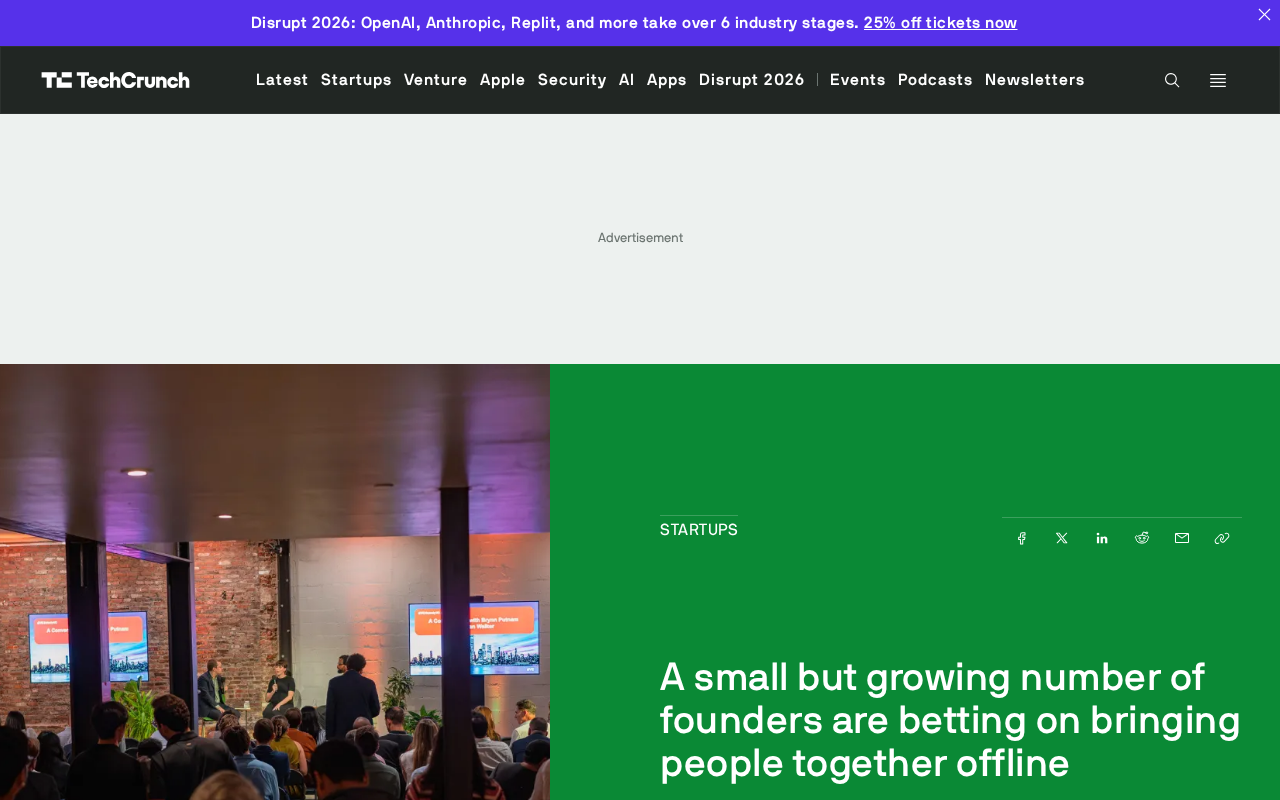
As the tech industry pours resources into AI and virtual experiences, a contrarian group of founders led by Brynn Putnam and Tristan Walker is building in the opposite direction — creating offline, in-person experiences that bring people together. Putnam's connected fitness company Mirror was acquired by Lululemon for $500M, validating the commercial power of real physical experience. Now both founders are doubling down on face-to-face community rather than pure digital plays. The underlying logic: in an age of digital fatigue and epidemic loneliness, in-person connection is becoming scarce — and with capital flooding into software and AI, this space offers less competition and potentially stronger moats.
While Tech Giants Chase Virtual Worlds, These Founders Are Going Back to IRL
Amid a tech landscape dominated by AI, the metaverse, and remote work, a quiet counter-movement is taking shape: a small but growing cohort of founders is placing their bets on in-person experiences — on literally bringing people together.
Two prominent figures in this trend are Brynn Putnam and Tristan Walker — both of whom have already achieved what most founders can only dream of: building companies compelling enough to be acquired by larger players.
From Ballet Dancer to a $500M Exit
Brynn Putnam's story is nothing short of cinematic. A professionally trained ballet dancer, she initially ran a small chain of boutique fitness studios. But it was her connected fitness company, Mirror, that made her a household name in startup circles.
Mirror's core product — a smart mirror that streams interactive fitness classes directly into your home — was acquired by activewear giant Lululemon for $500 million in cash, less than three years after the company was founded.
That kind of exit speed and scale is rare in consumer hardware. It also validated something important: products built around the body, movement, and real physical experience still carry enormous commercial value and capital appeal.
Mirror represented a category known as "Connected Fitness" — a segment that bundles hardware devices (mirrors, treadmills, bikes) with subscription-based streaming classes, generating recurring revenue through monthly fees. The model follows a "razor and blades" logic. The most well-known competitor in this space was Peloton, whose interactive bike became a cultural icon during the pandemic, reaching a peak valuation of over $50 billion. But as pandemic tailwinds faded, Peloton's stock collapsed by more than 90%, exposing how heavily the model depended on the unique circumstances of lockdown life. Mirror's acquisition at the height of the hype was, in many ways, a well-timed exit call. Lululemon's strategic intent was to build a closed-loop ecosystem spanning apparel to fitness content — but that business later underperformed, reflecting the broader cycle of the connected fitness category moving from euphoria to sobriety.
Why "In-Person Connection" Is Having a Moment
What's interesting is that Putnam and fellow serial entrepreneur Tristan Walker haven't continued down a purely digital path in their next chapters. Instead, both have pivoted toward models that emphasize offline, face-to-face gathering.
This reflects a broader emotional shift. After years of remote work, screen-mediated living, and digital-first everything, people's appetite for genuine social interaction, in-person community, and physical presence is surging. Loneliness, social burnout, and "digital fatigue" have become very real struggles for many.
For founders, this represents both a social need and a business opportunity. When the majority of capital is chasing AI and software, building experiences that bring people together in the real world suddenly looks like a relatively uncrowded, under-competed space.
A Contrarian Bet With a Long-Term Logic
It's worth noting that founders choosing this path are still a distinct minority. Offline businesses typically mean heavier operations, lower margin scalability, and growth ceilings that look nothing like the exponential curves typical startup logic demands — all of which runs counter to the classic tech playbook.
But when founders like Putnam — who have already notched a successful exit — are willing to place another bet here, it signals they're seeing something others aren't: that genuine human connection has a scarcity value that technology simply cannot fully replicate.
As virtual experiences become cheaper and more homogenous, products that create high-quality in-person gathering may actually build deeper moats and stronger user loyalty in the long run.
What This Means for the Industry
This trend is a reminder to the broader tech and venture ecosystem: the ultimate purpose of technology shouldn't only be to keep people in front of screens — it can also be to help people come together more meaningfully.
From connected fitness to offline communities, this cohort of founders is exploring the middle ground of "tech-enabled real-world experience." Whether they'll succeed remains to be seen, but they've already proven one thing: in an era dominated by virtual narratives, rebuilding genuine human connection is still a business worth taking seriously.
Context
In 2023, U.S. Surgeon General Vivek Murthy released an official advisory declaring loneliness a public health "epidemic," noting that the health risks of loneliness are comparable to smoking 15 cigarettes a day. The report brought the "social connection crisis" into mainstream policy discourse and provided a macro narrative framework for startups focused on in-person gathering. Meanwhile, academic research has continued to validate that face-to-face interaction builds trust and belonging in ways that online communication cannot fully replicate. This backdrop gives in-person experience products not just emotional resonance, but data- and policy-level credibility — helping founders frame their pitch not as a lifestyle upgrade, but as a genuine solution to a real social problem.
Related articles

Cursor Can Now Control Your Computer: AI Agents Can Drive Desktop Apps for Testing
Cursor adds desktop control: AI agents can drive desktop apps like the iOS Simulator to test their own features. We analyze the impact on dev workflows, possible technical approaches, and reliability concerns.

Vibecoding a Custom Inference Engine: High Hopes, Harsh Reality
A Reddit developer shares the real experience of vibecoding a custom inference engine: running GGUF Q4 models in the browser with WebGL2 and GLSL, only to fall into tokenizer debugging hell. This article analyzes the engineering challenges of browser-side LLM inference and why cloning llama.cpp is the more rational choice.

How High Are Anthropic's Early Investor Paper Returns Ahead of IPO?
Anthropic's early investor paper returns draw attention ahead of IPO. This article analyzes sources of book gains, capital structure, pre-IPO games and risks, and implications for the AI startup ecosystem.