The Next Evolution of Coding Agents: Letting the Brain Escape the Sandbox
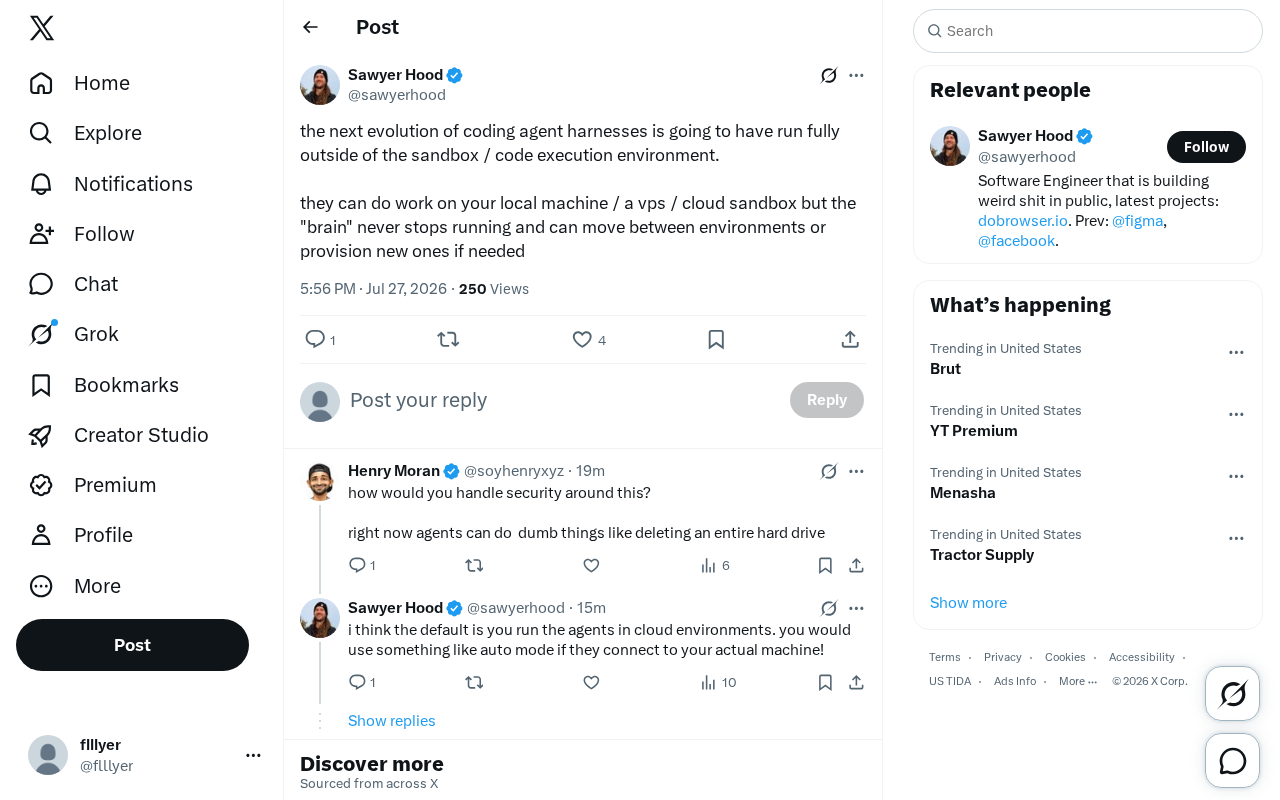
The next leap for coding agents: separating the reasoning brain from disposable execution environments.
This article explores a pivotal architectural shift for coding agents — decoupling the reasoning core (control plane) from code execution environments (execution plane). By keeping the agent's "brain" always online while treating sandboxes as swappable "hands and feet," this approach enables stronger task continuity, elastic resource scheduling, and a form factor closer to a digital employee. The article also examines key engineering challenges including state synchronization, security boundaries, and latency-consistency trade-offs.
A Critical Inflection Point in Coding Agent Architecture
Most mainstream coding agents today share a common architectural trait: the agent's "brain" — the core logic responsible for reasoning, planning, and decision-making — is tightly coupled with the code execution environment. Whether running on a local machine, a cloud sandbox, or inside a container, once the execution environment restarts, crashes, or gets destroyed, the agent's running state is often interrupted along with it.
Coding agents are AI systems capable of autonomously completing software development tasks. Notable examples include Devin, OpenAI Codex, Cursor Agent, and Claude Code. These systems typically use a large language model (LLM) as their reasoning engine, combined with tool capabilities like file I/O, terminal command execution, and code search, forming a complete automated programming loop. Their general workflow is: receive user instructions → analyze the codebase → formulate a modification plan → execute code changes → run tests for verification → iterate and fix. The field is currently in a rapid transition from "assisted completion" to "autonomous engineering."
Recently, some developers have put forward a notably forward-looking perspective: the next evolution of coding agent frameworks (harnesses) will have the agent running entirely outside the sandbox and code execution environment. In other words, the agent's "brain" never stops running, while execution environments become the "hands and feet" that can be switched and allocated on demand.
This idea may seem simple, but it touches on a core contradiction in AI agent system design that has long been overlooked: the binding between state persistence and execution environment lifecycle.
Why Separate the "Brain" from the "Hands and Feet"
Limitations of Existing Coding Agent Architectures
In most coding agent implementations today, the agent's runtime logic and the code environment it operates on are monolithic. When you launch an agent to modify a code repository, it typically completes the entire process — from reading files and executing commands to running tests — within a single sandbox.
In the coding agent context, a sandbox refers to an isolated code execution environment, usually implemented with Docker containers, microVMs (such as Firecracker), or lightweight virtual machines. Its core purpose is security isolation — preventing code executed by the agent from damaging the host system. Typical sandbox implementations include E2B (a cloud sandbox designed specifically for AI agents), Modal's container environment, and remote development containers provided by various IDEs. The lifecycle of a sandbox is typically ephemeral: create → execute → destroy. While this design is secure, it also means that the running state within it is short-lived.
This design has several obvious problems:
- Environment equals state: Once the execution environment is reclaimed, the agent's context and ongoing task chains may be lost.
- Migration is difficult: Agents cannot freely move between different environments. For example, if it's halfway through a task on your local machine and you want to switch to a more powerful cloud host to continue, a seamless handoff is nearly impossible.
- Resource waste: To maintain task continuity, the entire heavyweight execution environment often needs to stay online, which is costly.
The New Paradigm: Decoupling the Control Plane from the Execution Plane
The core of this vision is that the agent's "brain" is always online and can flexibly choose execution environments based on task requirements:
- Execute work on your local machine;
- Spin up a VPS (Virtual Private Server);
- Use a cloud sandbox;
- Or even provision entirely new execution environments on demand.
This is fundamentally an architectural philosophy of separating the Control Plane from the Execution Plane. This concept is already well-established in distributed systems and cloud-native domains — Kubernetes controllers and worker nodes, CI/CD schedulers and executors all follow similar designs. Now, this approach is being introduced into AI agent architecture.
The separation of control plane from data/execution plane is one of the most fundamental design patterns in distributed systems architecture. In Kubernetes, the control plane includes components like the API Server, Scheduler, and Controller Manager, responsible for cluster decision logic; while the kubelet and container runtime on worker nodes constitute the execution plane, responsible for actually running containers. Similarly, in Software-Defined Networking (SDN), the controller handles routing decisions while switches handle data forwarding. The core advantage of this separation is that decision logic can maintain a global view and persistent state, while execution units can elastically scale and independently recover from failures. Applying this pattern to AI agent architecture means the LLM reasoning loop (decisions) and code execution (operations) can be independently operated and scaled.
Practical Impacts of Separating Control and Execution Planes
Stronger Task Continuity
When the agent's reasoning core is independent of the execution environment, a long-running task is no longer constrained by the stability of any single environment. Execution environments can crash and be rebuilt at any time, while the agent still remembers what it was doing and what the next step should be. This is especially critical for complex engineering tasks that take hours or even days to complete.
To achieve this, the core problem to solve is agent state serialization and persistence. This includes: storing conversation context and reasoning chains — typically achievable through vector databases or structured storage for long-term memory; task state machine snapshots — recording what stage the current task is in and which sub-steps have been completed; file system snapshots of the execution environment — maintaining the brain's awareness of environment state through overlay file systems or incremental sync mechanisms (similar to rsync or git). There are already some explorations in the industry: LangGraph's checkpoint mechanism allows agent state persistence and recovery, and Microsoft's AutoGen framework is also exploring cross-session agent state management.
Elastic Resource Scheduling
Agents can invoke compute resources just like calling an API. During the early phase of a task, research and planning can be done in a lightweight local environment; when heavy computation is needed for compilation and testing in the middle phase, it can switch to a high-spec cloud instance; after completion, resources are automatically released. This "on-demand provisioning" capability gives coding agents true operational autonomy.
Provisioning is a core concept in cloud computing, referring to the automated process of creating and configuring compute resources on demand. In IaC (Infrastructure as Code) practices, tools like Terraform and Pulumi allow creating virtual machines, networks, storage, and other resources through declarative configurations. When a coding agent gains autonomous provisioning capability, it essentially obtains infrastructure operation privileges similar to those of a DevOps engineer — automatically creating execution environments suited to task requirements (such as machines with GPUs for machine learning tasks, or high-memory instances for compilation tasks), and automatically releasing them after task completion. This has a natural affinity with on-demand compute models like Serverless and Spot Instances.
Closer to a "Digital Employee" Form Factor
An agent with an always-on brain and flexible hands and feet behaves more like a real remote engineer: it's not a one-shot command executor, but a persistent entity that can collaborate across multiple machines and take on new tasks at any time. This is exactly what the industry envisions as the ultimate form of AI agents.
Core Engineering Challenges for Implementation
Of course, bringing this vision to reality is no easy feat. Making the "brain" independent means solving a series of new problems:
-
State synchronization: How to efficiently synchronize communication, file system state, and process state between the brain and execution environments will directly determine the user experience. In practice, this may require a combination of file system monitoring (inotify), incremental transfer protocols, and declarative descriptions of environment state. By analogy, this is similar to the local-remote state synchronization problem that remote development tools (like VS Code Remote) need to solve, but the complexity is higher in agent scenarios because the agent may operate multiple environments simultaneously and switch between them frequently.
-
Security boundaries: For an agent that can autonomously provision cloud resources and move across environments, permission management and security auditing become critically important. Uncontrolled automatic provisioning could lead to serious cost and security risks. This requires introducing fine-grained permission models (similar to AWS IAM's principle of least privilege), resource quota limits, operation audit logs, and human-in-the-loop approval gates. When an agent has the ability to create infrastructure, a single reasoning error could cause large amounts of resources to be meaninglessly created and consumed.
-
Latency and consistency: Separating the control plane from the execution plane inevitably introduces network latency. How to maintain operational consistency while ensuring response speed is a core technical challenge. This is similar to the classic CAP theorem trade-off in distributed systems — among Consistency, Availability, and Partition tolerance, agent architectures need to make different trade-offs based on specific operation types. For example, file write operations may require strong consistency guarantees, while log reads can tolerate eventual consistency.
Conclusion: Coding Agent Architecture Is Maturing
From early "prompt + single execution" to today's "multi-step reasoning + tool calling," coding agent architecture has been evolving rapidly. Liberating the agent's reasoning core from the execution environment — letting the "brain" never stop running — may be a crucial step toward truly autonomous, persistent, and scalable AI engineers.
Looking back at this evolution: the first generation of coding AI was simple code completion (like early Copilot); the second generation introduced multi-turn dialogue and context understanding; the third generation added tool calling and environment interaction capabilities (such as executing commands and reading/writing files); and the control plane / execution plane separation being discussed now can be seen as the fourth generation architecture — it grants agents true "infrastructure autonomy," evolving them from passive tools into proactive engineering entities.
This perspective is still at the frontier of industry exploration, but it reveals a clear direction: future coding agents will no longer be programs running inside sandboxes, but intelligent entities capable of commanding multiple sandboxes. When the "brain" and "hands and feet" are fully separated, the upper bound of AI agent capabilities will be redefined.
Related articles

Disaster and Glory of the Apollo Program: The History We Must Revisit Before Returning to the Moon
From the fatal Apollo 1 fire to Apollo 8's daring lunar orbit to Apollo 11's successful landing—revisiting the disasters, fears, and compromises of the Apollo program and their lessons for today's return to the Moon.

Netflix Trust Exercise Turns Into Firing Trap: Where Are the Boundaries of Corporate Trust?
A Netflix employee was fired after sharing private info in a trust exercise. We analyze the risks of corporate trust exercises and how employees can protect themselves.

AMD CDNA5 Architecture Deep Dive: Technical Evolution and the AI Computing Competition Landscape
Deep analysis of AMD's CDNA5 architecture covering Chiplet packaging upgrades, HBM memory evolution, and low-precision compute optimization, examining how AMD challenges NVIDIA's AI chip dominance.