The Other Side of Anthropic's IPO: The Trillion-Dollar Loss Illusion and the 2008 Specter Hiding in AI Debt
Anthropic's hundred-billion loss is an accounting illusion; the real risk is a $715B non-cancellable compute bet.
Anthropic's IPO reveals sharply split market sentiment: revenue surged 1,200% in a year to $3.3B in nine months, yet the headline loss hit $104B. The article finds this loss mainly stems from paper appreciation of convertible notes (Amazon's $6.2B injection ballooning to $108B) and $3.3B in stock-based compensation — all non-cash items — while adjusted operating profit is actually $4.1B at a 12% margin. The real risk lies in the $900B compute commitment, of which about $715B is non-cancellable, averaging $100B per year against projected full-year revenue of just $50–60B. The author builds four future scenarios, only one of which is profitable, requiring both "customers keep flooding in" and "compute keeps getting cheaper" to hold for five years. If demand reverses, over $500B in data center debt hidden through SPVs could replay a 2008-style systemic risk.
Introduction: The Most Controversial IPO — An Accounting Magic Trick About "Winners Losing Money"
Anthropic's IPO has split the market down the middle. Bulls call it "the most profitable money printer in history," pointing to revenue that surged 1,200% in a single year and hit $3.3 billion in the first nine months of 2026 — a milestone that took Google 13 years and Amazon 16 years to reach. Bears fixate on the headlines: a $104 billion loss over nine months, paired with $900 billion in compute commitments — more than 10x revenue.
How can a company be both a "money printer" and a "disaster" at the same time? The answer lies in the 400-plus pages of the S-1 filing: the headline loss figure is an artifact of accounting rules, while the real risk comes from a long-term bill that cannot be cancelled.
Deconstructing the $104B "Loss": It's Not Losing Money — It's Valuation Rising Too Fast
To understand Anthropic's finances, you first need to understand one concept: convertible notes (IOUs). According to the video author's plain-language explanation using a taxi company as an example, when investors inject capital in exchange for future equity, and the company's valuation soars, the value of the equity owed expands in tandem. Accounting rules require the appreciation to be booked as a paper loss — but no cash ever leaves the company's account.
Amazon injected $6.2 billion into Anthropic through such instruments. As Anthropic's valuation soared, the paper value of these notes exceeded $108 billion by June, forcing the company to book a $94 billion "loss." The video author calls this "a loss created by success" — the more successful the company, the more frightening the paper loss.
The actual operating loss is far smaller: operating loss for the first nine months of 2026 was $1.26 billion, which itself includes $3.3 billion in stock-based compensation (also a non-cash expense). Strip these items out, and adjusted operating profit comes to $4.1 billion — a 12% margin, rising to 15% in Q3 alone. The headline -$104B sitting alongside the business's +$4.1B is precisely the source of the market's split sentiment.
A convertible note is a financing instrument that sits between debt and equity: investors inject funds as debt, with an agreement to convert into company equity at a preset valuation at some future point (or at the next funding round). For startups, this instrument defers valuation negotiations and reduces financing friction, but it also plants the seeds of accounting volatility. Under US GAAP (or similar IFRS provisions), when the fair value of a note increases significantly due to rising company valuation, the appreciation must be recognized as a "fair value change loss" on the income statement — even if the company hasn't paid a single cent in cash. That's why when Anthropic's valuation doubles, hundreds of billions in paper losses appear out of thin air. Understanding this is crucial: such losses reflect the mark-to-market revaluation of a financing structure, not operating cash outflow, and must be strictly distinguished from operating losses in any analysis.
The Cost Curve: How the Compute Bill per $100 of Revenue Fell from $1,056 to $57
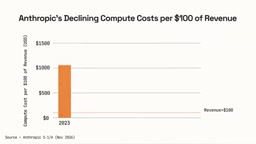
Anthropic's path to profitability depends heavily on improving unit economics. In 2023, for every $100 of revenue, the company spent $1,056 on compute infrastructure — more than 10x revenue. By 2026, that number had dropped to $57.
According to the video analysis, there are three reasons for the cost decline: the more users, the lower the per-user infrastructure cost; the smarter the model, the fewer compute cycles needed for the same answer; and increased chip supply lets the company shop around. The data bears this out: Q3 revenue grew 1,127%, while the compute bill grew only 382%.
This explains why operating loss plummeted from $8 billion last year to $1.26 billion, and why the company achieved its first quarterly operating profit of $974 million in Q2. But the sustainability of profitability is not without conditions.
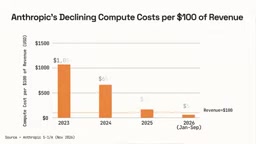
Unit economics is the core analytical framework for assessing the sustainability of AI companies: it focuses on "cost and profit per unit of revenue" rather than aggregate figures. For large-model companies, the most critical unit cost is inference compute: the GPU-hours and electricity consumed to process a single request. In 2023 this cost was high, partly because models hadn't yet been optimized for inference, batching efficiency was low, and chip supply constraints drove premiums. As user scale expands, fixed costs (like trained model weights and infrastructure depreciation) get spread thinner; meanwhile techniques like model distillation, quantization, and speculative decoding let answers of equal quality consume less compute; and with increased supply from Nvidia, AMD, and in-house chips, purchasing power improves. Only the combination of all three produced a nearly 20x decline in unit cost. Note, however, that falling unit costs do not automatically mean total costs are under control — if revenue scales more slowly than committed compute spending, the aggregate can still bleed.
The $900 Billion Bet: $715 Billion Non-Cancellable, Only One of Four Futures Makes Money
What really makes Wall Street nervous isn't the historical loss — it's the $900 billion compute commitment. About $715 billion of it is non-cancellable: Anthropic must pay whether or not it uses the compute.
Why sign such a bold contract? The S-1 admits that Anthropic has severely underestimated compute demand in the past. Current chip booking lead times run 12 to 18 months, and compute is the scarcest resource on Earth. But the risk is this: most of the commitment is spread over 5 to 10 years — at 7 years, that's roughly $100 billion per year in average spending. Meanwhile, the company's full-year 2026 revenue is projected at $50–60 billion at most.
The video author constructs four future scenarios:
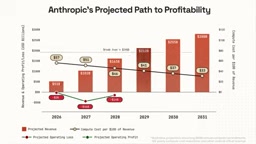
Scenario 1: Customers keep coming, compute keeps getting cheaper. Revenue growth decelerates from 100% to 20% annually, and compute costs fall 10% per year. Revenue breaks through the $190 billion break-even line in 2029, with profit of about $48 billion and a 17% margin in 2031. This is the only path the bulls are betting on.
Scenario 2: Compute gets cheaper, but customers leave. Competitors or Chinese models offer equivalent services at half price, and revenue growth drops to 30%, 10%, 5%. Because the $715 billion commitment is locked in, no matter how cheap compute gets, fixed spending of $100 billion per year means the company never turns a profit — annual losses of $55–65 billion.
Scenario 3: Customers come, but compute stops getting cheaper. Revenue grows to $280 billion per the Scenario 1 trajectory, but the compute cost per $100 of revenue stays at $57. Now the bigger the scale, the bigger the loss — because at current levels the company still loses $4 per $100 of revenue, and after 2029 it would still lose $8–11 billion per year.
Scenario 4: Customers leave, and compute doesn't get cheaper. This is a guaranteed death spiral.
Three of the four futures are difficult; the only successful path requires two conditions to hold simultaneously for five straight years.
A non-cancellable compute commitment is accounting-wise similar to a "take-or-pay" contract: a company commits to purchasing a minimum quantity of compute or chip capacity over multiple years, and must pay regardless of actual usage. Such contracts typically don't appear under debt on a traditional balance sheet, but are disclosed as "purchase obligations" in the notes to the financial statements — and are therefore easily overlooked by headline numbers. For AI companies, signing long-cycle contracts is about locking in scarce leading-edge chips and hyperscale data center capacity — with GPU booking lead times of 12 to 18 months, failing to lock in early could mean falling behind in the large-model race. But the price is mortgaging future operating flexibility all at once: once demand growth slows or unit costs get undercut by competition, fixed spending acts like leverage to magnify losses. This is why analyzing Anthropic requires looking beyond the income statement to the commitment schedules and amount distribution in the notes.
Echoes of 2008: $500 Billion in Debt Hidden in SPVs
The video's sharpest argument isn't about Anthropic itself — it's about systemic risk. If enterprises slash AI spending because of cheaper models, Anthropic and OpenAI can't absorb their committed compute, and the chain reaction unfolds in sequence: Amazon, Google, and Microsoft lose major customers, Nvidia orders dry up, data center construction halts, and construction workers, electricians, and utilities lose jobs.
The deeper hazard lies on the debt side. Over $500 billion in debt has been used to build data centers, much of it lent by private credit funds — funds whose capital comes from the retirement savings of ordinary people in pension and insurance funds. The risk is also hidden in hard-to-track special purpose vehicles (SPVs).
The video draws an analogy to the 2008 subprime crisis: back then, everyone believed housing prices could only go up, and risk hid where no one was looking; today, everyone believes AI demand can only go up, and companies sign 20-year contracts based on revenue that might vanish next month.
The author also points out key differences: banks are safer, tech giants are richer, and most are already profitable. But the most unsettling fact is this — no one knows exactly how large the total debt is, or who holds it.
A special purpose vehicle (SPV) is an independent legal entity, typically established by a parent company, to hold specific assets, isolate risk, or conduct off-balance-sheet financing. In data center construction, SPVs are often used to carry project debt: banks or private credit funds lend to the SPV, which uses the money to build facilities and buy equipment, then charges AI companies in the form of long-term leases. Because the SPV is legally independent from the operating company, its debt often doesn't appear directly on the tech giant's consolidated balance sheet, making it hard for outsiders to accurately gauge the true leverage across the AI infrastructure ecosystem. One of the lessons of the 2008 subprime crisis was precisely that masses of mortgage loans were packed into SPVs and securitized layer upon layer, until no one could identify the ultimate source of risk. Today's AI data center SPV debt similarly lacks unified disclosure standards, and rating agencies and regulators have limited ability to look through it — creating a blind spot in systemic risk monitoring.
Conclusion: Buying the IPO Means Buying a Five-Year Double Bet
Anthropic's IPO is essentially selling two assumptions bundled together: customers will keep flooding in, and compute will keep getting cheaper. Over the past five years, both assumptions have held: revenue grew over 1,000% annually, and compute cost per $100 of revenue fell about 20x. But there are no guarantees for the next five years.
For investors, this isn't a question of "is the company good" — it's a probability judgment about "can both conditions hold simultaneously for five years." The video author explicitly states he is not a licensed advisor and the content is for educational purposes only. And those two numbers side by side in the S-1 — the $104 billion headline loss and the $4.1 billion adjusted profit — will continue to define the controversy surrounding this IPO.

Related articles

Gemini 4 Neon Opens Paid API: Million-Token Long Tasks and Local LLM Benchmarks
Gemini 4 Neon opens its paid API with 1M-token context at $3/$15 per million tokens; OpenAI live dictation drops the 10-minute limit; local LLM tests show order-of-magnitude speed gaps; GitHub Skills rankings update.

Gemini 4 Neon Hands-On: Crushing Claude on Value, But Two Pitfalls
Gemini 4 Neon hands-on: ranks 2nd on KingBench 4 at 37.9/60 across six projects, doing for $20.36 what cost Fable 5.2 $222 — but container escapes and dead-API coding expose blind spots.

Anthropic IPO: The AI Gamble Behind a $1.33 Trillion Valuation
Anthropic launches its IPO at a $1.33T fully diluted valuation. Of its $104B nine-month GAAP loss, $94.3B is non-cash. Morningstar sees $92; Michael Burry flags $900B compute risk.