The Overlooked Attention Temperature: Hidden Bias in Zero-Shot Context Extension Evaluation

Evaluating zero-shot context extension at default temperature systematically exaggerates attention modification advantages due to baseline miscalibration.
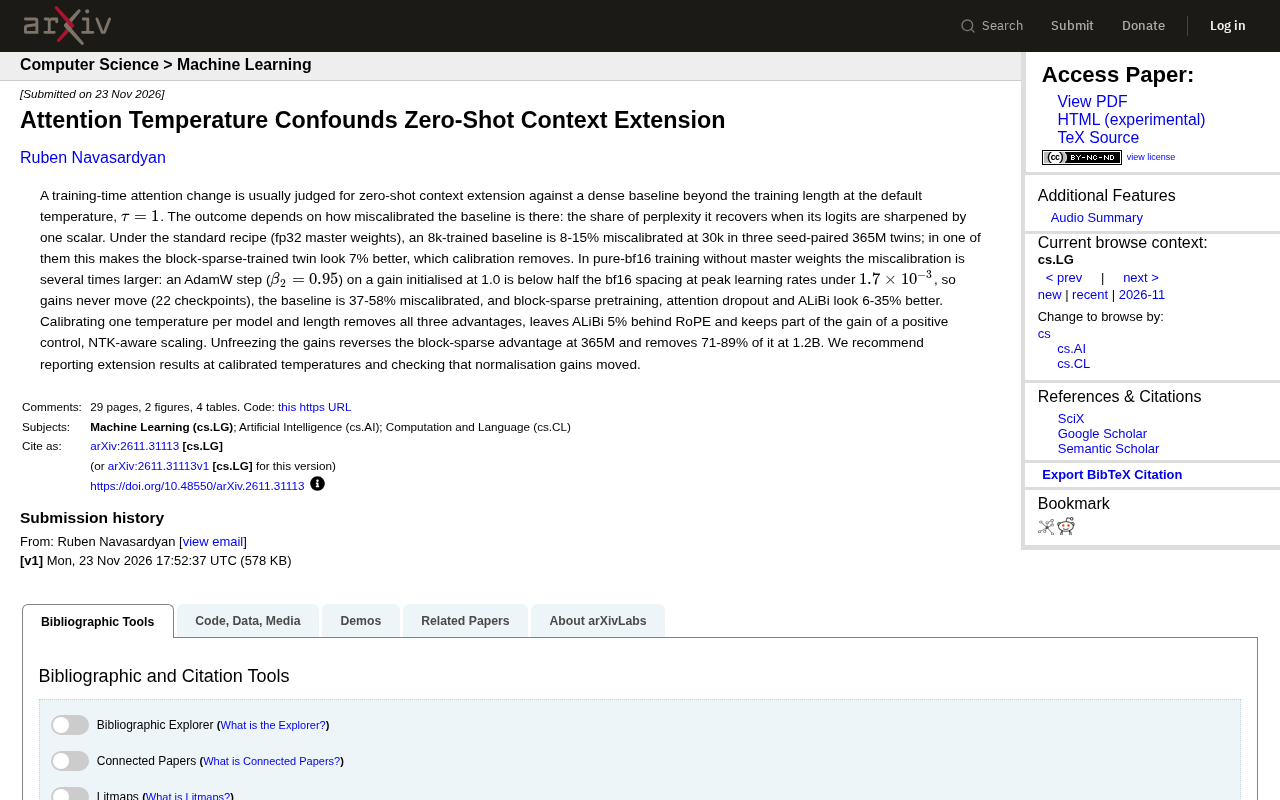
The paper argues that prior conclusions about attention modifications improving zero-shot context extension may rest on a biased baseline. At default temperature τ=1, the dense-attention baseline is poorly calibrated beyond training length: 8-15% miscalibration under standard recipes, and 37-58% under pure bf16 without master weights due to frozen normalization gains, making block-sparse attention, attention dropout, and ALiBi appear 6-35% better. After calibrating temperature per model and length, all three advantages vanish, with ALiBi even trailing RoPE by ~5%; NTK-aware scaling as a positive control retains partial gains. Unfreezing the gain reverses the block-sparse advantage on the 365M model and reduces it by 71-89% on the 1.2B model, confirming the bias source. The paper recommends using calibrated temperatures and checking whether normalization gains actually move.
Large language model context window extension has long been a research hotspot. A small modification to the attention mechanism during training—say, switching to block-sparse attention—can make a model perform better on text beyond its training length, which is typically seen as an improvement in zero-shot context extension capability. But a new paper points out that such comparisons may be built on a biased baseline: perplexity at the default temperature τ=1 does not reflect the model's true calibration state.
The Blind Spot of Evaluation at Default Temperature
The standard practice for evaluating training-time attention modifications is to take a dense-attention baseline model and compute perplexity on text beyond the training length, keeping the temperature at the default τ=1. The problem is that the baseline model may itself be poorly calibrated at that length. The paper quantifies this miscalibration using a "perplexity recovery ratio": how much of the original perplexity loss the baseline can recover when its logits are sharpened by a scalar. The higher this ratio, the more the baseline is underestimated at the default temperature, and the easier it is for any modification to look "better."
The researchers ran controlled experiments on three seed-paired 365M-parameter models. With the standard training recipe (fp32 master weights), an 8k-training-length baseline showed 8–15% miscalibration at 30k length. In one seed, the block-sparse-trained twin model appeared 7% better than the baseline, but after calibrating a single temperature per model and length, this advantage vanished entirely.
Perplexity and Temperature Calibration
Perplexity (PPL) is the most commonly used metric in language model evaluation, defined as the exponentiated average negative log-likelihood of the model over a test sequence. It depends directly on the softmax temperature: given logits $z$, the distribution at temperature $\tau$ is $\text{softmax}(z/\tau)$. When the model is within its training distribution, $\tau=1$ is usually close to optimal; but once the sequence length exceeds the training range, the scale of attention outputs may mismatch the positional encoding and normalization statistics, causing the logit distribution to be too flat or too sharp, in which case PPL at $\tau=1$ is systematically inflated. "Calibration" means searching for a scalar $\tau$ individually for each model and each length to minimize PPL. Calibrated PPL removes temperature as a confounding factor, enabling a fair comparison of the true modeling capability of different architectures. The paper's "perplexity recovery ratio" precisely measures the extent to which PPL can be recovered between $\tau=1$ and the optimal $\tau$; the higher the ratio, the more distorted the default evaluation.
Pure bf16 Training Amplifies the Bias
A more severe case arises in scenarios without master weights, i.e., pure bf16 training. Here, a gain parameter initialized to 1.0, updated with AdamW (β₂=0.95) at a peak learning rate below 1.7×10⁻³, receives an update smaller than half the bf16 spacing, so the gain never moves at all—none of the 22 checkpoints showed any change. As a result, the baseline's miscalibration on long contexts reached 37–58%, and the three modifications—block-sparse pretraining, attention dropout, and ALiBi—each appeared 6–35% better.
These numbers show that training precision and optimizer state directly affect evaluation conclusions. When the gain parameter is "frozen" at its initial value, the model cannot adjust its attention scale at lengths beyond the training distribution, and the baseline is therefore systematically depressed.
bf16 Precision and Master Weights
bf16 (bfloat16) has only an 8-bit exponent and a 7-bit mantissa, with far lower mantissa precision than fp32. The standard approach in mixed-precision training is to maintain a copy of fp32 "master weights": forward and backward passes are computed in bf16, while parameter updates are performed on the high-precision master weights to avoid small updates being lost to rounding. If no master weights are used and optimizer updates are applied directly to bf16 parameters, then when the update magnitude is smaller than the minimum bf16 spacing (ULP) corresponding to the parameter's current magnitude, the update is rounded away entirely and the parameter remains unchanged. In the paper, the normalization gain is initialized to 1.0, whose ULP under bf16 is about 0.0078; AdamW at a low peak learning rate may produce an update smaller than half this spacing, so the gain never moved across all 22 checkpoints. This explains why pure bf16 training significantly amplifies baseline miscalibration in long-context evaluation.
Advantages Vanish After Calibration, Positive Control Retains Partial Gains
The paper's core experiment is to calibrate a separate temperature for each model and each length before comparing. After calibration, the advantages of all three modifications—block-sparse, attention dropout, and ALiBi—disappeared entirely. ALiBi actually fell behind RoPE by about 5%. As a positive control, NTK-aware scaling retained part of its gains, showing that calibration does not erase all genuine long-context extension effects.
The implication of this result is clear: some of the previously reported conclusions that "attention modifications improve zero-shot extension" may simply be artifacts of baseline miscalibration. True capability differences need to be re-measured at calibrated temperatures.
NTK-aware Scaling and ALiBi
NTK-aware scaling is a training-free context extension method: it does not change the model weights but instead adjusts the RoPE rotation base to redistribute the extrapolation behavior of different frequency components, so that the model maintains reasonable relative positional encoding beyond the training length. Because its modification acts directly on the frequency structure of the positional encoding, it retains some genuine gains after temperature calibration, making it suitable as a positive control to verify that temperature calibration does not erase all effective method benefits. ALiBi, by contrast, adds a linear bias proportional to distance onto the attention logits, introducing an extrapolation inductive bias during training; the paper finds that after calibration it actually falls behind RoPE by about 5%, indicating that its previously reported advantage came mainly from baseline miscalibration rather than the architecture's own extension capability. Block-sparse attention reduces computation by restricting the connectivity pattern of the attention matrix, while attention dropout randomly zeros attention weights; both also lose their advantage after calibration.
Frozen Gains Are the Source of Bias
The researchers further verified the mechanism: after unfreezing the gain parameter, the block-sparse advantage reversed on the 365M model and decreased by 71–89% on the 1.2B model. This directly attributes the bias to the normalization gain not being updated during training. In other words, the baseline is miscalibrated on long contexts because its attention output scale cannot adapt to out-of-distribution lengths, and the modified models happen to compensate for this in some way.
The paper's recommendation is very concrete: use calibrated temperatures when reporting context extension results, and check whether the normalization gain actually moves. For teams doing long-context training or evaluation, this is a low-cost check that can prevent misjudgment.
Implications for Evaluation Practice
The value of this work lies not in proposing a new method but in revealing a widely overlooked evaluation variable. Attention temperature is not a hyperparameter detail; it determines whether comparisons between different architectures are fair. When the training recipe involves low-precision training, gain initialization, or freezing strategies, miscalibration can be amplified severalfold, causing conclusions to completely reverse.
For researchers focused on zero-shot context extension, a feasible approach is: first measure the baseline's calibration state at the target length, then decide whether to use temperature-calibrated perplexity for cross-comparison; at the same time, confirm that the normalization gain was actually updated during training. These two steps require no additional training but can significantly reduce the risk of misreading baseline defects as method advantages.
One-line Summary
Evaluating zero-shot context extension at the default temperature systematically exaggerates the advantages of attention modifications due to baseline miscalibration.
Paragraph Summary
The paper points out that previous conclusions about attention modifications improving zero-shot context extension may be built on a biased baseline. When computing perplexity beyond the training length at the default temperature τ=1, the dense-attention baseline is itself poorly calibrated: 8–15% miscalibration under the standard training recipe, and 37–58% under pure bf16 training without master weights due to frozen normalization gains. This makes block-sparse attention, attention dropout, and ALiBi each appear 6–35% better. After the researchers calibrated a separate temperature for each model and length, the advantages of all three modifications disappeared entirely, with ALiBi even falling behind RoPE by about 5%; NTK-aware scaling, as a positive control, retained part of its gains. After unfreezing the gain parameter, the block-sparse advantage reversed on the 365M model and decreased by 71–89% on the 1.2B model, confirming that the source of bias is the normalization gain not being updated during training. The paper recommends using calibrated temperatures when reporting extension results and checking whether the normalization gain actually moves.
Related articles

From 0 to 1: Vibe Coding an AI Knowledge Base — A Practical Retrospective and Tech Stack Breakdown
A retrospective on building the AI knowledge base OilBook from scratch with Vibe Coding: Next.js+Neon stack, Oil Dev Skill workflow, Stripe paywall security, interview-style writing, AI-flavor control, and Vercel deployment.

GLM-5.4 Hands-On: Native Vision Meets a New Vibe Coding Workflow
Hands-on with Zhipu GLM-5.4: native vision tested across a 3D product demo, pure-code video generation, and remote-control Vibe Coding, compared with GPT-6.2 and Gemini Neon.

AI and Humans Claim to Prove the Riemann Hypothesis: Machine-Verified, Yet Nobody Can Understand It
Anthropic mathematician and AI Claude claim to prove the Riemann Hypothesis with 17 million lines of Lean code, machine-verified but unreadable by humans. This article analyzes the event, the zero proportion record from 41.6% to 67.2%, and the gap between machine verification and human understanding.