The Overlooked "Boring" Infrastructure Behind Production-Grade AI Agents

Production AI Agents need boring infrastructure—idempotency, audit trails, and durable execution—not just better models.
A Reddit discussion highlights that taking AI Agents to production requires far more than orchestration frameworks. Teams must build idempotency, retry mechanisms, action ledgers, policy versioning, audit tables, and human-in-the-loop workflows—infrastructure that inevitably grows into a semi-independent platform. The article offers a practical framework for deciding what to build vs. what to delegate to mature tools like Temporal and OpenTelemetry.
After the Demo Works: The Real Engineering Has Only Just Begun
A recent Reddit discussion about production-grade AI Agents has struck a deep chord. The poster raised a pointed question: How much "boring" infrastructure have you ended up building around production agents?
The focus here isn't on orchestration frameworks like LangGraph or CrewAI that get mentioned repeatedly—it's about the things that never appear in demo videos yet determine whether a system can actually run in production: idempotency, approval states, retry mechanisms, action ledgers, reconciliation jobs, policy versioning, tool-call history, state snapshots, audit tables, human escalation workflows...
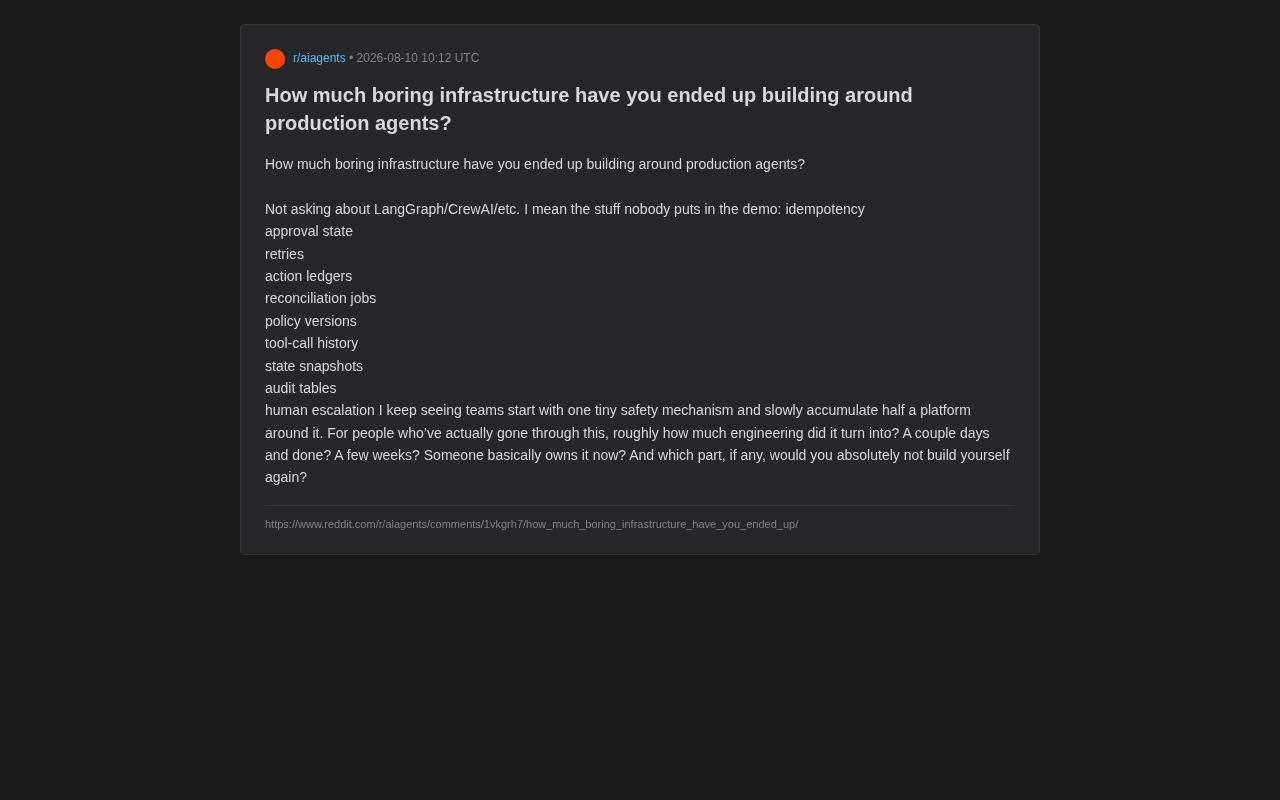
This question resonates because it hits the core contradiction of AI Agent deployment today: Building a demo takes only a few hours, but turning it into a trustworthy, auditable, rollback-capable production system often evolves into a semi-independent platform engineering project.
Production Agent Essentials: The Things Nobody Puts in Their Demo
The original post's checklist deserves item-by-item scrutiny, because each one corresponds to a category of real production incidents.
Idempotency and Retries: Classic Distributed Systems Problems Resurface
When an Agent calls external tools (sending emails, placing orders, writing to databases), network jitter or timeouts trigger retries. Without idempotency guarantees, a single "retry" can become a "duplicate order" or "double charge." This is fundamentally a classic distributed systems problem, only amplified in the Agent scenario—because LLM outputs are inherently non-deterministic, you can't even guarantee that two invocations will generate identical parameters.
From a technical implementation perspective, idempotency means an operation produces the exact same result whether executed once or multiple times. In distributed systems, this concept was first formalized by the HTTP protocol specification—GET, PUT, and DELETE are defined as idempotent methods, while POST is not. Common patterns for implementing idempotency include: using a unique idempotency key to tag each request, with the server checking whether that key has already been processed before execution; or adopting a two-phase "check-then-execute" pattern. In payment systems, companies like Stripe have long treated idempotency keys as first-class API citizens. But in Agent scenarios, the challenge is greater: in traditional systems, the caller is deterministic code, while an Agent's caller is a probabilistic model that might issue a "same intent" request with slightly different wording—making idempotency key generation and matching far more complex. You may need to determine whether two calls represent "the same operation" based on semantics rather than literal values.
Action Ledgers and Audit Tables: Leaving Traces for Unpredictable Behavior
Traditional software behavior is deterministic—when things go wrong, you check the logs. But Agents make "autonomous decisions." When one executes an unexpected action, you need to be able to answer: What context did it see at the time? Which tool did it call? What parameters did it use? Based on which version of the policy? This is why action ledgers, tool-call histories, and state snapshots keep getting added to systems. They're not nice-to-haves—they're the lifeline for incident postmortems and compliance audits.
The design philosophy of an Action Ledger is highly consistent with the Event Sourcing pattern. Popularized by Martin Fowler and others, Event Sourcing's core idea is: don't store the current state—store the complete sequence of events that caused state changes, and the current state can be rebuilt at any time by replaying the event sequence. In Agent systems, the action ledger records not just "what the Agent did" but also "why it did it"—trigger conditions, input context, model version, policy version, tool call parameters and return values. This enables post-hoc analysis to fully reconstruct the Agent's decision path, while also providing an immutable evidence chain for regulatory compliance. Some teams have already adopted append-only storage strategies to ensure audit records cannot be modified, borrowing the "immutable ledger" design philosophy from blockchain technology.
Policy Versioning: Making Agent Behavior Traceable
Policy Versioning solves the problem of Agent behavior traceability. An Agent's behavior depends not only on the underlying LLM but also on multiple policy layers: system prompts, tool permission configurations, business rule constraints, and more. When an Agent exhibits anomalous behavior, the team needs to know exactly which version of the policy combination was in effect at that time. This is similar to model version management in machine learning (Model Registry in MLOps), but more complex—because an Agent's "behavior definition" is distributed across multiple configuration layers. Mature practices typically tag each Agent execution with a policy snapshot label, ensuring that any historical behavior can be reproduced and debugged under the same policy environment. The GitOps philosophy applies here as well: all policy changes are managed through version control systems, change history is traceable, and rollback to any historical version is possible when necessary.
Approvals and Human Escalation: Putting Humans Back in the Loop
Almost every serious production Agent introduces a human-in-the-loop mechanism. High-risk operations require human approval, and edge cases need to be escalatable to human handlers. Once approvals are introduced, "approval state management" inevitably follows—pending, approved, rejected, auto-processed on timeout—and these states need persistence, notifications, and timeout policies.
Human-in-the-loop (HITL) isn't a new concept in AI systems, but its implementation complexity in Agent production environments far exceeds academic scenarios. A seemingly simple "wait for human approval" requirement actually involves multiple engineering challenges: asynchronous waiting and timeout handling (approvers might not respond for hours or even days), complete presentation of approval context (approvers need to see the Agent's reasoning chain and environment snapshot to make a judgment), concurrency control (the same operation shouldn't be approved redundantly by multiple people), auditability of the approval chain (who approved what and when), and degradation strategies (what happens when the approval system itself is unavailable). In heavily regulated sectors like finance and healthcare, HITL isn't just a safety mechanism—it's a hard regulatory requirement. The system must be able to prove that critical decisions were confirmed by authorized personnel, or face compliance risks and even legal liability.
From One Safety Mechanism to Half a Platform: The Agent Infrastructure Bloat Journey
The original post's most precise observation is: Teams often start with one tiny safety mechanism, then slowly pile up half a platform around it.
This is a classic "boiling frog" engineering bloat process. You might just want to add a simple "dangerous operations need confirmation" feature, but quickly discover:
- Once you have approvals, you need state storage for approvals;
- Once you have state, you need versioning and snapshots of state;
- Once you have multiple Agent instances, you need reconciliation to ensure consistency;
- Once you have reconciliation, you need an action ledger as the single source of truth;
- Once you have a ledger, you need audit tables for compliance;
- When things go wrong, you need rollback capability, which requires even more comprehensive state management...
Each step is perfectly reasonable, but cumulatively, you're already building a dedicated Agent runtime infrastructure platform. The original post raises a painfully real question: did this end up taking days? Weeks? Or does someone already "own" this system full-time? Based on the general sentiment from community feedback, the answer is usually the latter two—it continuously consumes one engineer's or even a small team's effort.
This bloat pattern is not uncommon in software engineering history. It's similar to the early days of microservice architecture, when teams started by "splitting off one service" and eventually discovered they needed service discovery, configuration centers, distributed tracing, circuit breakers, and an entire infrastructure suite—ultimately giving birth to platform-layer abstractions like Service Mesh. Agent infrastructure is undergoing the same evolutionary path.
What to Build Yourself and What Not to Reinvent?
One of the most valuable questions from the original post is: Which part would you absolutely never build yourself a second time?
While the post itself is an open discussion, we can offer a decision framework based on common engineering experience:
Worth Building Yourself
Policy logic tightly coupled to your business, approval business rules, and domain-specific reconciliation logic—these often have no universal solution, and building them yourself is actually clearer. The core principle: if a component's design decisions are primarily driven by your domain knowledge, it's worth building in-house.
Not Worth Reinventing
- Persistent state machines and workflow engines: Idempotency, retries, and state snapshots are essentially durable execution problems. Mature frameworks like Temporal (formerly Uber's internal Cadence project) and Restate handle these well. Implementing your own reliable retry and state recovery mechanism is extremely costly and error-prone. The core idea of Durable Execution is: automatically persist workflow execution state so that even if a process crashes or a server restarts, the workflow can resume precisely from the interruption point. Temporal records the result of each execution step through event sourcing and skips completed steps during replay. Compared to traditional message queue + state machine approaches, these frameworks internalize retry, timeout, and compensation logic as platform capabilities—developers only need to write business code that appears to execute sequentially. This is exactly what Agent infrastructure needs: the uncertainty of Agent decisions is handled by the LLM layer, while execution reliability is guaranteed by the durable execution layer.
- Auditing and observability: Rather than hand-rolling audit tables, integrate specialized tracing/observability tools (like the OpenTelemetry ecosystem, LangSmith, Arize, and other observation platforms built for LLM applications).
- General-purpose message queues and idempotency key management: These are battle-tested infrastructure components validated over decades—there's no reason to rewrite them.
In other words, you should own the "business decisions" while outsourcing "reliable execution" to mature infrastructure. This layering strategy aligns with the classic "buy vs. build" decision framework in software engineering: build in-house where your differentiated competitive advantage lies, and reuse wherever capabilities are generic.
Practical Advice for Teams Currently in the Trenches of Agent Productionization
Drawing from this discussion, we can distill several practical principles:
- Treat the Agent as a distributed system from day one, not as a chatbot. Idempotency, retries, and state persistence will come up sooner or later—planning early is far cheaper than patching later. Design patterns accumulated over decades in the distributed systems field—idempotency, eventual consistency, compensating transactions (Saga pattern), circuit breakers—all apply to Agent systems.
- Decouple "deterministic infrastructure" from "non-deterministic LLM decisions" into separate layers. Let the Agent be responsible for deciding "what to do," and let a reliable execution layer handle "how to do it safely." This separation of concerns not only reduces system complexity but also allows the two layers to be tested and iterated independently.
- Prioritize durable execution frameworks for hosting workflow state—avoid reinventing state machines. When evaluating options, focus on: granularity of failure recovery, compatibility with your existing tech stack, and community activity.
- Design auditing and ledgers in from day one—retrofitting them after the fact is nearly impossible to do completely. This is because Agent behavioral context (the prompt at the time, retrieved documents, the model's intermediate reasoning) cannot be reconstructed after the fact if not recorded in real-time during execution.
Conclusion
This Reddit discussion reveals the true barrier for AI Agents moving from demo to production: The barrier isn't in the model, nor in the orchestration framework, but in that boring, tedious, yet indispensable engineering infrastructure. As more teams realize this, we may see a new market opportunity emerge—infrastructure layers purpose-built for production-grade Agents providing "reliable execution + auditing + human-in-the-loop," much like web applications once spawned various middleware and platform services.
In fact, this market is already forming. From LangSmith's Agent observability offering, to workflow engines like Temporal being adopted by an increasing number of Agent teams, to various Agent frameworks beginning to build in audit and human approval capabilities—the ecosystem is gradually filling in the gaps. But the industry still has a long way to go before reaching a "de facto standard" Agent runtime platform comparable to what Kubernetes is to container orchestration.
For every engineer currently pushing Agents toward production, this question is worth thinking through in advance: How much of the world behind an Agent are you prepared to build?
Related articles

Python 3.15 New Feature: Is the sentinel Type Better Than None?
Python 3.15 adds the sentinel type, using named unique sentinel objects to replace None and bare object(), resolving confusion among missing values, explicit emptiness, and invalid input while avoiding type hint failures.

Deep Learning's Three Architectures and the Universal Approximation Theorem: A Complete Guide to MLPs, CNNs, and Transformers
Explaining the inductive bias differences among MLP, CNN, and Transformer, the existence meaning of the Universal Approximation Theorem (UAT), and the role of Taylor expansion in approximation analysis, while clearing up common misconceptions.

GitLab Emergency Patch Release: Analysis of Critical Security Fixes
GitLab releases critical patch 19.5.1, sparking 355 points of discussion on Hacker News. This article analyzes the background, upgrade steps for self-hosted instances, and verification points to help DevOps teams respond quickly to security updates.