The Overlooked Everyday Uses of Claude: How AI Becomes a Thinking Partner

Claude's stickiest value comes from everyday micro-decisions, not flashy use cases like writing or coding.
This article starts from a Reddit question exploring how people use Claude beyond the obvious "star use cases." The key observation: mundane everyday uses — drafting emails, rehearsing difficult conversations, sorting out weekend plans — actually create stronger long-term habits than generating code or long-form content. The article draws on the "rubber duck debugging" concept to explain the cognitive logic: expressing thoughts to AI converts fuzzy intuition into clear language, while AI's responsive feedback upgrades this into a Socratic-style self-clarification process. From a product perspective, high-frequency, low-friction daily scenarios are what form lasting habits, and AI's value is shifting from a productivity tool for complex tasks to an everyday cognitive collaborator.
When AI Shifts from Tool to Thinking Partner
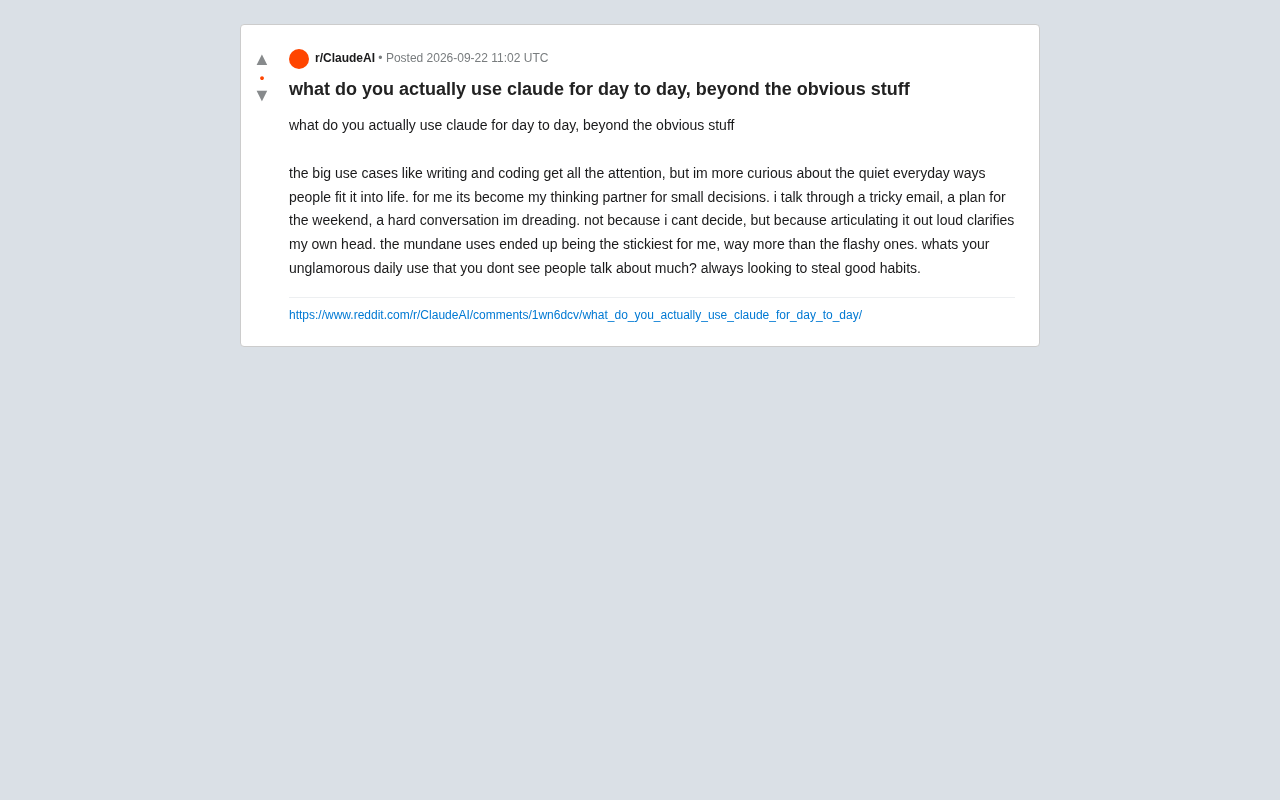
Most discussions about Claude tend to focus on the "star use cases" — writing and coding. But on Reddit, one user posed a far more intriguing question: beyond those obvious scenarios, what do you actually use Claude for day to day?
The poster's own answer was telling. For him, Claude had become a "thinking partner" for handling small decisions. A tricky email, a weekend plan, a difficult conversation he was dreading — he'd talk them through with Claude. The key insight: he wasn't doing this because he couldn't make up his own mind, but because the act of "saying it out loud" helped him organize the tangled thoughts in his head.
Why Mundane Use Cases Are More "Sticky" Than Impressive Ones
The poster made a counterintuitive observation: the dull, unremarkable use cases ultimately became his stickiest habits — far more so than the flashier features.
This actually points to a core principle in AI product design. Tasks like writing code or generating long-form content tend to be low-frequency and clearly bounded — you use it, then you're done. But the need to "sort through your thoughts" shows up almost every day: should I reply to this email, how do I phrase this more tactfully, is there an angle I'm missing on this decision? When a tool fits seamlessly into these high-frequency, micro-scale moments, it stops being software you remember to open when needed and starts existing as naturally as a daily habit.
From a product retention perspective, what determines whether users stick around long-term often isn't the jaw-dropping demo — it's these small, unglamorous dependencies that happen every single day.
The Cognitive Value of "Thinking Out Loud"
One detail the poster mentioned is worth unpacking: he uses Claude not to have AI make decisions for him, but to clarify his own thinking through the act of expressing himself to it.
This maps onto a classic phenomenon in psychology — the "rubber duck debugging" method. When a programmer explains their code line by line to a rubber duck, they often discover the bug themselves in the process of explaining it. The act of articulating something forces the brain to convert fuzzy intuition into clear, structured language, exposing blind spots in the thinking.
Claude plays a role that goes one step beyond the rubber duck: it's not just a passive listener, but can respond with structured observations after you've expressed yourself, ask follow-up questions, and even point out angles you hadn't considered. This "self-clarification with feedback" is precisely why so many people find themselves genuinely unable to do without it.
The "rubber duck debugging" method traces back to Brian Kernighan and Rob Pike's The Practice of Programming (1999) and has since spread widely throughout programming culture. Its psychological mechanism lies in the "expressive writing and verbalization" effect — when people are forced to convert implicit cognitive states into explicit language, working memory becomes constrained, mind-wandering is interrupted, and the brain must organize information in a more linear, rigorous way. Cognitive psychologists call this the "self-explanation effect." Research shows that simply articulating a problem out loud significantly improves problem-solving accuracy, regardless of whether there's a real audience present. This also explains why practices like journaling or morning pages are equally effective at clearing the mind — the "intellectual level" of the listener doesn't matter; what matters is forcing yourself to complete the transformation from chaos to language. AI's involvement upgrades this mechanism: it can respond, probe further, and reframe, essentially layering a "Socratic dialogue" on top of "passive listening," dramatically improving the efficiency of self-clarification.
In the product retention space, Nir Eyal's classic Hook Model breaks habit formation into four stages: trigger, action, variable reward, and investment. High-frequency, low-friction scenarios naturally have stronger "trigger density": the daily communication anxiety or micro-decisions that arise every day serve as constant internal trigger signals. Low-frequency tasks like writing code or generating long-form content, by contrast, lack a stable triggering rhythm and struggle to form conditioned-reflex usage habits. The "minimum viable effort" principle from behavioral economics is also at work — the cognitive cost users are willing to pay for a tool is extremely limited, and only tools that can be recalled and used "zero-friction" in context have a chance of entering genuine daily behavioral loops. This is precisely the product advantage of the "thinking partner" positioning: it doesn't require users to switch into a specific work mode, the conversational barrier is extremely low at any time and place, making it far easier to weave into the gaps of daily life.
These "Unglamorous" Everyday Use Cases
The poster ended with an invitation: share those practical, everyday uses you don't often hear people talk about — he was happy to "steal" some good habits.
Based on the scenarios mentioned in the thread, a few underrated but highly practical categories emerge:
- Rehearsing emotions and conversations: "Rehearsing" an email you're about to send or a difficult conversation you need to have — testing whether the tone is right and whether you're stepping on any landmines.
- Sorting out small decisions: Weekend plans, scheduling, and other miscellaneous tasks that don't require serious analysis but that you're too lazy to methodically think through yourself.
- Externalizing and organizing thoughts: Talking through a tangled mess of ideas in your head with AI, using the act of expression and response to achieve self-clarification.
What these use cases share: none of them are "impressive," and they'd never make for a stunning promotional demo. But it's precisely these uses that allow AI to genuinely weave itself into the fabric of ordinary people's lives.
What This Discussion Reveals
This Reddit thread is just an open-ended question, yet it reflects a shift that AI applications are undergoing: moving from "a productivity tool for completing tasks" toward "an everyday collaborator in daily cognition."
For ordinary users, this offers a new lens through which to reconsider your own usage habits — you may have been treating AI purely as a writing or coding assistant, overlooking its potential for sorting through your thoughts and supporting micro-decisions. For product designers, it's also a reminder: AI's value lies not only in how complex a task it can perform, but in whether it can lightly embed itself into the small, seemingly insignificant yet genuinely present moments users encounter every day.
Next time you open a chat window, try treating it as an on-call thinking partner — not just a task executor.
Related articles

Hands-On with the Gemini 4 Argon API: Thinking Levels and Background Mode Explained
A Free Code Camp crash course on the Gemini 4 Argon API: from getting a key and sending your first request to controlling reasoning costs with thinking levels, enabling multi-turn chat with previous_interaction_id, and generating a Breakout game in background mode—plus a Google engineer's take on the model's capabilities.

Reinforcement Learning Takes On Getting Over It: Distributed Training Strategies Behind 63% Progress
A developer uses deep reinforcement learning to tackle Getting Over It. The agent climbs from the bottom to 63% progress but gets stuck at the anvil. The project is open-sourced, using divide-and-conquer training and CPU-only training, seeking community collaboration to break the bottleneck.

Sigma FP2 Released: The World's Smallest Full-Frame Camera Gets Sensor and Screen Upgrades
Sigma launches the FP2 full-frame camera, retaining its smallest-and-lightest design with three key upgrades: improved sensor, articulating LCD screen, and longer battery life—built for portable video creators.