The PAGE Framework: Using AI to Study American Comics and Manga at Scale

PAGE uses AI and human validation to analyze tens of thousands of comics pages at scale.
The PAGE framework converts scanned comics pages into structured, computable data: a vision-language model annotates panels, text, and bibliographic records according to a researcher-designed codebook, with human samples used to validate accuracy and publisher/genre variables controlled for. Applied to 3,929 Golden Age American comics (1938–1956) and 87 manga volumes, three empirical studies validated its ability to analyze political power depictions, identify artist styles, and track cross-cultural speaker distributions. Beyond research, PAGE supports content-based archival search, accessibility for blind readers, and attribution for uncredited artists.
When Comics Research Meets Artificial Intelligence
Comics are among the most important visual records of the twentieth century. Across hundreds of thousands of pages, mass audiences encountered their leaders, their wars, and their heroes. Yet this vast visual archive has rarely been studied as a whole — traditional comics scholarship tends to proceed one volume at a time, making it difficult to grasp the full picture at the scale of an industry or an era.
A new study argues that artificial intelligence — including generative models — has the potential to change this, and ultimately to give back to the medium itself. The researchers propose a framework called PAGE, designed to turn AI into a systematic tool for comics research.
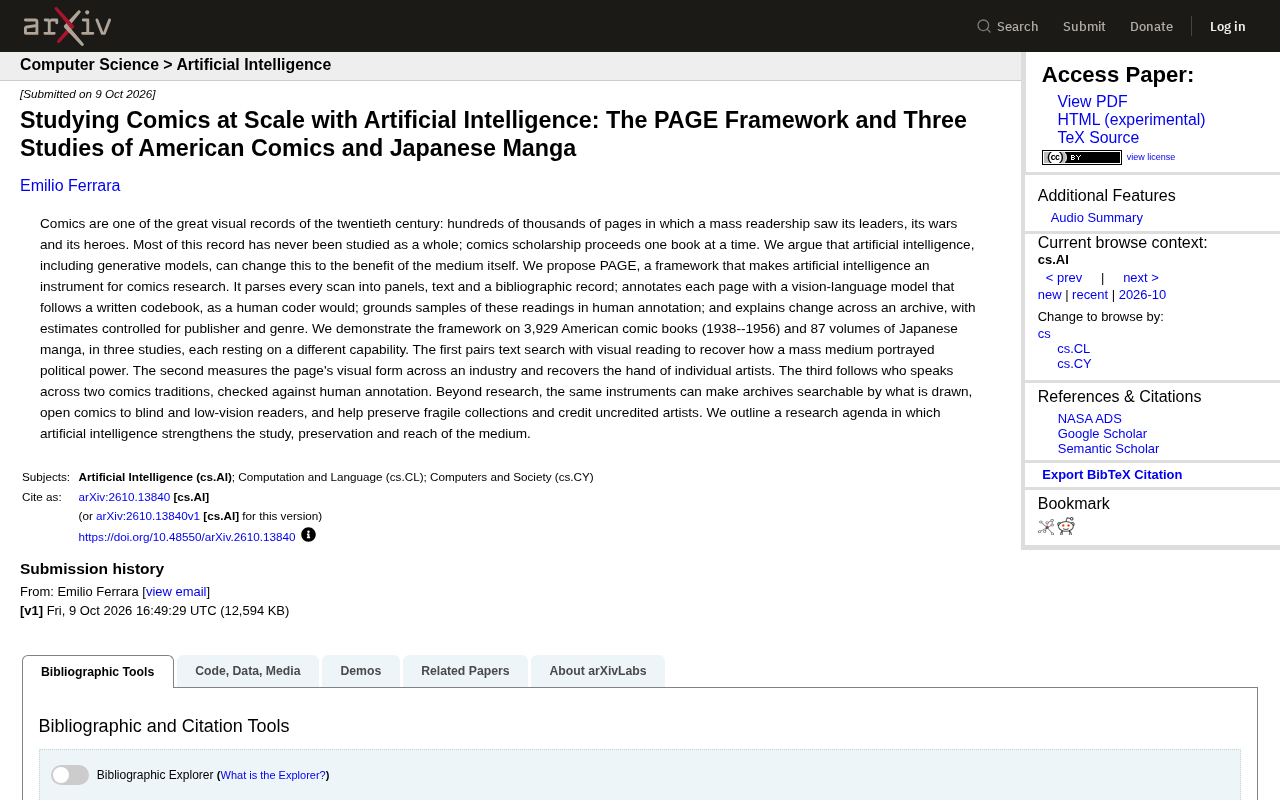
The PAGE Framework: From Scanned Pages to Interpretable Archival Analysis
The core idea behind PAGE is to transform each scanned comics page into structured, computable data. Its workflow consists of roughly four stages:
Parsing and Annotation
The framework first breaks each scanned page down into panels, text, and bibliographic records. It then uses a vision-language model (VLM) to annotate each page. Crucially, the model follows a written "codebook" — its annotation logic mirrors the work of a human coder rather than generating free-form descriptions.
A vision-language model (VLM) is a multimodal AI system capable of understanding both images and text simultaneously. Representative examples include GPT-4V, LLaVA, and Claude Vision. Unlike traditional image classification models, VLMs can perform open-ended description, question answering, or structured extraction based on natural language instructions. In the context of comics analysis, their strength lies in handling compound questions that require both visual context and semantic understanding — such as "Does this panel feature a figure representing authority?" or "Is the speaker male or female?" The codebook is a critical constraint: it locks the VLM's output to a predefined analytical framework designed by the researcher, preventing the model from improvising, and ensuring that annotations across different pages and batches remain comparable — a basic requirement for data consistency in humanities and social science research.
Human Grounding and Interpretability
To ensure reliability, the framework grounds a portion of AI readings against human annotations, using manually coded samples to validate the accuracy of machine judgments. Going further, it attempts to explain trends across the archive while controlling for factors such as publisher and genre — bringing the analysis closer to rigorous social science methodology rather than simple data description.
In the content analysis tradition of the social sciences, "inter-coder reliability" is the central metric for annotation quality, typically quantified using coefficients such as Cohen's Kappa or Krippendorff's Alpha. When PAGE replaces human coders with AI, it must meet the same standard: by comparing machine annotations against human-coded samples, researchers can estimate the AI's accuracy and directional bias on specific dimensions. "Controlling for publisher and genre" corresponds to the covariate control logic in regression analysis — for example, a rise in violent content during a given period might stem from a shift in genre composition (e.g., a higher proportion of war comics) rather than a broader change in editorial culture. Failing to distinguish between these would confound the conclusions. This kind of methodological design brings PAGE's findings closer to causal inference than mere correlation.
Three Empirical Studies: Validating Large-Scale Reading
The researchers demonstrated the framework on 3,929 American comics published between 1938 and 1956, as well as 87 volumes of Japanese manga, conducting three studies to validate different capability dimensions.
Study 1: How Political Power Is Depicted
The first study combined text search with visual reading to reconstruct how this mass medium portrayed political power. Keyword search alone cannot capture the attitudes and imagery conveyed through visuals; pairing textual retrieval with a "reading" of the panels reveals how the medium depicted power across different periods.
Study 2: Measuring the Visual Form of Pages
The second study measured the visual form of pages at the scale of an entire industry, attempting to identify "the hand of individual artists" — that is, recognizing specific creators through stylistic features. This has direct implications for restoring proper credit to uncredited artists.
Identifying artists through stylistic features is known in computational art history as "stylometric attribution" or the visual equivalent of "authorship attribution." The Golden Age of American comics (roughly 1938–1956, the period covered by PAGE) was characterized by assembly-line production: publishers employed large numbers of artists who were either uncredited or inconsistently credited, with penciling, inking, and coloring on a single page often completed by different people. As a result, the creative contributions of many artists remain formally undocumented to this day, and their copyright claims are accordingly obstructed. If AI can identify "the same pair of hands" through subtle stylistic cues — the rhythm of linework, panel composition habits, facial rendering — it could provide new technical grounds for revising historical archives and establishing copyright attribution.
Study 3: Who Gets to Speak
The third study tracked the distribution of "who speaks" across two comics traditions, using human annotations as a validation baseline. This kind of cross-cultural, cross-tradition comparison is precisely the perspective that single-volume research cannot achieve.
Beyond Research: Archives, Accessibility, and Preservation
Beyond academic research, this toolkit has broader applications:
- Making archives searchable by "what is depicted", rather than relying solely on textual metadata;
- Opening comics up to blind and low-vision readers through structured visual descriptions that improve accessibility;
- Helping preserve fragile collections and restoring proper attribution to uncredited artists.
These applications extend AI's role from a pure analytical engine to infrastructure that serves the medium itself.
A New Research Agenda
The value of this work lies not only in its three specific case studies, but in the research agenda it sketches out: using artificial intelligence to simultaneously strengthen comics as a medium across the three dimensions of research, preservation, and dissemination.
From a methodological standpoint, PAGE represents a mature form of collaboration between humanities research and AI — one that emphasizes the capacity for large-scale processing while insisting on human grounding and interpretability, and controlling for confounding variables such as publisher and genre. This orientation toward both "scale" and "rigor" offers lessons for other humanities and social science fields that rely on vast visual archives.
Of course, as a framework-level study, its annotation accuracy, generalizability across languages and cultures, and the biases that vision-language models themselves may introduce still require ongoing validation across larger and more diverse datasets. But it at least provides a clear paradigm: AI need not replace humanities researchers — it can instead become a tool that amplifies their vision.
Related articles

Chain of Thought Isn't Just for AI: How Humans Can Use CoT to Improve Thinking Quality
Chain of Thought isn't just a prompt trick for large models. Starting from a Hacker News discussion, this article analyzes why CoT works for human thinking too, breaks down actionable ways to transfer it, and highlights the key differences between human CoT and machine CoT.
Cloudflare Teams Up with OpenAI: Closi…
Cloudflare Teams Up with OpenAI: Closing the Loop from Vulnerability Discovery to Defense with AI
Cloudflare uses OpenAI Daybreak to investigate security vulnerabilities and generate reviewable remediation plans, while developers use Codex to boost coding efficiency and quality.

Orca Multi-Agent Orchestration in Practice: A Guide to Parallel Collaboration with Claude and Codex
Orca is Stable AI's free open-source agent workbench supporting 34 agents like Claude Code and Codex in parallel. Learn its Git worktree isolation, multi-model orchestration, and mobile management.