The PRIME Framework: How Multi-Threshold Neurons Achieve Near-Lossless ANN-to-SNN Conversion
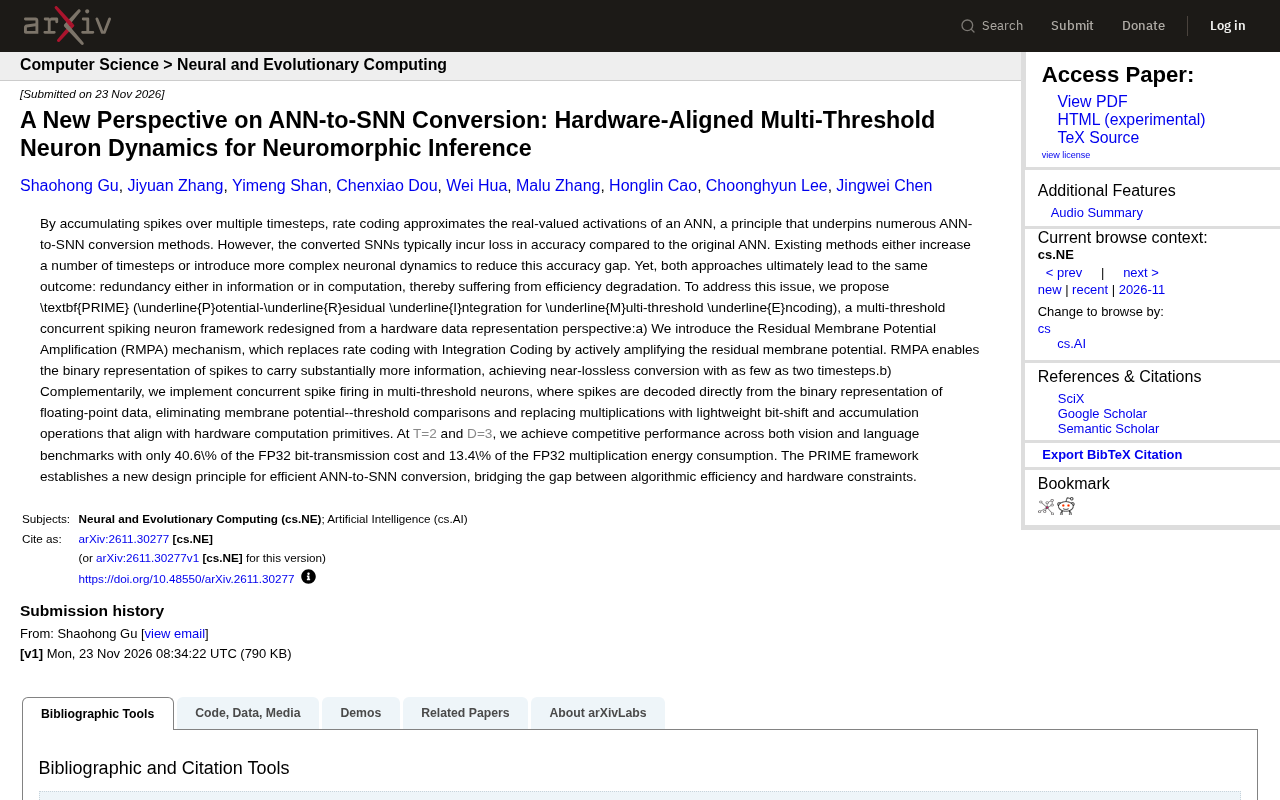
PRIME designs multi-threshold spiking neurons from hardware data representation, approaching lossless ANN-to-SNN conversion in two time steps.
The article introduces the PRIME framework, which redesigns ANN-to-SNN conversion from a hardware data representation perspective. Traditional conversion relies on rate coding, narrowing the accuracy gap by adding time steps or complicating neuron dynamics, but both bring information or computational redundancy. PRIME proposes two mechanisms: RMPA replaces rate coding with integral coding so spike binary representations carry more information, approaching lossless conversion in two time steps; multi-threshold concurrent spiking neurons decode spikes directly from floating-point binary, replacing multiplication with shift-and-add. Under T=2, D=3, PRIME performs competitively on vision and language benchmarks, with bit transmission cost only 40.6% of FP32 and multiplication energy at 13.4%, reflecting the design principle of aligning neuron dynamics with hardware constraints.
Spiking Neural Networks (SNNs) are often regarded as an ideal vehicle for low-power neuromorphic inference, but SNNs converted from Artificial Neural Networks (ANNs) often suffer from accuracy loss. Traditional approaches either stack more time steps or introduce more complex neuron dynamics to close the gap, at the cost of information or computational redundancy. A new paper proposes the PRIME framework, which takes a different angle: redesigning multi-threshold spiking neurons starting from hardware data representation, approaching lossless conversion with very few time steps.
The Conversion Accuracy Dilemma: More Time Steps or More Dynamics
Rate-coding-based ANN-to-SNN conversion works by accumulating spikes over multiple time steps and approximating the real-valued activations in the ANN using firing rates. This principle underpins a large number of conversion methods, but there is usually an accuracy gap between the converted SNN and the original ANN.
The paper points out that existing methods mainly rely on two approaches to narrow this gap: increasing the number of time steps, or introducing more complex neuron dynamics. Both ultimately lead to the same outcome—information redundancy or computational redundancy—resulting in reduced efficiency. More time steps mean higher inference latency and energy consumption; more complex dynamics mean higher hardware implementation costs. This means that patching things up purely at the algorithmic level makes it difficult to balance accuracy and efficiency simultaneously.
Rate Coding is the most commonly used information encoding scheme in SNNs: the firing rate of a neuron (number of spikes / number of time steps) within a given time window is interpreted as the activation strength of that neuron. Its advantage is that it can be mathematically mapped one-to-one to the real-valued activations in an ANN—an activation with a value of 0.7 in an ANN corresponds approximately to firing 7 spikes within 10 time steps in an SNN. This is also the theoretical basis on which ANN-to-SNN conversion methods rest: as long as there are enough time steps, the frequency approximation error tends toward zero. But the cost of rate coding is also direct—accuracy is proportional to the number of time steps, and each time step implies a complete hardware inference cycle, so latency and energy consumption grow linearly with accuracy requirements. This is precisely the fundamental bottleneck of the "stack more time steps" approach, and the reason PRIME attempts to bypass rate coding with integral coding.
PRIME's Core Idea: Deriving Neuron Design from Hardware Data Representation
The full name of PRIME is Potential-Residual Integration for Multi-threshold Encoding. Its starting point is not to improve the encoding algorithm itself, but to ask a more fundamental question: how hardware represents and transmits data determines how neurons should be designed.
This shift in perspective brings two concrete mechanisms: Residual Membrane Potential Amplification (RMPA) and concurrent spike firing. The former addresses "insufficient information capacity," while the latter addresses "computational mismatch"; together they form a multi-threshold concurrent spiking neuron framework.
Multi-threshold Neuron is an extension of the classic Integrate-and-Fire neuron. A traditional neuron has only one threshold: when the membrane potential exceeds it, the neuron fires a spike and resets. A multi-threshold neuron sets multiple thresholds, with different threshold regions corresponding to different spike output combinations, allowing a single neuron to express more than "0/1" information within a single time step. In the context of ANN-to-SNN conversion, the multi-threshold structure essentially maps the binary bits of a floating-point activation bit by bit to the trigger states of multiple thresholds, so that the spike firing pattern itself carries the bit-level precision of the activation value. Its hardware appeal lies in the fact that multi-threshold comparison can be implemented with a simple comparator array, and the concurrent multi-spike output naturally corresponds to a shift-and-add data path, without the need for additional serial time steps.
RMPA: Replacing Rate Coding with Integral Coding
The core action of the RMPA (Residual Membrane Potential Amplification) mechanism is to actively amplify the residual membrane potential, replacing rate coding with integral coding.
In traditional rate coding, a single spike carries only binary "yes or no" information, and expressing finer activation values requires accumulating multiple time steps. RMPA allows the binary representation of spikes to carry significantly more information, thereby achieving near-lossless conversion in as few as two time steps. In other words, accuracy no longer depends on repeated sampling along the time dimension, but on the information density encoded in a single firing event.
Integral Coding differs from rate coding in where the information is carried: rate coding places information in "how many times a neuron fires over a period of time," whereas integral coding places information in "how much the membrane potential has accumulated at the moment of firing." In integral coding, the residual membrane potential is not cleared and discarded but retained and involved in subsequent spike generation, so a single firing or a few firings can encode a high-precision value. An analogy helps: rate coding is like tallying proportions through multiple votes, while integral coding is like weighing an exact mass on a balance in one go. The reason RMPA can approach lossless conversion within a very short time window such as T=2 is precisely that the residual is amplified and participates in encoding, rather than being wasted at each reset as in traditional approaches.
Multi-Threshold Neurons: Decoding Spikes Directly from Floating-Point Binary
If RMPA addresses "how much information each spike can carry," then the concurrent firing of multi-threshold neurons addresses "how this information can be read out efficiently."
In PRIME, spikes are decoded directly from the binary representation of floating-point data, skipping the membrane potential versus threshold comparison process. At the same time, it replaces multiplication with lightweight shift and add operations—precisely the form that hardware computational primitives excel at. The multi-threshold structure allows multiple spikes to be fired concurrently rather than judged serially time step by time step.
The practical benefit of this design is reflected in resource overhead. The paper reports that under the configuration of T=2 and D=3, PRIME achieves competitive performance on both vision and language benchmarks, while requiring only 40.6% of the bit transmission cost of FP32 and only 13.4% of the multiplication energy consumption of FP32.
Shift-and-Add is a fundamental computational primitive in digital hardware: multiplying by a power of 2 is equivalent to shifting left by some number of bits, so the multiplication of two numbers can be decomposed into several shifts and additions, without the need for a dedicated multiplier. FP32 multiplication requires considerable area and energy on general-purpose hardware, whereas shift-and-add units are extremely small in area and highly energy-efficient. PRIME maps multiplication in SNNs to shift-and-add, precisely exploiting the structure that the binary representation of a floating-point number is itself "mantissa × 2^exponent"—after spikes are decoded from binary bits, weight multiplication degenerates into a shift operation determined by the exponent. This is also the source of the reported metric "multiplication energy consumption is only 13.4% of FP32": the energy savings do not come from approximation, but from the alignment of the computational form with the data representation.
Rebalancing Efficiency and Accuracy
The significance of PRIME goes beyond a set of metrics. It proposes a new design principle: ANN-to-SNN conversion should not only pursue finer approximations at the algorithmic level, but also align neuron dynamics with hardware constraints.
From the paper's exposition, this framework attempts to bridge the gap between algorithmic efficiency and hardware constraints. When spike encoding, threshold judgment, and multiplication can all be mapped to fundamental operations such as bit shifting and addition, the energy-efficiency advantages of neuromorphic inference have a chance to truly materialize. For readers interested in low-power inference and neuromorphic hardware, PRIME offers a direction worth following: treating hardware data representation as the starting point for algorithm design, rather than an object of after-the-fact adaptation.
One-line Summary
PRIME designs multi-threshold spiking neurons starting from hardware data representation, approaching lossless ANN-to-SNN conversion in two time steps.
Paragraph Summary
The article introduces the PRIME framework, a method for redesigning ANN-to-SNN conversion from the perspective of hardware data representation. Traditional conversion relies on rate coding, narrowing the accuracy gap by increasing time steps or complicating neuron dynamics, but both bring information or computational redundancy. PRIME proposes two major mechanisms: Residual Membrane Potential Amplification (RMPA) replaces rate coding with integral coding, allowing the binary representation of spikes to carry more information so that near-lossless conversion is possible in two time steps; multi-threshold concurrent spiking neurons decode spikes directly from floating-point binary and replace multiplication with shift-and-add. Under the T=2, D=3 configuration, PRIME performs competitively on vision and language benchmarks, with bit transmission cost only 40.6% of FP32 and multiplication energy consumption at 13.4%, embodying the design principle of aligning neuron dynamics with hardware constraints.
Related articles

Michael Nielsen Takes Down His Classic Neural Network Textbook, Sparking Community Discussion
Michael Nielsen's classic free textbook Neural Networks and Deep Learning has been taken offline, sparking discussion on Hacker News about the reasons and impact.

Inside the AI Training Data Market: The Trade-off Between Exclusivity and Discounts
G2i founder Gabe Greenberg reveals the dual-track pricing of the AI training data market: labs pay a premium for exclusive data or accept discounts that allow others to buy it.

SessionGraph: Unifying All Coding Agent Sessions in One Interactive Graph
SessionGraph aggregates coding agent sessions into an interactive graph, helping developers review, debug, and manage AI coding workflows across sessions. This article examines its positioning, value, and open questions.