The pump.fun Fake Sponsorship Scam: How Open Source Maintainers Can Identify and Respond

pump.fun fake sponsorship scam exploits open source maintainers' reputation to launch memecoins that fleece retail traders.
A new scam targeting open source maintainers uses fake sponsorship emails to lure them into pump.fun memecoin schemes. The "sponsorship" money comes from trading fees on tokens named after their projects — essentially profiting from retail investors' losses. Even though the payments are real, maintainers risk permanent reputational damage on the immutable blockchain. The article details how the scam works and offers practical advice for maintainers to protect themselves and their communities.
A Scam Hiding Behind a "Sponsorship Email"
Receiving corporate sponsorship emails is routine for open source project maintainers, but a new type of "sponsorship" has been quietly infiltrating the community. Disguised as open source support, it's actually bait for cryptocurrency speculation.
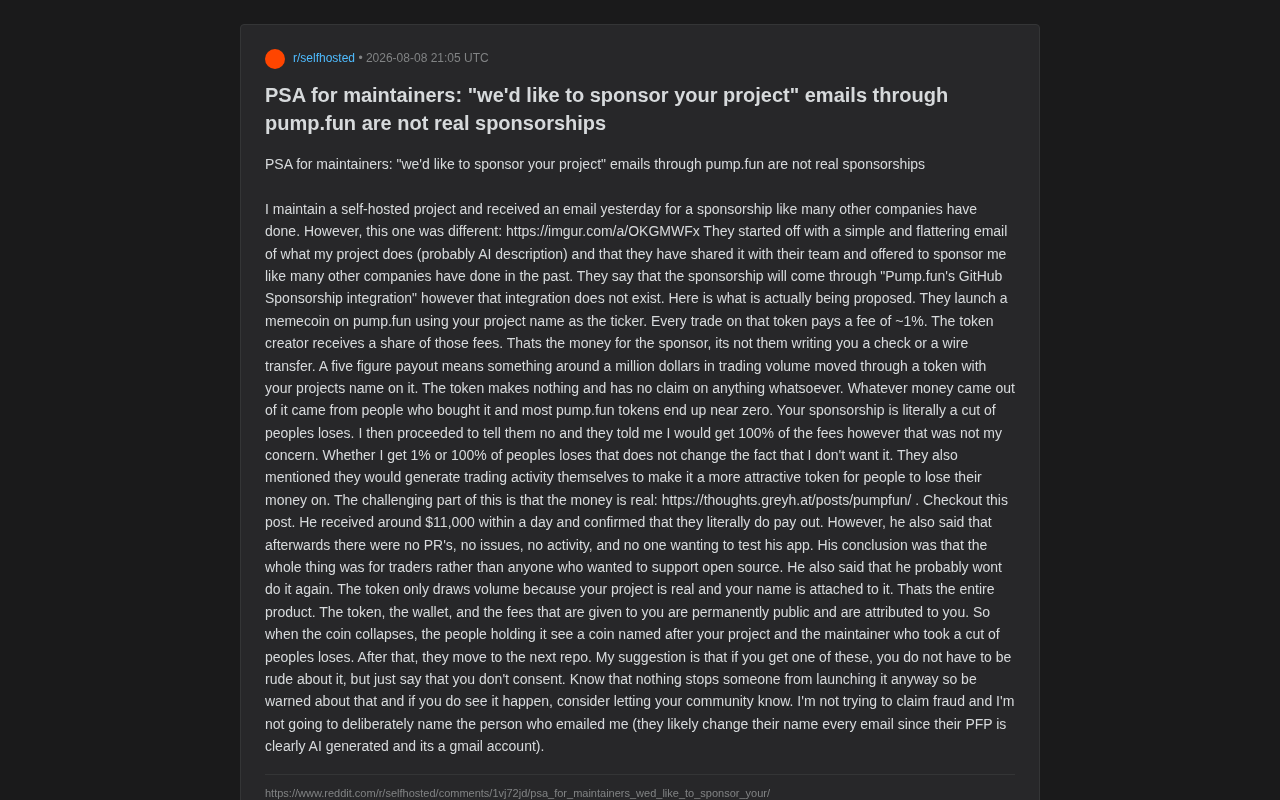
According to a post by a self-hosted project maintainer on Reddit, he received what appeared to be an ordinary sponsorship email. It opened with the usual praise for his project (most likely AI-generated), claimed to have shared it with their team, and offered sponsorship just as many companies have done in the past. Everything sounded normal — until the sender mentioned that sponsorship would be distributed through "Pump.fun's GitHub Sponsorship integration."
The problem is, this so-called integration doesn't exist.
It's worth noting that legitimate sponsorship channels for open source projects currently include GitHub Sponsors, Open Collective, Patreon, and direct corporate sponsorship agreements. GitHub Sponsors launched in 2019, allowing individuals and organizations to directly fund open source maintainers with zero platform fees. However, according to a 2023 survey, over 60% of critical open source project maintainers receive less than $1,000 in annual sponsorship. This chronic underfunding means maintainers naturally lack vigilance when faced with any seemingly generous sponsorship offer — and this is precisely the structural vulnerability that these new scams exploit.
How the pump.fun "Sponsorship" Actually Works
Strip away the rhetoric, and here's what's really happening: the other party issues a memecoin on the pump.fun platform using your project's name as the token ticker.
To understand the technical foundation of this scam, you need to know about Pump.fun. Pump.fun is a memecoin launch platform that exploded in popularity on the Solana blockchain in early 2024. It reduced the barrier to token creation to virtually zero — anyone can issue a new token with just a few clicks, no smart contract coding required, no audits, no technical background needed. The platform uses a bonding curve pricing mechanism where token prices automatically rise with buying volume and fall with selling volume. Statistics show that over 95% of tokens launched on Pump.fun eventually go to zero, with the vast majority having a lifespan of less than 24 hours. At peak activity, tens of thousands of new tokens are created daily with total trading volume reaching billions of dollars, making it one of the most controversial pieces of infrastructure in the crypto speculation ecosystem.
Memecoins themselves are a class of cryptocurrency with no fundamental value backing. Their worth depends entirely on community hype, narrative, and speculative sentiment. From the early Dogecoin to Shiba Inu to the millions of micro-memecoins that emerged in 2024, these assets are essentially zero-sum games — early buyers' profits come entirely from the capital invested by later participants.
Where the So-Called Sponsorship Money Comes From
Each transaction of the token incurs approximately a 1% fee, and the token creator receives a share of these fees — this is the actual source of the so-called "sponsorship." It's not a check written by the other party, nor a bank wire transfer. Pump.fun's fee mechanism is core to its business model: this design means creators don't need the token to appreciate in value to profit — they just need sufficient trading volume. This model incentivizes creators to constantly generate buzz and gimmicks to attract trading activity, and a real, community-backed open source project is precisely the best "buzz material."
In other words, a "five-figure" sponsorship means approximately one million dollars in trading volume flowed through a token named after your project. The token itself creates no value and has no claim on any assets. All the money flowing out of it comes from those who bought in — and the vast majority of pump.fun tokens eventually go to zero.
The maintainer hit the nail on the head: your "sponsorship" is essentially a cut of other people's losses.
Refusing Doesn't Stop Them From Launching the Token
When he explicitly declined, the other party immediately upped the ante, offering him 100% of the fees. But that was never the point — whether the cut is 1% or 100%, it doesn't change the fact that the money comes from others' losses. Even more disturbing, they mentioned they would personally generate trading activity to make the token "more attractive," thereby luring more people into losing money.
This "generating trading activity" is known in the crypto space as wash trading — where a single entity repeatedly buys and sells the same asset through multiple wallets, artificially creating the illusion of trading volume to make outside observers believe the token has genuine market demand and liquidity.
"The Money Is Real" — And That's Precisely the Biggest Trap
The trickiest part of this scam is: the money actually does arrive.
Blogger greyh.at documented the complete experience on his blog. He received approximately $11,000 within a day of accepting, confirming that the other party does indeed pay. But what happened afterward? No Pull Requests, no Issues, no activity of any kind, and nobody wanting to test his application.
His conclusion was clear: The whole thing serves traders, not anyone who genuinely wants to support open source. He also stated he "probably won't do it a second time."
Your Name and Reputation Are the Only Product
Here lies the most insidious logic: the only reason the token attracts trading volume is because your project genuinely exists and your name is attached to it. Your reputation is the scam's entire product.
The token, wallet addresses, and fees paid to you are all permanently public and attributed to you. One of blockchain's core characteristics is that all transaction records are permanently public and immutable. On-chain analysis tools like Etherscan, Solscan, and Arkham Intelligence can easily trace fund flows and associate wallet addresses with real identities. For open source maintainers, this transparency means that even if you later realize the problem and stop participating, the historical record remains clearly visible and could be dug up at any future moment as evidence to question your professional credibility.
So when the coin crashes to zero, holders see a token named after your project and a maintainer who took a cut from their losses. Then the operator moves on to the next repository and repeats the playbook.
How Open Source Maintainers Should Respond to pump.fun Fake Sponsorships
Facing these emails, the original poster offered several pragmatic suggestions:
- No need to be rude, but be explicit: Simply tell them "I don't consent."
- Be aware of unauthorized token launches: Recognize clearly that no mechanism exists to prevent them from launching a token without your consent.
- Proactively notify your community: If you discover someone has actually launched a token in your project's name, consider promptly informing your community so users are aware.
One detail worth noting: these emails are often difficult to trace. The poster mentioned that the sender's avatar was obviously AI-generated, they used a Gmail account, and likely changed their name with each email. He also carefully noted that he wasn't accusing anyone of fraud nor intended to publicly identify the sender.
It's worth highlighting the role AI plays in social engineering attacks here. Current large language models can generate highly personalized phishing emails, automatically analyzing a target project's README, documentation, and commit history to craft seemingly sincere and specific praise. Meanwhile, AI image generation tools (such as Stable Diffusion, Midjourney) can batch-produce realistic profile photos, making fake identities harder to identify. This "personalization at scale" capability allows attackers to simultaneously send customized bait emails to hundreds or even thousands of maintainers, dramatically improving hit rates while reducing the marginal cost per attack.
The Open Source Ecosystem Needs New Defensive Awareness
This phenomenon reflects a deeper issue: the reputation and trust of open source projects are becoming assets that crypto speculators view as arbitrageable. Traditional sponsorship models are built on the foundation of "supporters genuinely recognizing project value," while this pump.fun-style operation turns maintainers' credibility into a tool for harvesting retail investors.
For maintainers, this isn't simply a matter of "rejecting spam" — it's a battle to defend personal brand and community trust. Once your name is linked to a crashed memecoin, whether you knew about it or profited from it, the damage can be real and lasting.
In an era of increasingly pervasive AI-generated content and crypto speculation, the open source community may need to establish clearer public awareness: genuine sponsorship never requires issuing a token to "monetize" your reputation. When someone tells you "the money is real," the most important question to ask is — whose losses does this money come from?
Key Takeaways
Related articles
ChatGPT Space Launches: Team Collaboration and New Pages Features Explained
ChatGPT Space is OpenAI's new team collaboration feature with Pages, real-time collaboration, and Slack/Google Drive sync. We break down its privacy design, multi-platform integration, and the full workflow from conversation to document.

Migrating Apache Spark UDFs to GPU Acceleration with AI Agents
NVIDIA developer blog explains how AI Agents rewrite Apache Spark UDFs for GPU acceleration, covering migration criteria, agent rewriting and verification workflows, plus pitfalls like result consistency and CPU-GPU transfer overhead.
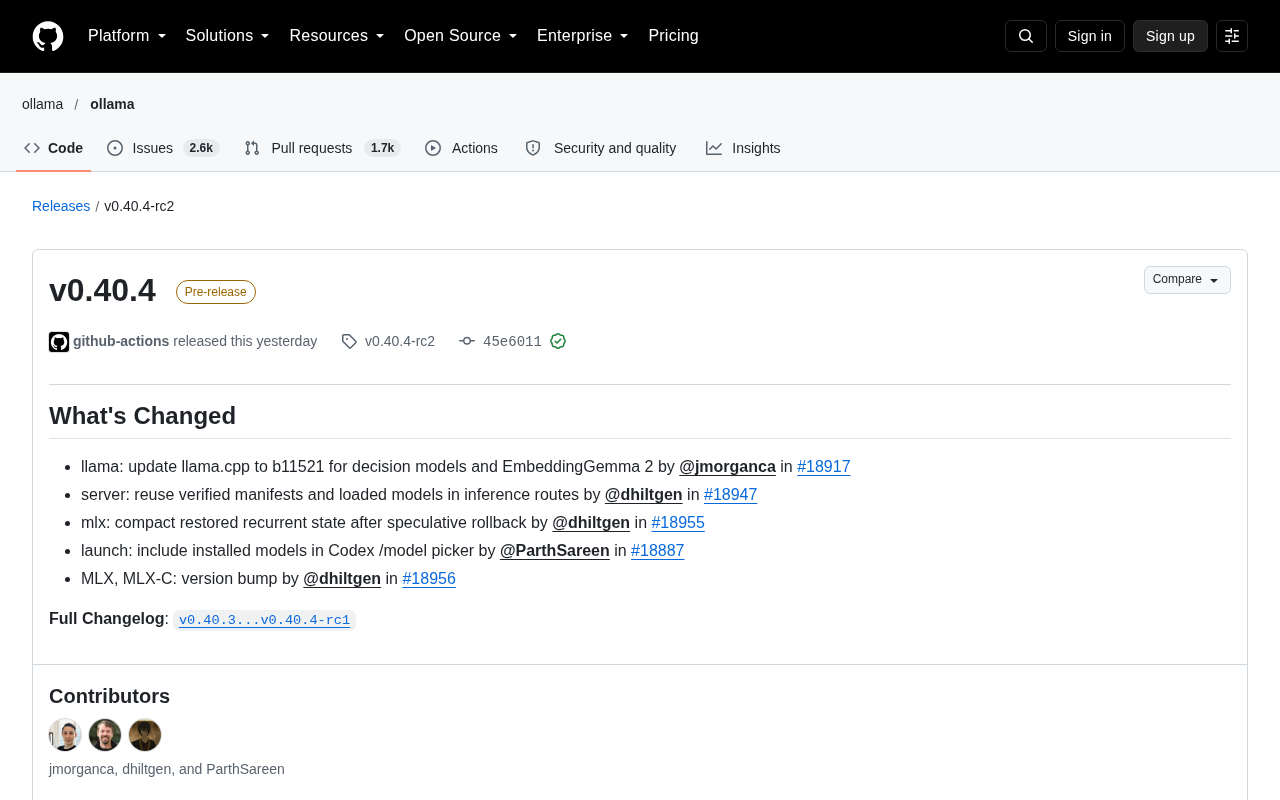
Zed Editor v0.40.4-rc2 Released: Usage Credits Now Available Without Upgrading
Zed editor releases v0.40.4-rc2, allowing users to use usage credits for AI features without upgrading to a paid plan, lowering the trial barrier.