The Real AI Startup Opportunity: Helping Businesses Actually Use AI

Help businesses deploy AI as a one-person company — the supply gap is real and the policy tailwinds are here.
The article argues that solo entrepreneurs can now leverage OPC (One Person Company) policies and mature AI tooling to build lean, full-cycle businesses at minimal cost. The biggest opportunity is enterprise AI deployment: three signals — OpenAI acquiring a consulting firm, exploding demand for FD roles, and DeepSeek hiring for Harness positions — all point to the same gap: models are available, but people who can integrate them into real business workflows and prove ROI are scarce. Big tech will chase big clients, leaving niche verticals wide open. The recommended approach is a three-layer service model (0→30 education, 30→80 coaching, 80+ delivery guarantee) with outcome-based pricing of 20–30% of measurable gains.
One Person, One Company: OPC Is Being Pushed Forward by Policy
The government is paving the way for solo entrepreneurs. According to the video creator, Beijing has launched a pilot OPC (One Person Company) program, with Hangzhou quickly following by committing roughly 1 billion RMB in support funding. The signal is clear: individuals can now run a legitimate limited liability company — not just register as a sole trader.
The core logic of OPC is "one person plus AI running the full business loop." The chain of build → distribute → collect payment only needs to work once before it can run on near-autopilot. The creator argues this model is especially suited to people with a marketable skill, the discipline to manage their own time, and the ability to take on freelance work — no coding expertise required.
In terms of verticals, any business that can be delivered remotely — knowledge products, e-commerce operations, design, consulting — is a candidate for the "one person + AI" model. For tooling, the recommended stack is: Claude for content, GPT for development, Cursor for coding, and N8N for automation, keeping the total monthly cost under 500 RMB.

Importantly, the creator does not encourage quitting your job on impulse. The advice is to treat OPC as a second income stream first — learning and building during evenings and weekends — and only consider going full-time once the model has been validated. That's a grounded way to start.
At the legal level, the key difference between an OPC (One Person Company) and a standard limited liability company comes down to shareholder count: traditional LLCs in China require at least two shareholders, while an OPC allows a single individual to serve simultaneously as the sole shareholder and legal representative. The 2023 revision of China's Company Law formally recognized this structure, giving solo founders "limited liability" protection — meaning personal assets are in principle shielded from company debts, so startup risk doesn't bleed into personal finances.
Compared to sole proprietorships, OPCs carry more credibility in commercial contexts: signing B2B contracts, issuing VAT invoices, applying for government subsidies, securing bank credit, or meeting procurement thresholds all become more accessible. On top of that, incentive policies rolled out across multiple cities — deferred registered capital, social insurance fee reductions, office space subsidies — further lower the fixed cost of going solo, making a lean "validate first, scale later" approach structurally viable.
Three External Signals: Models Are Ready, but Enterprises Can't Deploy Them
If OPC answers "how to start a company," the more important question is "what to do." The creator's thesis is that helping enterprises deploy AI may be the single largest opportunity right now. This conclusion rests on three external signals.
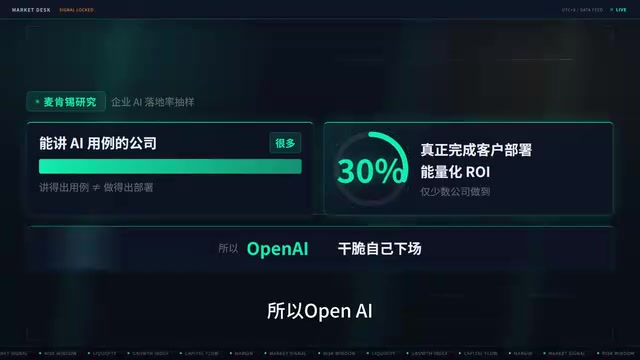
Signal one: On May 11, OpenAI agreed to acquire an AI consulting and engineering firm called Tomorrow. This means model companies are getting directly into enterprise deployment. The reason: no matter how capable a model is, if it never makes it into a company's real business workflows, it generates no actual business value. The creator cites McKinsey research to back this up — plenty of firms can explain how to use AI, but only about 30% have actually completed client deployments with quantifiable ROI.
Signal two: AI deployment roles (referred to in the video as FD roles) are exploding in demand — not just in Silicon Valley, but domestically too, with Xuhui District in Shanghai even running dedicated training programs. The creator describes these roles as "AI deployment specialists" — a combination of technical ability, business acumen, and delivery execution in one. The fact that local government is stepping in to train people is itself evidence of how thin the talent supply is.
Signal three: DeepSeekAd has started hiring for Harness-focused positions. These roles aren't about making models smarter — they're about making models produce reliable output inside real business environments.
Three different threads, one conclusion: a model is just an engine. The real value lies in installing that engine into a working business system. The defining challenge of AI's next phase isn't model capability — it's enterprise deployment capability.
FD roles (Field Deployment / Functional Deployment) is an umbrella term in the AI industry for on-site deployment engineers or business integration specialists — the exact title varies by company, but the core responsibilities are consistent: completing AI system integration, debugging, and outcome validation within a client's real business environment. These roles require understanding both model APIs and prompt engineering on one side, and the client's business processes and data structures on the other — plus the ability to explain ROI to non-technical decision-makers. Traditional IT implementation consultants are process-heavy; traditional ML engineers are model-heavy. FD roles demand both, with an added "translation layer" responsibility: converting model capabilities into business language, and converting business pain points into executable technical solutions. This compound requirement makes qualified candidates extremely rare, which is exactly why government agencies are organizing targeted training programs.
Harness-focused roles follow the same logic — their emphasis is on wiring large models into a company's existing workflows and data pipelines, solving for stability, access control, and audit trails in production environments, rather than benchmarking a model's intelligence ceiling. Both role types point to the same industry gap: model supply is now relatively abundant, but the talent and services needed to connect those models to real business operations and keep them running reliably are severely scarce.
Why Big Tech Can't Crush This Market
A common fear is that large tech companies will enter the enterprise AI deployment space and squeeze everyone else out. The creator's view is that this concern is overblown — the market is simply too large and the pie too divisible.
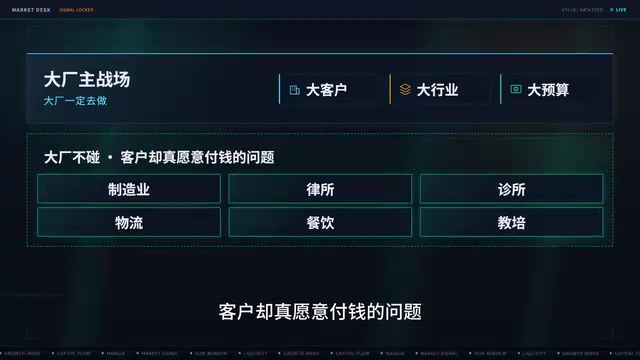
Large companies will go after large clients, large industries, and large budgets. But there are countless niche verticals and niche use cases that big tech won't bother with — and where clients are genuinely willing to pay. Find a segment you know well that big players don't care about, and you have a foothold. The creator even makes a bold claim: every single industry deserves to be rebuilt from scratch with AI-native thinking.
There's another reason now is a good time: market education has already happened. After years of knowledge-product courses and AI hype cycles, business owners have sat through the lectures. They've heard "AI will change everything" more times than they can count, and the anxiety is real. But here's the turning point: they will no longer pay for well-packaged truisms. Selling courses or selling fear doesn't work anymore. What owners actually need is someone who will walk into their business and help them use AI for real.
In other words: demand exists, willingness to pay has been validated by the market — the only missing piece is supply.
The Double Dividend: Supply Vacuum + Asset-Light Operations
The creator uses a few numbers to illustrate the market size: China has approximately 189 million registered business entities, with over 60 million small and medium-sized enterprises. That many verticals across that many businesses points to two conclusions.
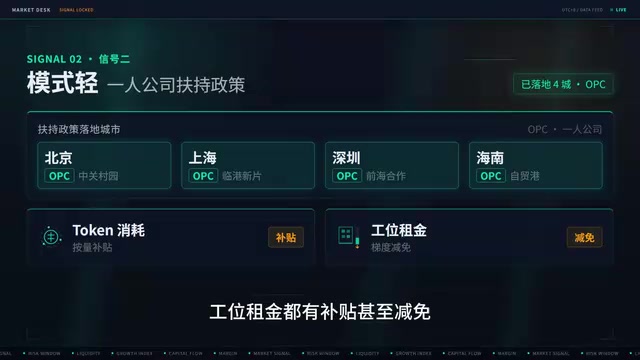
First, it's easy to get started. AI enthusiasm is high, and even the most skeptical business owners have tried something like Doubao. What they haven't seen is a live demonstration inside their own workflow. Second, the model is light. Beijing, Shanghai, Shenzhen, and Hainan all have support policies for one-person companies — token costs, social insurance, rent — with subsidies or waivers available.
More importantly, there's a compounding effect. Each project you complete becomes a reusable asset. As that experience compounds, efficiency rises sharply — making this a business that gets lighter the more you do it.
From Selling Anxiety to Selling Results: A Three-Layer Service Model
The creator wraps up with a concrete service methodology, broken into three layers of client value creation.
Layer one: 0 to 30. Help the client understand what AI-native actually means — take a business owner who's curious but unclear and make them genuinely understand what AI can do. This layer solves their understanding.
Layer two: 30 to 80, coaching alongside. Work with the client to address real bottlenecks in their operations and find genuine cost savings or efficiency gains — while you're learning their business model and profit drivers in the process. This layer is about your understanding of them.
Layer three: 80 and above, underwriting the outcome. When the coaching phase hits a wall neither of you can break through, you roll up your sleeves and deliver it yourself — giving the client a guaranteed, measurable result. That's mutual value creation.
On pricing, the creator recommends charging 20–30% of the cost savings or efficiency gains delivered, with adjustments based on project specifics. The fundamental shift is from the knowledge-product era's "sell anxiety" model to a "sell results" model — embedding AI into a client's business, and potentially using AI to reshape the entire business model entirely.
"Charging 20–30% of measurable cost savings or efficiency gains" is fundamentally a risk-sharing, outcome-based pricing model — well-established in management consulting. The logic: by linking your fee to the client's quantifiable benefit, you lower the decision barrier. Clients don't need to pre-judge your capabilities; they just need to decide whether the revenue-share percentage is fair.
Two practical considerations: First, define the measurement baseline together with the client before the project kicks off — hours of manual labor, error rates, cost-per-acquisition, etc. — to prevent disputes at delivery. Second, the share percentage should flex with project complexity and timeline. For situations where existing solutions can be reused quickly, you can push the percentage higher; for deep transformation projects requiring long-term coaching, consider milestone-based payments to protect cash flow. A useful side effect of this pricing structure is that it forces you to rigorously assess feasibility before taking on a project — naturally filtering out engagements where ROI can't be clearly defined.
Closing: Find the Track That's Yours
The value of this framework is that it builds a high-ticket, compounding, reputation-driven business — not a one-and-done transaction. For individuals looking for their opening in the AI era, OPC combined with enterprise AI deployment offers a path with manageable barriers to entry, policy tailwinds, and validated demand.
That said, readers should independently verify the specific policy details and acquisition events mentioned in the source video before making any decisions. The real opportunities tend to hide in the niches no one has fully worked through yet — and the only way to find yours is to go run the loop once.
Related articles

Workbuddy for Absolute Beginners: How a Desktop AI Agent Fits Into Real Workflows
A beginner's guide to the Workbuddy desktop AI agent: installation, claiming credits, file management, and building automated workflows—compared with CodeX for fit and cost, helping professionals shift from AI question-askers to AI managers.

OpenAI's New Agent Stack: Computer Use, Decisions API, and Ultra-Fast Workflows
OpenAI Dev Day unveiled a new agent stack: Computer Use outperforms humans, Decisions API delivers ultra-low-latency classification via Luna, Agents API opens the same Computer Use capabilities, and GPT-6.1 Sol costs only one-seventh of Astra. Core updates, benchmark data, and developer insights.

Liang Wenfeng Open-Sources DeepInfo Inference Framework, Takes On U.S. Ban
DeepSeek open-sources its DeepInfo inference framework after its models, featuring GPU/CPU cross-pipelining, small-model prediction with large-model verification, and full Huawei Ascend and NVIDIA chip support—facing the U.S. federal ban head-on. This article analyzes its significance for AI deployment and open-source strategy.