The Real Bottleneck for AI Adoption: Context Engineering, Not Model Capability

The bottleneck for AI adoption isn't model capability—it's context engineering.
Most people find AI to be a gimmick because they give it zero context. This article uses three real business scenarios—meeting follow-ups, KPI tracking, and content production—to reveal how context engineering transforms Claude from a hallucinating toy into an operations partner that saves 5-10 hours a week.
When Everyone Talks About AI Writing Code, the Real Pain Point Gets Ignored
Open X or LinkedIn and you'll see countless posts exclaiming "Claude killed Figma" or "Claude replaced Oracle." But one Reddit user made an intriguing observation: aside from the developer community using it to ship code faster, few people actually discuss how to use Claude for those "boring yet genuinely business-critical" day-to-day operational tasks.
Behind this lies a deeper question—why do most people feel AI is just a gimmick, or that it constantly "hallucinates"? The answer often isn't in the model itself, but in how it's being used.
What is AI hallucination? LLMs (large language models) are fundamentally probabilistic prediction systems—they predict the next most likely token based on statistical patterns in their training data, rather than retrieving answers from a factual database. When the input context is thin, the model lacks the "anchors" to ground itself in real information and can only rely on its general training distribution to generate content that looks fluent but may be distorted. This explains why the same model performs so differently across use cases—hallucination isn't a random glitch, but the inevitable result of low-quality context input.
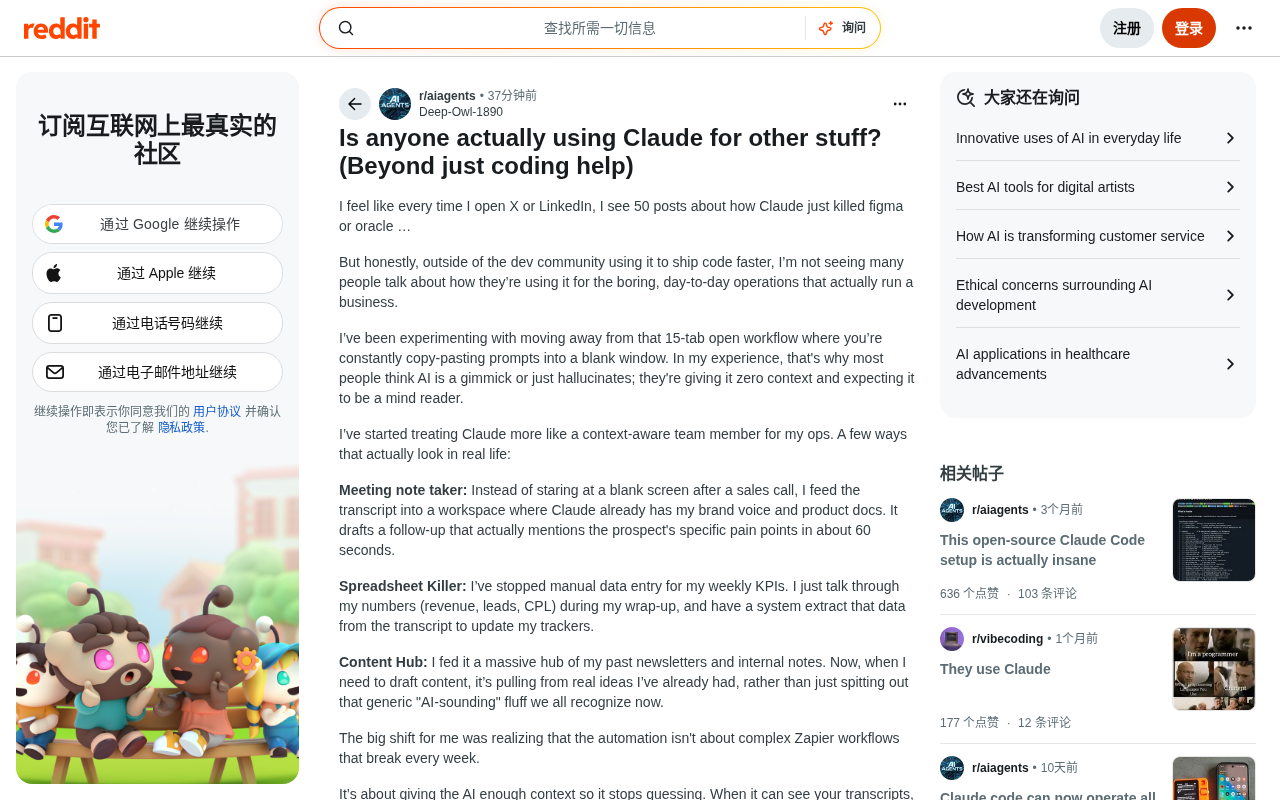
This founder's core insight is: people are accustomed to a workflow of "keeping 15 tabs open and constantly copy-pasting prompts into a blank window." In this mode, you give the AI almost zero context yet expect it to output with mind-reading precision. Disappointment is the natural result.
From "Blank Window" to "Context-Aware Team Member"
The most valuable shift in this discussion is repositioning Claude from a "one-off Q&A tool" to a team member who understands your business context. When the AI can simultaneously see your meeting notes, product documentation, and brand voice, it truly moves from "guessing" to "understanding."
The following three scenarios—already running in real businesses—are worth breaking down one by one.
Scenario One: Auto-Generating Meeting Notes and Follow-Up Emails
After a sales call ends, instead of staring at a blank screen, feed the call transcript into a workspace pre-loaded with your brand voice and product documentation. Claude can draft a follow-up email in about 60 seconds—and this email will specifically reference the pain points the prospect mentioned during the call, rather than generic, cookie-cutter template language.
The key is "pre-loaded context": brand voice and product materials aren't pasted in ad hoc each time, but permanently reside in the workspace, so every generation is built on real business context.
Scenario Two: Replacing Manual KPI Tracking with Voice Input
This approach is called the "spreadsheet killer." Instead of manually entering key weekly metrics, you verbally run through the numbers during your work recap—revenue, lead count, cost per lead (CPL)—and the system automatically extracts the data from the transcript and updates the tracking sheet.
What is CPL? CPL (Cost Per Lead) is a core metric in digital marketing for measuring acquisition efficiency, calculated as total marketing spend divided by the number of valid leads acquired. For early-stage startups, CPL ranks alongside revenue and lead count as one of the most critical growth-health metrics. Manually entering this kind of data is not only time-consuming but also introduces errors through human handling, distorting the basis for decisions. The voice transcription + AI extraction approach essentially shifts "data collection" from filling out structured forms to unstructured natural language processing, eliminating the operational step most prone to both procrastination and error.
Scenario Three: A Content Production Hub Based on Real Ideas
Consolidate all your past newsletters and internal notes into a single content hub. When you need to draft new content, Claude pulls material from the creator's own real ideas from the past, rather than churning out the kind of hollow, instantly recognizable "AI-flavored" content.
This point is especially important: it directly addresses the most criticized problem with AI-generated content—homogenization. The root cause of AI content homogenization is that when everyone uses the same base model with highly similar prompts, the output naturally gravitates toward the highest-frequency expression patterns in the training data—i.e., "the most average voice." Building the creator's own historical content and internal notes into a private knowledge base (i.e., retrieval-augmented generation, or RAG), so the model prioritizes extracting information from these unique materials during generation, fundamentally changes the "DNA" of the generated content. When the model's input is your unique knowledge assets, the output naturally carries your intellectual fingerprint.
True Automation Doesn't Rely on Complex Multi-Tool Workflows
Here's a counterintuitive conclusion: the core of automation isn't building those complex Zapier workflows that break every week.
Why do Zapier workflows break so easily? No-code automation platforms like Zapier connect thousands of SaaS tools through a "trigger-action" model, but multi-step workflows have inherent fragility: any API change, authentication failure, or data format shift at an intermediate node can cause the entire chain to fail silently. For non-technical founders, the cost of debugging these distributed failures is extremely high. This is also the core reason why "feeding concentrated context to a single powerful model" is often more sustainable in practice than building complex automation pipelines.
The real leverage lies in giving the AI enough context so it stops guessing. Only when it can see your transcripts, documents, and voice all in one place can it deliver real value for the business functions that "depend on the founder personally." And it's precisely these functions that tend to trap founders in daily minutiae, unable to break free.
This also echoes a general pattern in current AI adoption: model capability has long been sufficient, and the bottleneck often lies in Context Engineering. Context engineering refers to the systematic design, management, and optimization of the information structure fed into AI models to maximize output quality—it spans prompt design, document preprocessing, knowledge base retrieval, memory persistence, and more. Compared to "prompt engineering," context engineering focuses more on the long-term accumulation and dynamic injection of information, rather than single-conversation techniques. As model capabilities approach their ceiling, context engineering is becoming the core variable that differentiates AI adoption outcomes. The same Claude is a "hallucinating toy" with zero context, but a "operations partner that saves 5-10 hours a week" with sufficient context.
Four Practical Takeaways for Founders and Knowledge Workers
These frontline lessons distill into several immediately actionable recommendations:
- Don't use AI like a search engine. Throwing out a question once and expecting a perfect answer is the least efficient way to use it.
- Invest in context persistence. Accumulate your brand voice, product documentation, and historical content into reusable workspaces, rather than pasting them in ad hoc each time.
- Start with "boring but high-frequency" tasks. Meeting notes, data entry, content drafts—these unsexy but daily time-consuming steps are precisely the highest-ROI automation entry points.
- Beware of over-engineering. Rather than building fragile multi-tool automation chains, first feed a single powerful model with ample context.
A question worth serious reflection for every reader: what have you built in your real business that genuinely saves you time every week? Amid all the noise about AI disrupting industries, the answer may well be hidden in the most unremarkable daily operational tasks.
Key Takeaways
Related articles

Code with Claude Event: AI-Powered Creative Experiments on Tiny Computers
At Code with Claude, Anthropic gave participants tiny computers to build creative projects with AI assistance, showcasing how AI coding tools empower the maker community.
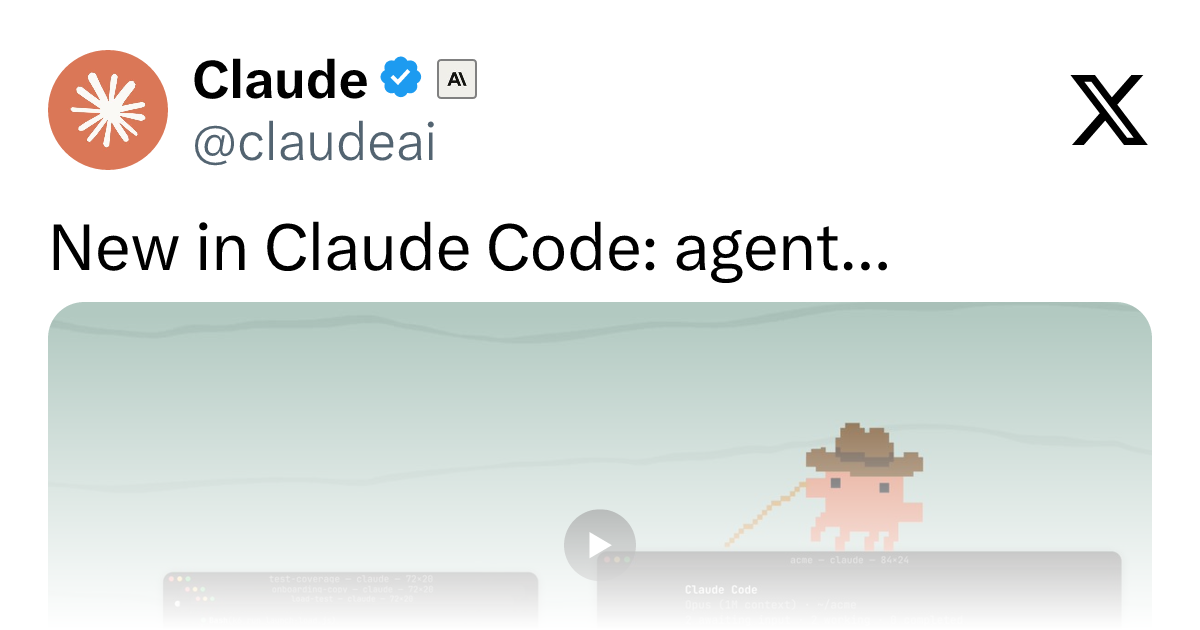
Claude Code Adds Agent View: A Research Preview for Unified Session Management
Claude Code's new Agent View feature (research preview) consolidates all coding sessions into a unified list, advancing AI tools toward multi-agent orchestration.
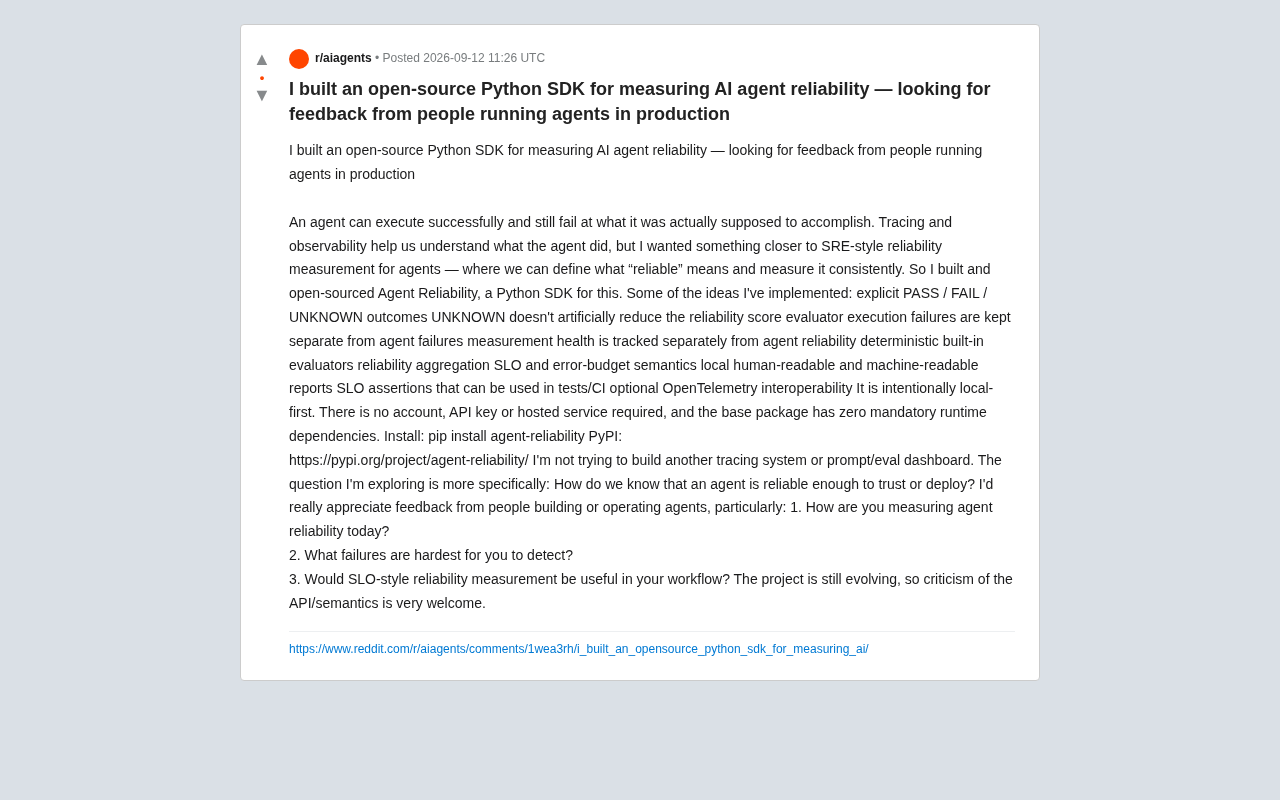
Open-Source Python SDK: Measuring AI Agent Reliability with SRE Principles
Agent Reliability is an open-source Python SDK that applies SRE's SLO and error budget concepts to AI Agent evaluation, with PASS/FAIL/UNKNOWN states, CI assertions, and zero forced dependencies.