The Real Bottleneck for Coding Agents: Human-AI Collaboration, Not Benchmark Scores
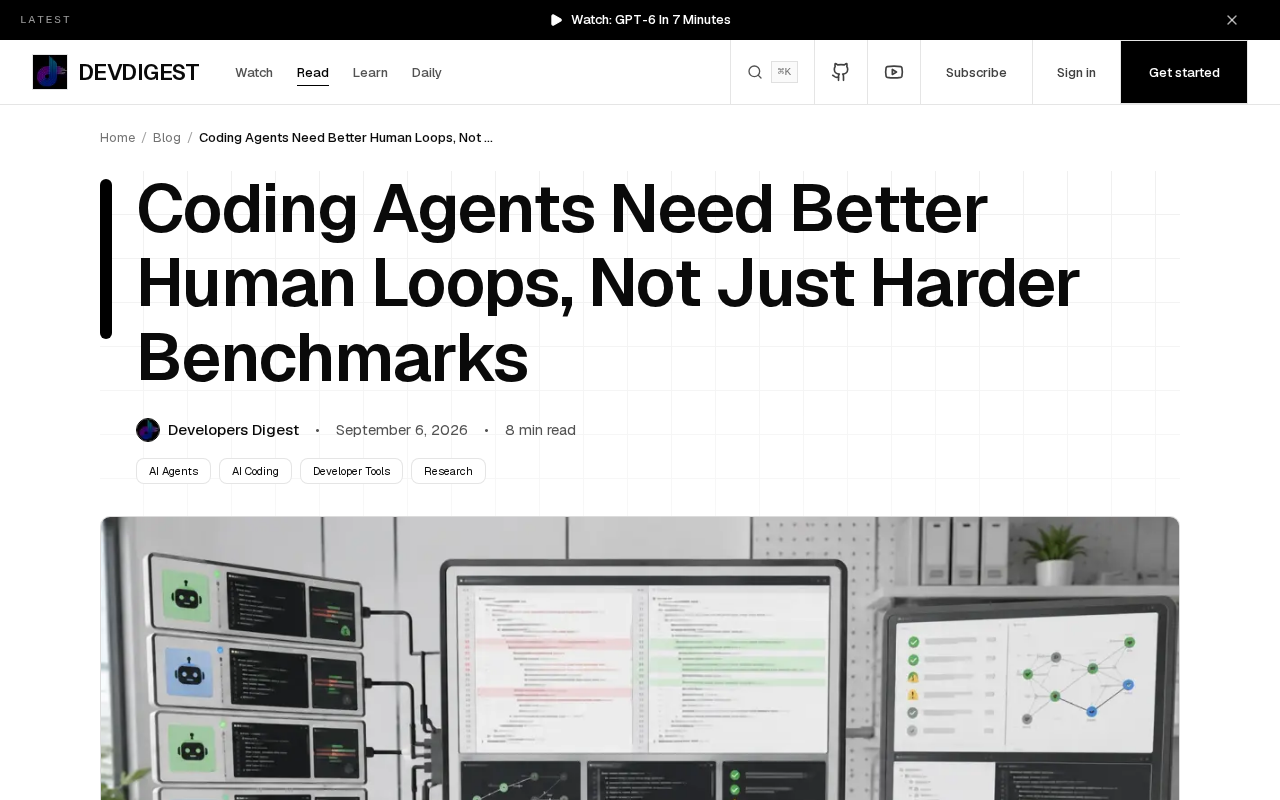
Why human-AI collaboration, not benchmark scores, is the true bottleneck for coding agents
Current AI coding agent research over-optimizes autonomous capability while overlooking the real bottleneck: how developers steer, verify, and adapt these agents in practice. This article examines three core collaboration challenges and argues that next-generation tools need better Human-in-the-loop mechanisms rather than harder benchmarks.
Introduction: Are We Heading in the Wrong Direction?
A newly published position paper presents a provocative perspective: current research on AI coding agents is over-optimizing for "solo autonomous capability," while the real bottleneck preventing these tools from landing in practice is actually developers' ability to steer, verify, and adapt these agents in real-world workflows.
In other words, the industry has been competing over who can achieve higher benchmark scores and complete more complex tasks without human intervention, overlooking the fact that software development is fundamentally a human-AI collaborative activity. The paper's core thesis can be summarized in one sentence: Coding agents need better Human-in-the-loop (HITL) mechanisms, not harder benchmarks.
Human-in-the-loop (HITL) is a classic paradigm from human-computer interaction and control theory, emphasizing the preservation of human review and intervention rights at critical decision points in automated processes. In machine learning, HITL was first widely applied in Active Learning scenarios—where models actively request human annotation when uncertain, achieving maximum information gain with minimal labeling cost. In recent years, RLHF (Reinforcement Learning from Human Feedback) has become the core training paradigm for aligning with human preferences, essentially embodying HITL thinking in the model training phase. What this paper advocates is extending HITL from the training phase to the inference and usage phase—establishing continuous, low-friction human-AI feedback channels during the agent's actual task execution.
The Myth of Chasing "Autonomy"
The Allure of Benchmarks
In recent years, benchmarks like SWE-bench have become the gold standard for measuring coding agent capabilities. Research teams and product companies compete to top leaderboards, using "the percentage of GitHub Issues solved without human intervention" as a core metric. This approach has its merits—it provides quantifiable, comparable progress curves and aligns with academic publication logic.
SWE-bench is a benchmark dataset released by a Princeton University research team in 2023, collecting real GitHub Issues and their corresponding Pull Requests from 12 popular Python open-source repositories. It requires AI agents to automatically generate fix patches given a codebase and problem description. The evaluation criterion is whether the patch passes the project's own test suite. SWE-bench filled the gap left by previous code generation evaluations (like HumanEval, MBPP, etc.) that only assessed isolated function-writing abilities, advancing evaluation scenarios to real engineering levels requiring context understanding, bug localization, and multi-file modifications. It later spawned subsets like SWE-bench Lite and SWE-bench Verified to improve evaluation reliability and efficiency.
However, the paper points out that this optimization direction contains a dangerous assumption: the ideal coding agent should minimize human participation as much as possible. This essentially treats "autonomy" as the ultimate goal, as if developer intervention is a "friction" that needs to be eliminated.
The Gap in Real Development Scenarios
Yet real software engineering is never a closed, clearly-defined task. Requirements change, codebases have implicit conventions, and business logic often exists only in team members' minds. In such environments, a "fully autonomous" agent might actually introduce risk: it will confidently write code that seems correct but deviates from intent, while developers lack effective means to course-correct in time.
The paper argues that when researchers invest all resources into improving "solo combat capability," they're optimizing for a scenario that doesn't truly exist in practice.
Three Core Bottlenecks of Human-AI Collaboration: Steering, Verification, and Adaptation
Steering: From One-Time Instructions to Continuous Dialogue
Developers need to be able to clearly express intent, impose constraints, and adjust direction during the agent's task execution. Most current AI programming tools' interaction patterns still remain at the "issue a one-time instruction, then wait for results" mode, lacking fine-grained mid-course intervention capabilities. When agents go off track, users often have no choice but to start over.
The root of this problem lies partly in the design philosophy of current agent architectures. Most autonomous coding agents employ ReAct (Reasoning + Acting) or similar reasoning-action loops: the model first generates a chain of thought, then executes an action (like editing a file or running a command), then continues reasoning based on observations. In this loop, the placement of human intervention points faces a fundamental design tension—overly frequent checkpoints disrupt the agent's autonomous reasoning chain, while too sparse checkpoints cause developers to lose control. The ideal steering mechanism should be "non-blocking": the agent continuously exposes its decision state during execution, and developers can choose to intervene or let go at any moment, rather than being forced to choose between "complete delegation" and "step-by-step approval."
Verification: The Severely Underestimated Collaboration Cost
Even when agents produce code, developers must be able to quickly judge whether the code is correct and meets expectations. The paper emphasizes that verification cost is a severely underestimated component of human-AI collaboration—if the cost of reviewing AI-generated code exceeds doing it yourself, then the agent's actual value is significantly diminished. Ideal tools should help developers more efficiently understand "what the agent did and why it did it."
Software engineering research has long shown that Code Review is one of the most cognitively demanding activities in the development process. Multiple empirical studies by Microsoft Research show that developers can effectively review about 200-400 lines per hour when reviewing others' code, and defect detection rates drop significantly beyond this threshold. AI-generated code exacerbates this problem: since reviewers didn't participate in the writing process, they lack contextual memory of design decisions and need additional mental model reconstruction costs. Google's internal research also found that as the proportion of AI-generated code changes increases, reviewers' Trust Calibration becomes a key challenge—developers tend to either relax review because "AI-written should be fine" or reverify line-by-line due to mistrust, both severely impacting efficiency. This means next-generation coding agents need not only to generate correct code but also to synchronously generate explainable decision traces—including why this approach was chosen, what alternative approaches were considered, and which parts have lower confidence—to reduce human reviewers' cognitive reconstruction costs.
Adaptation: Making Feedback Truly Settle into Long-term Understanding
Real development work is dynamic. Agents need to continuously adjust based on developer feedback rather than starting from scratch each time. How to let human corrections settle into the agent's long-term understanding is a research topic far more difficult and valuable than benchmark chasing.
Technically, this goal involves multiple frontier topics. First is the Long-term Memory mechanism: current mainstream Transformer-based large language models are limited by finite context windows; even when windows expand to million-token levels, they still don't equate to true persistent memory. Retrieval-Augmented Generation (RAG) provides a solution for connecting external knowledge bases to the reasoning process, but how to structurally store and precisely retrieve users' implicit preferences and correction signals remains an open question. Second is the contradiction between Continual Learning and catastrophic forgetting: how to efficiently adjust agent behavior from minimal interaction feedback without retraining the entire model, while not losing existing capabilities. Parameter-efficient fine-tuning methods like LoRA and In-context Learning based on prompt engineering provide partial solutions, but there's still a significant gap to true "continuous evolution through interaction." This also explains why "adaptation" is considered by the paper as the technically most challenging of the three bottlenecks.
Implications for Coding Agent Products and Research
The value of this position paper lies not in denying the significance of benchmarks, but in reminding the entire field: evaluation systems are shaping our research direction. If everyone only focuses on "unassisted completion rate," then product design will naturally evolve toward weakening human control. This phenomenon is not without precedent in tech history—Goodhart's Law states that "when a measure becomes a target, it ceases to be a good measure." SWE-bench scores are evolving from a useful reference metric into a driving force that may distort research resource allocation.
For product teams, this means reassessing interaction design priorities:
- Are developers provided with interfaces for real-time intervention and steering?
- Is the cognitive burden of reviewing and verifying AI outputs reduced?
- Can human feedback truly influence the agent's subsequent behavior?
For the research community, this perhaps calls for an entirely new class of evaluation metrics—no longer just measuring how far agents can go alone, but measuring the overall efficiency and quality of human-AI team collaboration. Such metrics may need to borrow methodologies from Human Factors Engineering and Computer-Supported Cooperative Work (CSCW) fields, focusing on multi-dimensional indicators like task completion time, human cognitive load, error detection rate, trust calibration accuracy, rather than a single automated pass rate.
Conclusion: The Strongest Coding Agent May Not Be the Highest Scoring One
From Copilot to Cursor to various autonomous coding agents, AI-assisted programming is evolving rapidly. GitHub Copilot, released in 2021, provided line-by-line code suggestions in the form of inline editor completion, representing the first generation of "AI-assisted programming." Cursor rose in 2023, deeply integrating large language models into IDEs, supporting multi-file editing, context-aware dialogue, and codebase-level semantic understanding, representing the second generation of "AI-enhanced IDEs." The current third generation of products, represented by Devin, SWE-Agent, OpenHands, etc., attempts to build end-to-end autonomous coding agents—they can autonomously browse codebases, execute command-line operations, run tests, and iteratively fix issues. The evolutionary path of these three generations precisely maps the two ends of the human-AI collaboration spectrum: from highly human-led, low-autonomy completion tools to highly autonomous, low-human-intervention agents.
But the question raised by this paper deserves deep consideration from every practitioner: are we building a "black box" that replaces developers, or a "partner" that can efficiently collaborate with developers?
The answer may determine the success or failure of next-generation coding tools. Truly powerful coding agents may not be those with the highest scores, but those that best understand how to collaborate with humans.
Key Takeaways
Related articles

Workbuddy for Absolute Beginners: How a Desktop AI Agent Fits Into Real Workflows
A beginner's guide to the Workbuddy desktop AI agent: installation, claiming credits, file management, and building automated workflows—compared with CodeX for fit and cost, helping professionals shift from AI question-askers to AI managers.

OpenAI's New Agent Stack: Computer Use, Decisions API, and Ultra-Fast Workflows
OpenAI Dev Day unveiled a new agent stack: Computer Use outperforms humans, Decisions API delivers ultra-low-latency classification via Luna, Agents API opens the same Computer Use capabilities, and GPT-6.1 Sol costs only one-seventh of Astra. Core updates, benchmark data, and developer insights.

Liang Wenfeng Open-Sources DeepInfo Inference Framework, Takes On U.S. Ban
DeepSeek open-sources its DeepInfo inference framework after its models, featuring GPU/CPU cross-pipelining, small-model prediction with large-model verification, and full Huawei Ascend and NVIDIA chip support—facing the U.S. federal ban head-on. This article analyzes its significance for AI deployment and open-source strategy.