The Real Bottleneck in Autonomous Driving Research: Why 600+ Datasets Are Mostly Gathering Dust

600+ autonomous driving datasets sit unused — a new paper calls for community-driven shared data infrastructure.
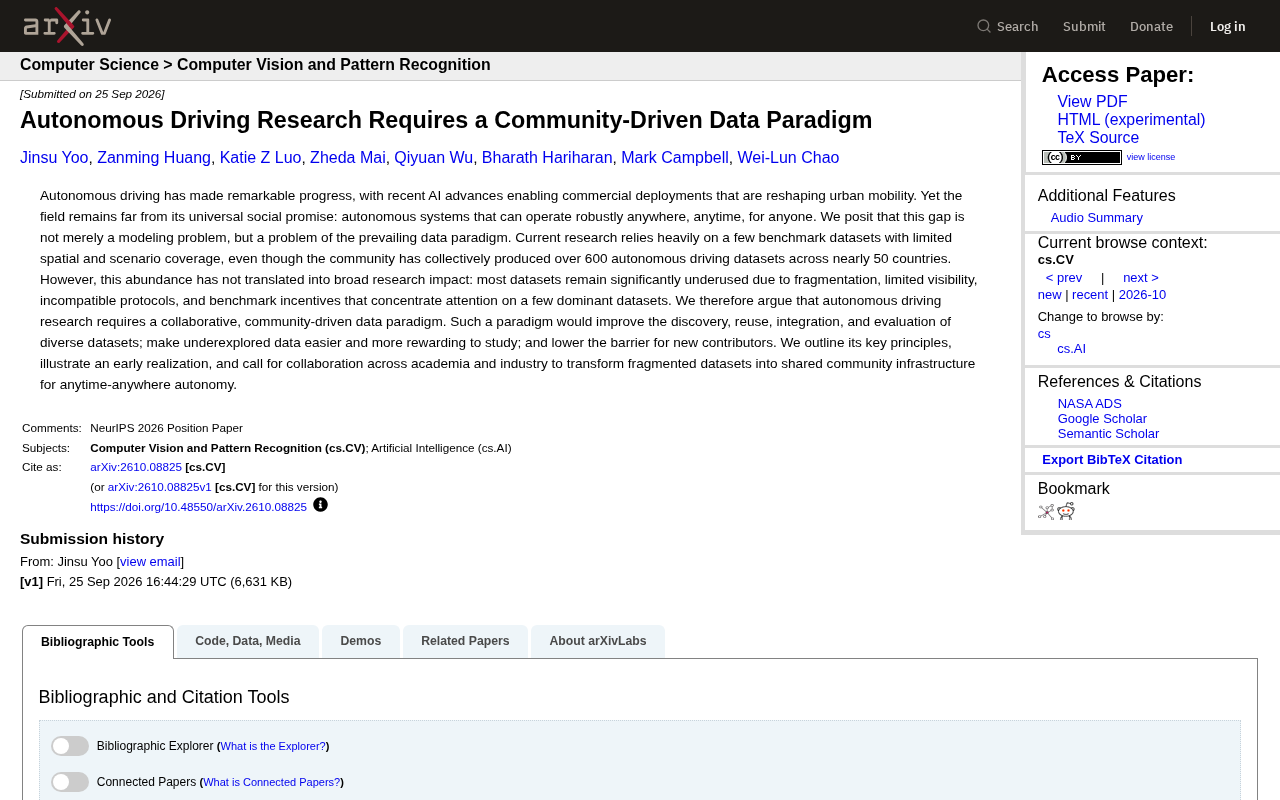
A new arXiv paper argues that the gap between current autonomous driving capabilities and universal deployment stems not from modeling limitations, but from structural flaws in the dominant data paradigm. The research community has produced 600+ datasets across nearly 50 countries, yet most remain severely underutilized due to fragmentation, poor visibility, incompatible protocols, and benchmark-driven concentration effects. The paper calls for a collaborative, community-driven data paradigm that improves discoverability, reuse, and integration of diverse datasets — turning fragmented data silos into shared community infrastructure.
The Real Bottleneck in Autonomous Driving: Not the Models, But the Data Paradigm
Autonomous driving has made remarkable strides in recent years. AI breakthroughs have turned commercial deployment into reality, reshaping how cities move. Yet the technology still falls well short of its ultimate promise — robust, universal systems that work for anyone, anywhere, at any time.
A new arXiv paper offers a thought-provoking diagnosis: this gap isn't primarily a modeling problem. It's a structural issue rooted in the dominant data paradigm. Researchers have long relied on a small set of benchmark datasets that are notably limited in geographic coverage and scenario diversity.
600 Datasets, ~50 Countries — Mostly Unused
The paper reveals a striking statistic: the research community has collectively produced more than 600 autonomous driving datasets spanning nearly 50 countries. On paper, that's an enormous wealth of resources.
In practice, it isn't. The paper argues that the vast majority of these datasets remain significantly underutilized, for several interconnected reasons:
- Fragmentation: Datasets exist in isolation, with no unified way to organize or navigate them;
- Limited visibility: Many datasets are simply hard to find — researchers don't even know they exist;
- Incompatible protocols: Differing formats and annotation standards make cross-dataset integration painful;
- Benchmark-driven concentration: Evaluation systems funnel research attention toward a handful of dominant datasets, creating a rich-get-richer dynamic.
In short, an abundance of data has not translated into an abundance of research impact. This is a classic resource misallocation.
Why Concentrating on a Few Benchmarks Is a Problem
When the entire field's evaluation and competition revolves around a few mainstream datasets, model optimization naturally drifts toward the specific distributions of those datasets. The risk is real: systems that perform well on benchmarks may not hold up in real-world scenarios that fall outside them.
The core challenge of autonomous driving lies precisely in long-tail scenarios — varying traffic rules across countries, rare weather conditions, unusual road configurations, regionally specific driving behaviors. Data covering much of this diversity already exists within those 600 datasets. It's just not being used effectively. Benchmark incentives quietly shrink the space of diversity exploration in research.
This phenomenon has well-known names in machine learning: Benchmark Overfitting, or a manifestation of Goodhart's Law — when a metric becomes the target, it ceases to be a good metric. In autonomous driving, a small group of datasets — ImageNet, nuScenes, KITTI, Waymo Open Dataset — have long dominated the leaderboards for perception, detection, and planning tasks. A model's ranking on these boards directly affects paper acceptance and research funding, pushing researchers to invest heavily in dataset-specific architectural tuning rather than improving general-purpose generalization.
This mirrors the "dataset bias" problem in medical AI, where models trained on one hospital's data often degrade sharply when deployed at another. The geographic bias in autonomous driving is even more extreme: mainstream datasets are overwhelmingly collected in a handful of North American and Western European cities, with virtually no coverage of complex mixed-traffic conditions in Asia, Africa, or Latin America, or the perceptual challenges posed by extreme climates.
The Paper's Proposal: A Community-Driven Data Paradigm
To address this impasse, the paper argues that autonomous driving research needs a collaborative, community-driven data paradigm — one designed to improve the discoverability, reuse, integration, and evaluation of diverse datasets.
Concretely, it aims to shift things at several levels:
Make Data Easier to Discover and Reuse
Through unified organization and retrieval mechanisms, scattered datasets should be findable and reusable without researchers having to reinvent the wheel every time.
Make Underexplored Data More Valuable
Currently overlooked datasets often contain the most valuable long-tail scenarios. The new paradigm aims to make studying these datasets easier and more rewarding, helping to rebalance where research attention flows.
Lower the Barrier for New Contributors
A healthy community ecosystem needs a steady influx of fresh contributors. By reducing technical barriers to participation, more researchers from both academia and industry can be brought into the fold.
The paper not only outlines the core principles of this paradigm but also presents an early implementation example. It calls for cross-sector collaboration between academia and industry to transform fragmented datasets into shared community infrastructure.
From Data Silos to Shared Infrastructure
The paper's value lies in redirecting the field's attention away from simply building bigger models toward a long-neglected dimension: data governance and community collaboration.
Achieving autonomous driving that works "for anyone, anywhere" is fundamentally a question of data diversity and coverage. Only when those 600 datasets are genuinely integrated into shared infrastructure can researchers validate and iterate on systems across a truly global range of scenarios.
Realizing this vision won't be easy. It requires overcoming fragmented standards, narrow incentive mechanisms, and institutional silos. But the paper's message is clear: the next breakthrough in autonomous driving may not come from larger models — it may come from a more open, more collaborative data ecosystem.
There are real-world precedents for this kind of shift. Open science has success stories: the FITS data format standard in astronomy, the NCBI database in genomics, and the Hugging Face Datasets platform in NLP all transformed fragmented data into reusable community assets through unified standards and centralized indexing. For autonomous driving, analogous infrastructure needs to tackle several technical challenges: cross-dataset sensor calibration differences (varying LiDAR models and camera parameters), unifying annotation ontologies (the same object class defined differently across datasets), and legal compatibility of data licensing agreements. These engineering problems are more tedious than model algorithms — yet they are the prerequisite for "shared infrastructure" to actually work. The community paradigm proposed in the paper is, in essence, a call to build an "operating system for autonomous driving data."
Related articles

JobRunner MCP Server: AI Agents Can Now Fix Failed Java Jobs
JobRunner launches an open-source MCP server enabling AI agents to view cluster status, diagnose failures, and recover Java jobs—incident response from any cloud coding environment or existing agent.

MLAI Digital Launches 9 Security Agents: MCP Server Safeguards the Full Lifecycle of Agentic AI
MLAI Digital launches Security MCP Server with nine built-in specialized security agents covering vulnerability discovery, attack simulation, prompt injection detection, API and infrastructure assessment, and accelerated remediation—embedding security validation across the full Agentic AI lifecycle from development to production.

Running Isaac Lab on H100 GPUs: Exploring Better Approaches
Exploring optimization methods for running Isaac Lab on NVIDIA H100 GPUs, including MIG configuration, mixed precision, TensorRT acceleration, and community experience to improve robotics simulation and reinforcement learning efficiency.