The Real Challenge of AI Governance: It's Not About Managing Tools, It's About Controlling Runtime Risk

AI governance must shift focus from tool approval to runtime control of permissions, behavior, and incidents.
A real enterprise AI governance review reveals that the core challenge isn't managing which AI tools are approved, but controlling what happens after AI systems connect to internal data and business processes. This article explores the critical distinction between AI governance (policy and compliance) and AI operational control (runtime monitoring, permission management, and incident response), offering practical recommendations for building AI-specific observability systems.
An AI Governance Review That Took an Unexpected Turn
When an enterprise launches an AI governance review, the team usually comes in with a clear expectation: produce a list that distinguishes which AI tools are approved for use and which aren't. This seems like the most natural starting point for governance work — first figure out what employees are actually using.
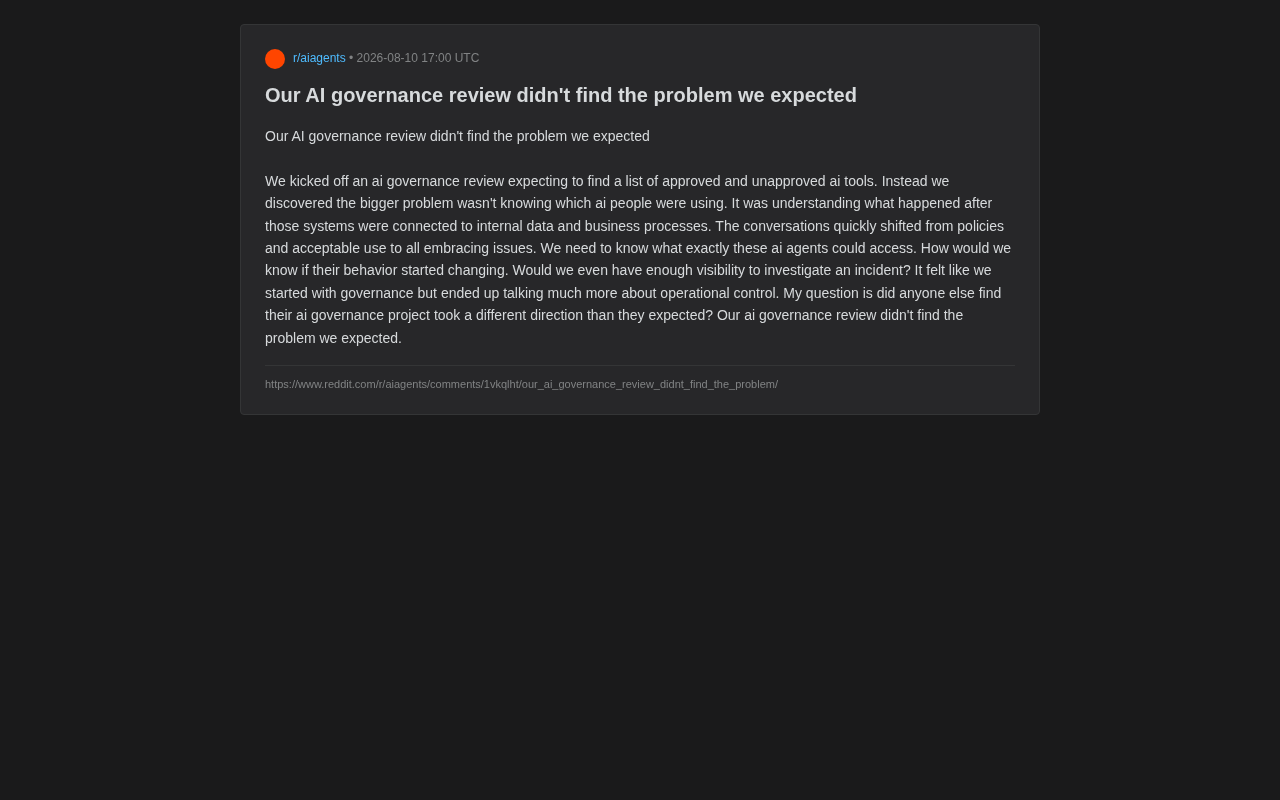
However, a real experience shared by an enterprise IT leader on Reddit revealed a much deeper problem. Their team originally thought the biggest challenge was "not knowing which AI tools employees are using," but the review process quickly made them realize: the real risk emerges after AI systems are connected to internal data and business processes.
"The conversation quickly shifted from policy and acceptable use frameworks to those all-encompassing questions."
This shift is quite representative. Many organizations, when developing their AI governance strategy, focus on "access control" while overlooking the thornier issue of "runtime control."
From "What's Being Used" to "What Can It Do": A Cognitive Upgrade in AI Governance
The questions raised by the poster point precisely to the most underestimated dimensions of AI governance:
What Can AI Agents Actually Access?
When an AI tool or Agent is connected to enterprise systems, its data access boundaries are often blurry. It might be connected via API to the CRM, code repositories, financial systems, or customer data. The issue isn't whether the tool has been approved — it's how much permission it gained after approval.
APIs (Application Programming Interfaces) are standardized communication protocols between software systems. When an AI Agent connects to a CRM (like Salesforce), code repositories (like GitHub), or financial systems via API, the permissions it obtains are typically determined by OAuth tokens or API keys. The problem is that many enterprises, in pursuit of full functionality during integration, grant overly broad read/write permissions (so-called "over-provisioning"). Unlike traditional software, AI systems may dynamically decide which endpoints to call and which fields to read based on context, making static permission audits unable to capture the actual data flow paths.
Traditional software procurement processes assume that a tool's behavior is static and predictable. But AI systems are different — their behavior is determined jointly by the model, prompts, and contextual data, and their permission scope may far exceed the original intent.
How Do You Detect AI Behavioral Drift?
This is a pointed question from the poster: "How do we know when their behavior starts to change?"
AI models get updated, prompts get adjusted, and connected data sources expand. An AI Agent that performed normally yesterday might today start producing unexpected outputs or taking unexpected actions due to some upstream change. Without continuous behavioral monitoring mechanisms, this kind of drift is nearly impossible to detect in time.
AI behavioral drift has multiple technical sources: First, model-level drift — when the underlying large language model (such as GPT-4, Claude, etc.) undergoes version updates, the output distribution may change even if prompts remain the same. Second, data drift — when the content or structure of data sources that the AI Agent connects to changes (such as database schema changes or new fields), the model's reasoning foundation shifts accordingly. Third, the cascading effect of prompt chains — in complex Agent architectures, a fine-tuning at one stage may affect all downstream decision nodes through chain reactions. This multi-source drift makes traditional regression testing methods inadequate for covering the full behavioral space of AI systems.
Can Incidents Be Traced Back for Investigation?
The final question touches on the core of post-incident auditing: "If an incident occurs, do we have sufficient visibility to investigate?"
For traditional IT systems, logs, audit trails, and access records are mature infrastructure. But when AI Agents autonomously execute tasks across multiple systems, this traceability chain is often broken — you might know the AI made a certain decision, but you cannot reconstruct "why" or "based on what data" it made that decision.
Traditional IT observability is built on the "three pillars": Logs, Metrics, and distributed Traces. But AI systems introduce an entirely new challenge dimension: decision uncertainty. Traditional system behavior is deterministic — the same input produces the same output, so logs can fully reconstruct the execution path. AI systems, however, are based on probabilistic reasoning; the same input may produce different outputs, and the reasoning process (such as attention weight distribution, information retrieval within the context window) is typically a black box. AI observability requires additionally recording input context, retrieved document fragments (in RAG architectures), intermediate reasoning steps, tool call sequences and their parameters, in order to reconstruct the decision chain after the fact.
AI Governance vs. AI Operational Control: Two Different Battlefields
The most valuable insight from this review is: AI governance and AI operational control are problems at two different levels.
- The governance layer answers "what do we allow" — policies, compliance, acceptable use frameworks.
- The operational control layer answers "what's actually happening" — access boundaries, behavioral monitoring, incident response capabilities.
Many enterprises assume that doing the former well is equivalent to managing AI risk, but the poster's experience proves that paper policies cannot constrain actual runtime behavior. No matter how perfectly written an "AI Usage Policy" is, it cannot tell you which sensitive data a particular Agent is accessing right now.
This also explains why such projects often "go off track" — you think you're working on compliance documentation, but end up discussing observability, permission management, and security auditing. This leap from governance to operations actually reflects the unique nature of AI technology itself: it's not a system that can be "set and forget" after static deployment, but a dynamic entity that continuously evolves and requires continuous oversight.
Widespread AI Governance Blind Spots
The poster concluded by asking the community: "Has anyone else found their AI governance project heading in an unexpected direction?"
The question itself demonstrates the universality of the problem. As enterprises move from "experimenting with AI" to "deeply embedding AI in business processes," the center of gravity for risk is shifting from access decisions to ongoing operations.
Several trends worth noting:
-
Shadow AI remains an issue but is no longer the biggest threat. The risks posed by formally approved AI that has been granted deep system permissions are often more hidden and more severe. Shadow AI is similar to the early concept of "Shadow IT" — employees using tools like ChatGPT to process work data without IT department approval. This type of risk is relatively easy to identify (through network traffic monitoring or endpoint management tools) and has a limited scope of impact. But formally approved and deeply integrated AI systems have legitimate system permissions, can process data in bulk, can autonomously trigger business processes, and are subject to lower security review frequency because they've "already been approved." This "trust paradox" means that the potential destructive power of official AI far exceeds that of shadow AI.
-
The autonomy of AI Agents amplifies this challenge. When AI does more than just answer questions — when it can invoke tools and execute operations — it becomes a "behavioral actor" that needs to be monitored. In architectures like ReAct and AutoGPT, Agents can autonomously plan task steps, invoke external tools (such as search engines, database queries, code execution environments), adjust strategies based on intermediate results, forming a "perceive-reason-act" loop. From a governance perspective, this requires enterprises to manage AI Agents like "digital employees" — with clearly defined responsibility boundaries, operational permissions, behavioral audit requirements, and escalation mechanisms for anomalous situations.
-
The observability gap is the Achilles' heel of most enterprises today — lacking logging, tracing, and alerting mechanisms specifically designed for AI behavior. Existing APM (Application Performance Monitoring) and SIEM (Security Information and Event Management) tools are primarily designed for traditional application architectures and lack native support for AI reasoning chains, context window content, and tool invocation decisions. Enterprises need to build a dedicated AI behavioral monitoring layer to fill this gap.
Practical Recommendations for Enterprise AI Governance
Based on this case, enterprises can adjust their approach when advancing AI governance:
1. Governance reviews must extend to runtime. Don't stop at "which tools are approved" — follow up with "what are their actual permissions and behaviors after approval?" Specifically, this means transforming AI governance from a one-time approval process into a continuous monitoring loop, similar to the paradigm shift in DevOps from "pre-deployment review" to "continuous delivery + continuous monitoring."
2. Build AI-specific observability systems. Traditional IT logs cannot cover AI decision chains. Specialized monitoring is needed to record what data AI accessed, what decisions it made, and what impact it produced. This includes but is not limited to: recording the complete input/output of every LLM call, tracking document sources and relevance scores retrieved by RAG systems, logging Agent tool call chains and the rationale for each decision step, and real-time evaluation of output quality and safety.
3. Define behavioral baselines and drift detection. Define what AI "normal behavior" should look like, so you can detect and intervene when it deviates. This requires establishing a behavioral baseline profile during the AI system's initial deployment — including typical response time distributions, output length ranges, tool call frequencies, data access patterns, and other metrics — then using statistical methods or dedicated monitoring models to detect anomalous behavior that deviates from the baseline.
4. Build incident response capabilities proactively. Assume AI will inevitably go wrong, and ask yourself: when something does happen, do we have a sufficient evidence chain to investigate and conduct a postmortem? This includes developing AI-specific Incident Response Playbooks, clearly defining isolation, rollback, and notification procedures for when AI produces harmful outputs or exceeds its authority, and ensuring all decision-making steps leave auditable records.
Conclusion
This AI governance review that "didn't find the expected problem" actually found a more important answer: The core of AI risk is shifting from "controlling the entry point" to "controlling the runtime."
For any organization currently undertaking or about to launch AI governance, this is a timely reminder — don't be distracted by policy checklists. What truly determines the level of risk lies in those invisible places after AI systems connect to business operations. As AI Agent technology rapidly matures in 2024-2025 and enterprise-grade deployments accelerate, this governance paradigm shift will no longer be a forward-looking discussion, but an urgent priority that every digital organization must confront.
Related articles

Workbuddy for Absolute Beginners: How a Desktop AI Agent Fits Into Real Workflows
A beginner's guide to the Workbuddy desktop AI agent: installation, claiming credits, file management, and building automated workflows—compared with CodeX for fit and cost, helping professionals shift from AI question-askers to AI managers.

OpenAI's New Agent Stack: Computer Use, Decisions API, and Ultra-Fast Workflows
OpenAI Dev Day unveiled a new agent stack: Computer Use outperforms humans, Decisions API delivers ultra-low-latency classification via Luna, Agents API opens the same Computer Use capabilities, and GPT-6.1 Sol costs only one-seventh of Astra. Core updates, benchmark data, and developer insights.

Liang Wenfeng Open-Sources DeepInfo Inference Framework, Takes On U.S. Ban
DeepSeek open-sources its DeepInfo inference framework after its models, featuring GPU/CPU cross-pipelining, small-model prediction with large-model verification, and full Huawei Ascend and NVIDIA chip support—facing the U.S. federal ban head-on. This article analyzes its significance for AI deployment and open-source strategy.