The Real Impact of AI on Employment: A Rational Analysis Beyond the Hype

A rational analysis of AI's real employment impact, cutting through hype and extreme narratives.
This article examines AI's actual impact on employment by dissecting three common hype narratives — doomsday predictions, salvation claims, and data ambiguity arguments. Drawing on real signals like entry-level job pressure, productivity gain destinations, and job restructuring trends, it provides a balanced analysis of how AI is reshaping rather than eliminating work, while highlighting why rational judgment remains so difficult amid vested interests and cognitive biases.
Introduction: A Heated Debate About Jobs
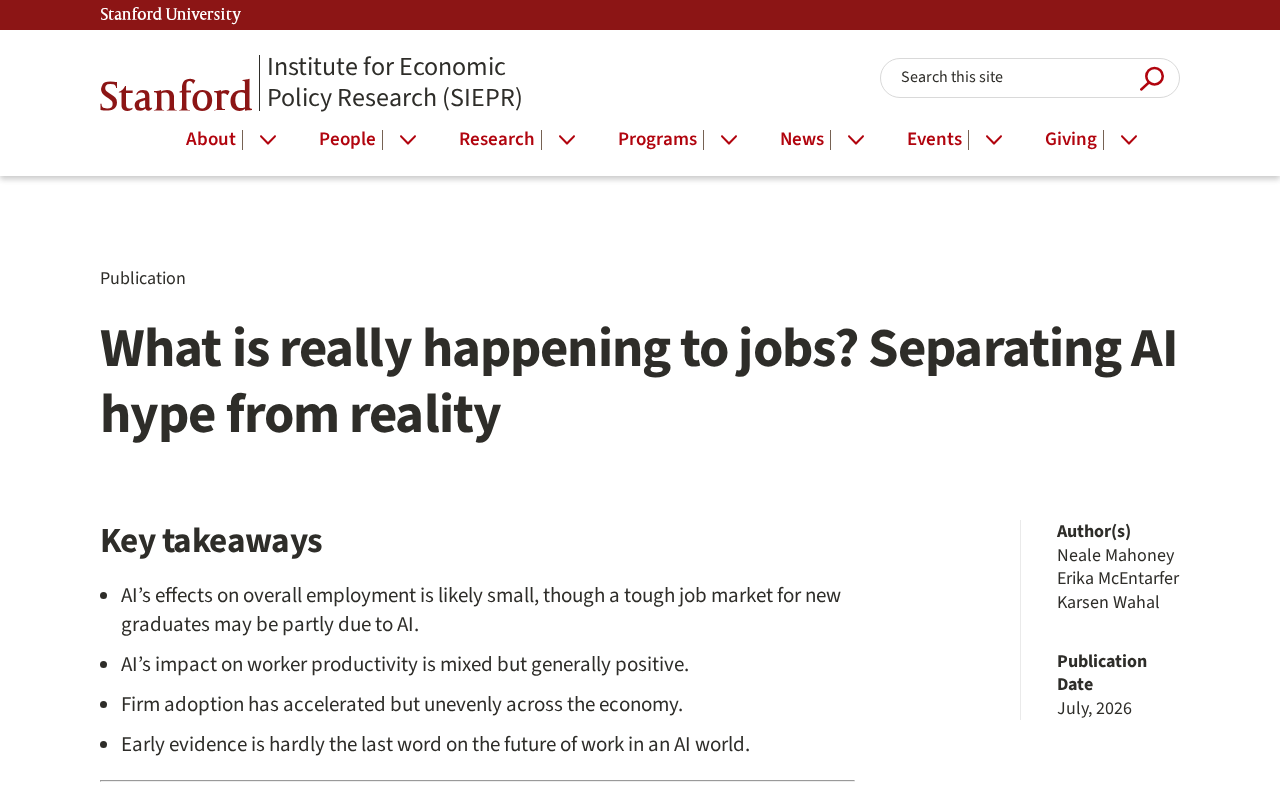
Recently, an article titled What is happening to jobs? Separating AI hype from reality sparked widespread discussion on Hacker News, garnering 249 upvotes and a whopping 317 comments. This level of engagement itself tells us something: the impact of AI on employment has evolved from an abstract topic in tech circles into a real-world anxiety weighing on countless people's minds.
Whether it's sensational media headlines proclaiming "AI will replace millions of jobs" or the "productivity revolution" visions painted by tech CEOs, public understanding of AI's impact on employment is often hijacked by extreme narratives. This article attempts to chart a more rational analytical path through all the noise.
Three Typical Hypes About AI Replacing Jobs
The Doomsday Narrative: AI Will Devour All Jobs
The most common hype is the "doomsday narrative." This storyline typically cites alarming prediction numbers from various institutions — something like "X billion jobs will disappear in the next five years." The problem is that these predictions are usually based on the technical potential for task automation, not on the actual economic and organizational capacity for deployment.
History has repeatedly shown that a technology being capable of doing something and businesses being willing and able to deploy it at scale to replace human labor are two entirely different propositions. The introduction of ATMs didn't eliminate bank tellers — in fact, by reducing branch operating costs, it encouraged banks to open more branches. This case is a classic example in economics for studying the substitution effects of technology. When ATMs began proliferating in the 1970s, there were approximately 300,000 bank tellers in the United States, and many predicted the profession would die out. But by 2010, the number of tellers had actually grown to around 600,000. Economist James Bessen analyzed this mechanism in detail in his research: ATMs reduced the operating cost of individual branches (cutting the number of tellers needed per branch from 20 to 13), which enabled banks to open more branches at lower cost to cover wider geographic areas. The increase in total branch count actually drove up overall demand for tellers. At the same time, the nature of tellers' work underwent a qualitative shift — from simple deposit and withdrawal operations to customer relationship management and financial product sales. This case reveals an important economic principle: the impact pathway of automation technology is far more complex than the linear logic of "machines replacing people," and the demand expansion effect driven by cost reduction is often overlooked.
The Salvation Narrative: AI Only Creates, Never Destroys
Opposite the doomsday narrative is the "salvation narrative" — the belief that AI will only create new jobs and boost productivity without causing any structural unemployment. This optimism equally warrants caution. During technological transitions, there is often a vast gap between the skills of displaced workers and the skills required by newly created positions. This "frictional unemployment" is real and painful.
In labor economics, frictional unemployment refers to the temporary unemployment that occurs when workers transition between jobs. However, in the context of technological change, this concept needs to be distinguished from "structural unemployment": frictional unemployment is typically short-term and self-resolving, but when technological change creates a massive gap between the skills of eliminated positions and those required by new ones, frictional unemployment can evolve into more persistent structural unemployment. Take the American "Rust Belt" as an example — after manufacturing relocated, large numbers of workers could theoretically transition to service or tech industries, but the actual retraining timelines, geographic relocation costs, and psychological adaptation barriers stretched the transition process over decades, with some communities still not fully recovered today. Skill transitions in the AI era face the same challenge — when the shift required is from "execution-oriented skills" to "judgment-oriented skills," the cognitive restructuring involved is far beyond what short-term training can accomplish.
The Data Ambiguity Argument: Nothing Is Certain Yet
The third attitude is avoidance — claiming there's too little data to make any judgments. While it's true that large-scale AI deployment is still in its early stages, "insufficient data" shouldn't be an excuse to refuse analyzing trend signals. The key question is: what can we read from the signals we already have?
The Real Impact of AI on the Job Market: Data and Signals
Entry-Level Positions Are Under the Greatest Pressure
From community discussions, one repeatedly mentioned phenomenon stands out: entry-level positions are under increasing pressure. Many developers report that the repetitive, template-based tasks originally handled by junior employees — such as writing boilerplate code, organizing documentation, and preliminary data processing — are precisely the areas where current generative AI excels.
Generative AI refers to AI systems based on technologies like large language models (LLMs) that can autonomously generate text, code, images, and other content. Representative products include ChatGPT, GitHub Copilot, and Claude. The reason these systems put particular pressure on entry-level positions is closely related to their technical characteristics: large language models learn patterns from massive training datasets and excel at tasks with high regularity and template-like characteristics — which happens to be the core work content of junior roles. For example, GitHub Copilot has been shown to improve developers' speed in writing boilerplate code by over 55%. The critical point is that current generative AI's capability boundaries create a misaligned match with the job seniority ladder: it performs excellently at structured, pattern-based tasks but still falls short on tasks requiring deep domain judgment, complex system architecture design, and cross-domain creative thinking — which are precisely the core value propositions of senior practitioners.
This creates a thought-provoking paradox: companies are reducing entry-level hiring, while senior talent remains scarce. Over time, the talent pipeline could be severed — if there are no junior positions serving as training grounds, where will future senior experts come from? This is a deep concern repeatedly emphasized by many practitioners.
Productivity Gains Don't Equal Mass Layoffs
Another noteworthy fact: the destination of AI-driven productivity gains is uncertain. It might manifest as layoffs (doing the same work with fewer people), or it might manifest as business expansion (doing more work with the same people).
Many practitioners point out that in highly competitive industries, companies tend to use AI to boost output rather than trim teams, because their competitors are doing the same. In other words, AI is more like an "arms race" — whoever lays down their weapons first falls behind. This analogy actually touches on the classic "Prisoner's Dilemma" structure from game theory. In highly competitive markets, every company faces a choice: adopt AI to improve efficiency, or maintain the status quo. If a competitor adopts AI and you don't, you'll be at a disadvantage in cost and speed; if both sides adopt AI, profit margins may be compressed back to original levels due to intensified competition, but neither side dares to exit first. Since 2023, virtually all major tech companies have emphasized AI investment in their earnings calls, partly out of fear of being perceived by investors and the market as "falling behind the AI wave." This competitive landscape means that even if AI-driven productivity gains may not be as significant as expected at the macro level (since all competitors are using similar tools), companies cannot stop investing. The impact on employment thus becomes more nuanced: companies may not engage in mass layoffs because of AI, but hiring standards will continue to rise, and each employee will be expected to deliver more value.
Jobs Are Being "Reshaped," Not "Eliminated"
The more universal reality is job restructuring. Most jobs aren't being replaced wholesale — rather, certain tasks within them are being automated, and practitioners' roles shift accordingly — from executors to reviewers, from producers to orchestrators.
Specifically:
- Programmers no longer write code line by line but review and optimize AI-generated code
- Copywriters no longer write from scratch but edit and polish AI drafts
- Data analysts shift from manually cleaning data to interpreting and validating AI-generated insights
This transformation reveals a core challenge in technology deployment known as the "Irony of Automation": the higher the degree of automation, the more critical the remaining human elements become, and the higher the demands on operators, because they need to identify subtle errors and edge cases within massive volumes of automated output. AI can generate code, write drafts, or produce data analyses, but the "last mile" from AI output to deliverable results — including quality review, contextual adaptation, stakeholder communication, and final decision-making — still depends heavily on human judgment. In software engineering, code review is itself an advanced skill requiring deep experience; when the volume of AI-generated code multiplies, the review burden doesn't decrease but actually increases, and reviewers need new capabilities to understand AI's typical error patterns.
This shift places new demands on practitioners' competency profiles: judgment, taste, and domain knowledge become more important than pure execution ability. In particular, "middle-tier" practitioners — those who are neither pure junior executors nor senior strategic decision-makers — face the most complex role redefinition.
Why Rational Judgment About AI's Employment Impact Is So Difficult
Information Distortion Driven by Vested Interests
Public statements about AI's employment impact almost always carry an agenda. AI companies need to hype transformation to attract investment, media outlets need extreme headlines to drive traffic, and corporate management may use "AI-driven efficiency" as external justification for layoffs — even when the actual reasons are entirely different. This means the information the public receives is inherently distorted.
The Lag in Statistical Data
Macroeconomic employment data collection and publication involves significant delays. Take the U.S. Bureau of Labor Statistics (BLS) as an example: its Occupational Employment and Wage Statistics (OEWS) data typically has a one-to-two-year lag from collection to publication, while more granular industry classification adjustments may take even longer. By the time official data can clearly show AI's impact on a particular industry, the changes may have already been underway for years. This time gap makes real-time judgment extremely difficult and gives various narratives room to survive.
Cognitive Bias from Individual Experience
Everyone observes the world from their own industry and social circle. A senior engineer empowered by AI tools whose efficiency has doubled, and a recent graduate struggling to find a job, will reach diametrically opposite conclusions. The heated debates in online communities are essentially collisions between different sample experiences. This phenomenon is known in psychology as "Availability Bias" — people tend to judge overall trends based on the most readily accessible information (i.e., their own experience), while ignoring the uniqueness of their own position and the limitations of their sample.
How to Maintain Clear Judgment in the AI Wave
Separating AI hype from reality may not have a definitive answer, but there are several reliable thinking principles:
- Be wary of absolutist predictions: Whether it's "AI will eliminate all jobs" or "AI will only create employment," overly absolute claims usually don't hold up to scrutiny
- Focus on structural signals: Rather than aggregate numbers, structural changes like the shrinking of entry-level positions and talent pipeline disruptions deserve more attention
- Distinguish between technical capability and employment consequences: The fact that AI can automate a task doesn't mean the corresponding job will disappear. Economist David Autor's research has repeatedly emphasized that jobs consist of a bundle of tasks, and automating some tasks may actually increase the value of the remaining tasks (and the people performing them)
- Continuously learn and adapt: Shift your capabilities from pure execution toward judgment, review, and orchestration
As the title of this widely discussed article suggests, what we truly need isn't yet another frightening prediction, but rather to strip AI of its mythology and panic, and calmly examine what it's actually doing — and not doing — in the real world. Changes in the job market are gradual and complex, and only by rejecting simplistic narratives can we make truly valuable personal and policy decisions.
Related articles

Why Are AI Coding Assistants So Expensive? The Real Bill Behind the Harness
Deep dive into the hidden cost structure of AI coding assistants like Claude Code, Cursor, and Cline — revealing how system prompts, Agent round trips, and Prompt Caching impact your bill.

monolog: The AI Note-Taking App That Requires No Organization — Semantic Search Finds Everything
monolog is an AI note-taking app that eliminates folders and tags. Just chat to yourself, and AI understands your content and retrieves it via semantic search. Syncs across iOS, Android, Web, and more.

AirTag Tracking Reveals: Amazon Suspected of Destroying Rare Books to Train AI
404 Media journalists used AirTags to track rare books, discovering they were sent to Amazon AI training facilities. The investigation reveals AI companies may be destructively scanning rare books for training data.