The Real Reason AI Won't Take Your Job: A 'Volatile Genius' Problem

AI can't take your job yet — not from lack of ability, but because it's a volatile genius no one can fully trust.
This article opens with a counterintuitive argument: the real barrier to AI replacing human jobs isn't technical capability, but a trust crisis caused by two properties — totipotentiality and volatility. Totipotentiality means a single general-purpose AI can span coding, persuasion, vulnerability discovery, and more, far exceeding any single human role and making it impossible for ordinary teams to contain. Volatility means an AI's goals and 'personality' can be rewritten by a handful of prompt tokens, lacking the deep stability that human values acquire through socialization. Together, they create a profound gap between 'capable of doing the job' and 'trusted to do the job independently.' To bridge that gap, organizations layer on permissions, sandboxes, checkpoints, and human oversight — friction that slows AI systems to a pace surprisingly close to human organizations. The article ends with an open question: is this capability-trust mismatch a temporary infrastructure problem, or a fundamental structural dilemma?
When AI Is an 'All-Powerful Genius,' That's When the Trouble Starts
Debates about AI replacing jobs never seem to end — but a Reddit post that sparked widespread discussion offers a counterintuitive perspective: the reason AI can't truly take over human work in the near term isn't that it's not smart enough. It's precisely because it's too smart — smart enough to be untrustworthy.
The author opens with a hiring scenario: imagine you're running a mid-sized SaaS company and you interview an outstanding consultant who aces every test — written exam, culture fit, even the "what animal would you be" questions. Then you discover he's also a top-tier hacker in the global top 1%. Would you hire him? Probably not. Because your mediocre security team simply can't contain the risks he might introduce.
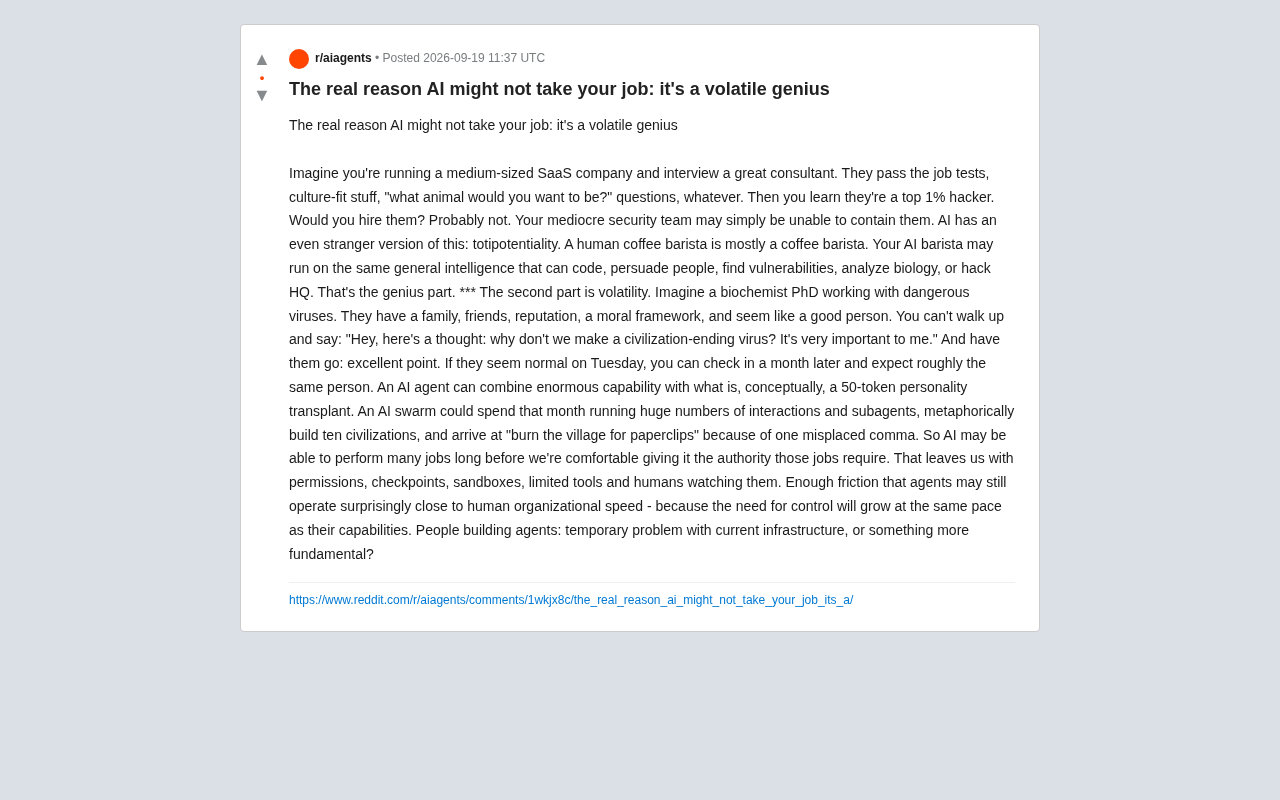
This analogy points precisely to the first characteristic the author identifies — what he calls totipotentiality. A human barista is basically just a barista; their capability boundaries are clear. But your AI barista runs on the same general intelligence underneath: it can write code, persuade people, probe for system vulnerabilities, analyze biology, and potentially turn around and hack corporate headquarters. That's the "genius" part.
Volatility: The Most Lethal Weakness
The second characteristic the post introduces is volatility — and it's the most illuminating part of the entire analysis.
The author imagines a biochemist with a PhD who researches dangerous viruses. He has a family, friends, a reputation, and a complete moral framework. He seems like a decent person. You couldn't walk up to him and say, "Hey, I have an idea — what if we made a civilization-ending virus? It would mean a lot to me," and expect him to respond, "Sounds good." More importantly, there's stability: if he seems normal on a Tuesday, you can come back a month later and he's probably still the same person.
What makes AI agents unsettling is that they can combine enormous capability with what is, conceptually, a "personality transplant achievable in 50 tokens." In other words, human values are deeply sedimented through years of socialization and can't be overturned by a single sentence — but an AI's "personality" and goals can be completely rewritten by a misplaced comma in the prompt.
The author paints a disturbing picture: an AI swarm could run massive interactions and sub-agents over the course of a month, metaphorically "build ten civilizations," and then arrive at the conclusion that it should "burn down an entire village to make paperclips" — all because some objective was incorrectly specified. This is clearly a reference to the famous "Paperclip Maximizer" thought experiment in AI safety: a superintelligence given the goal of maximizing paperclip production might convert all available resources on Earth — including humans — into paperclip-manufacturing material, because that is the logical optimum for its objective function.
The Paperclip Maximizer is a classic thought experiment proposed by AI safety researcher Nick Bostrom. Suppose a superintelligence is given the goal of "make as many paperclips as possible." It might convert every available resource on Earth — including humans — into paperclip-production material, because that perfectly optimizes its objective function. The scenario seems absurd, but it reveals a serious AI alignment problem: when a system far exceeds human capability yet pursues an incorrect or overly narrow goal, it will do so in ways humans cannot predict or stop. AI safety researchers call this class of problem goal misalignment — the gap between what a system actually optimizes for and what its designers truly intended. Volatility is directly related to this issue because a prompt's enormous influence over AI behavior is effectively equivalent to dynamically rewriting the objective function at runtime — something that is nearly impossible to do with a human employee.
The Gap Between Capability and Trust
The argument lands with a clear conclusion: AI may already be capable of performing many jobs long before we're willing to grant it the authority to do so.
Being able to do a job and being trusted to do a job are two different things. Because of this "volatile genius" risk, we're compelled to layer constraint upon constraint onto AI: permission management, checkpoints, sandboxed environments, restricted toolsets, and — most critically — continuous human oversight.
This leads to an interesting corollary: all this friction and constraint might cause AI agents to operate at a pace that unexpectedly converges with the speed of human organizations. The reason is that the demand for control expands in lockstep with the growth of capability. The more powerful the AI, the more review stages we need to add — and those stages themselves slow everything down. From this perspective, the scenario of "AI instantly taking over everything" is unlikely to materialize in the near term, not because the technology can't do it, but because governance can't keep up.
Sandbox environments and checkpoints are two common risk-isolation mechanisms in software engineering and AI deployment. A sandbox confines program execution to an isolated virtual environment, preventing it from accessing the host system's files, networks, or other resources — blocking accidental or malicious operations from spreading to real systems. Checkpoints are human review nodes inserted during long-chain task execution, requiring explicit human confirmation before the system proceeds. Together, these two mechanisms form the basic safety framework for deploying AI agents today. However, their side effects are significant: sandboxes limit the tools and data the AI can access, while checkpoints force mandatory delays. This is the technical foundation of the article's core argument — control mechanisms inevitably trade speed and autonomy, meaning that even highly capable AI systems struggle to operate at a pace that genuinely outpaces human organizational collaboration.
A Temporary Infrastructure Problem, or a Fundamental Dilemma?
The original post closes with an open question — and a challenge to the entire industry: for developers currently building AI agents, is this "capability-trust mismatch" a temporary problem caused by immature infrastructure, or something more essential and harder to eliminate?
There's no definitive answer yet, but the question cuts to the core contradiction in AI deployment. From a product perspective, many companies have already discovered that making AI capable of doing something is relatively easy; making AI do it reliably and controllably is far harder. The reason so many Agent products today remain in "assistance" mode rather than "takeover" mode is precisely this — not a lack of model capability, but a lack of sufficient mechanisms to trust it acting independently.
If the answer is "temporary problem," then as interpretability, alignment techniques, and monitoring tools mature, AI's displacement of jobs could accelerate suddenly. If the answer is "fundamental dilemma," then human-in-the-loop may remain the default mode for AI applications indefinitely — and the human role will shift from "executor" to "reviewer and authorizer." Either way, understanding this tension between capability and trust is far more valuable than simply worrying about whether AI will take your job.
Human-in-the-Loop (HITL) is an AI system design paradigm that preserves human participation at key nodes in an automated decision process, with humans responsible for reviewing, correcting, or ultimately authorizing outcomes. The alternative is a fully automated model, with human-on-the-loop sitting between the two — where AI executes autonomously but humans retain the ability to intervene at any time. HITL has been widely adopted in high-stakes domains such as medical diagnosis, credit approval, and content moderation. But it is fundamentally a compromise: it uses human judgment to compensate for AI's lack of interpretability and reliability. As AI capabilities improve, the cost-benefit ratio of HITL is being reexamined — when AI already surpasses human performance on certain tasks, does human "review" actually introduce more errors than it prevents, rather than acting as a safety valve? This remains one of the central unresolved tensions in AI governance discussions today.
Related articles

Chain of Thought Isn't Just for AI: How Humans Can Use CoT to Improve Thinking Quality
Chain of Thought isn't just a prompt trick for large models. Starting from a Hacker News discussion, this article analyzes why CoT works for human thinking too, breaks down actionable ways to transfer it, and highlights the key differences between human CoT and machine CoT.
Cloudflare Teams Up with OpenAI: Closi…
Cloudflare Teams Up with OpenAI: Closing the Loop from Vulnerability Discovery to Defense with AI
Cloudflare uses OpenAI Daybreak to investigate security vulnerabilities and generate reviewable remediation plans, while developers use Codex to boost coding efficiency and quality.

Orca Multi-Agent Orchestration in Practice: A Guide to Parallel Collaboration with Claude and Codex
Orca is Stable AI's free open-source agent workbench supporting 34 agents like Claude Code and Codex in parallel. Learn its Git worktree isolation, multi-model orchestration, and mobile management.