The Real Tell of AI Writing: Not the Phrasing, But the Lack of a Point of View

AI writing's fatal flaw isn't grammar mistakes — it's the complete absence of a genuine point of view.
Starting from a TikTok rant by @therealcornpop, this article dissects the most fundamental weakness of AI-generated content. Telltale patterns like the "It's not X, it's Y" construction and staccato writing are signals, but the deeper problem is hollowness — AI produces fluent, accurate text yet is structurally incapable of taking a stance, because its training optimizes for the statistical average of human writing. For audiences, what's missing isn't information but personality. The takeaway: AI should amplify a creator's voice, not replace it, and in an era of zero-cost content generation, genuine judgment and a distinctive perspective are the hardest things to replicate.
When AI-Written Content Becomes "Instantly Recognizable"
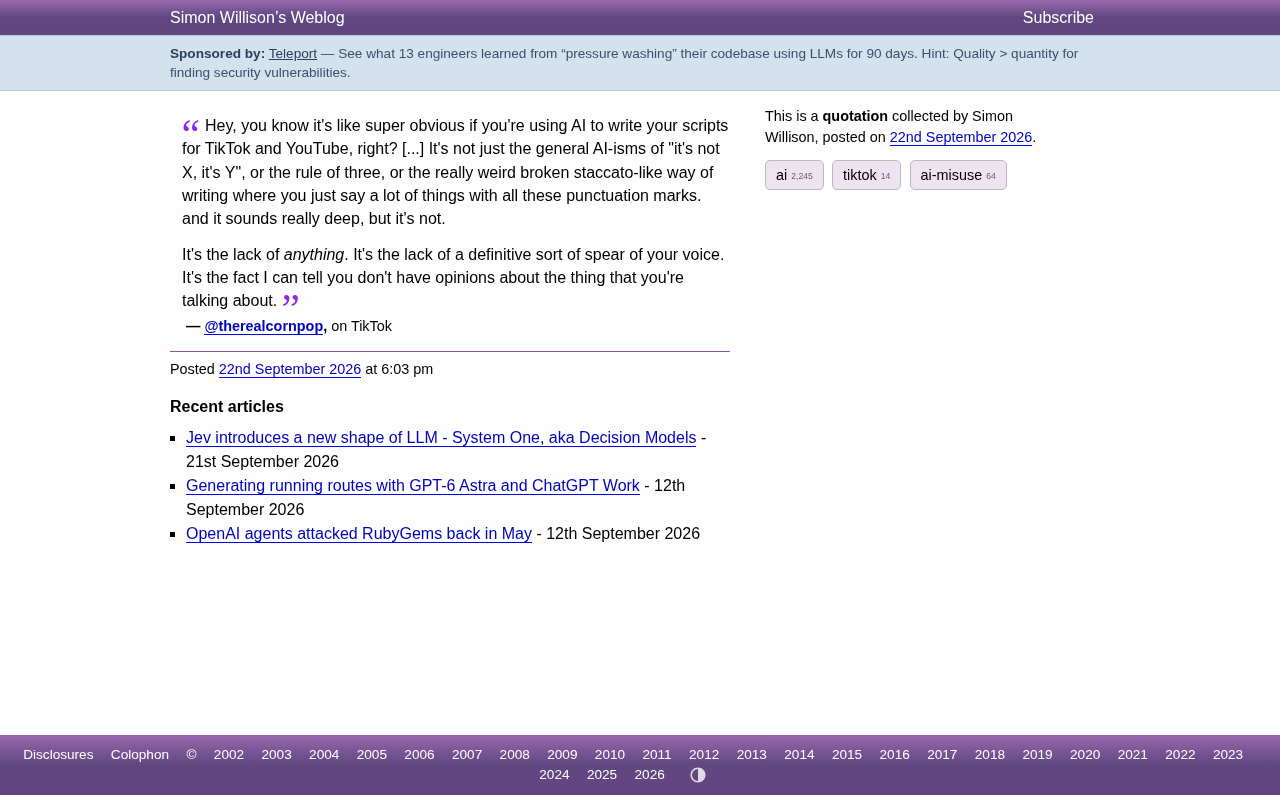
Using AI to mass-produce scripts on TikTok and YouTube is no longer a secret. But for content creators, an increasingly sharp question has emerged: audiences can actually tell immediately. A recent rant from TikTok creator @therealcornpop resonated across developer and creator communities — it was cited by well-known tech blogger Simon Willison, who tagged it with ai-misuse.
The reason this observation deserves a deeper look is that it cuts to the most fundamental weakness of AI-generated content today: not grammar issues at the technical level, but a hollowness at the content level.
The "AI Voice" Everyone Can Recognize
@therealcornpop called out several telltale signs of AI writing — patterns that have essentially become fingerprints of large language models:
- The "It's not X, it's Y" construction: A contrast-and-pivot structure that sounds insightful but has been so overused it now feels formulaic.
- The rule of three: Forcing ideas into three parallel points, with a rhythm so neat it feels unnatural.
- Fragmented, staccato writing: Sentences chopped up with heavy punctuation, stacking short phrases to manufacture a sense of depth — "but it's not."
None of these are fatal on their own — plenty of human writers use them too. The real problem is when they appear together at high frequency, creating a mechanical cadence that's instantly recognizable.
There's a technical reason these patterns are so concentrated in AI output. During text generation, models default to selecting token sequences with higher conditional probabilities, and these high-frequency sentence structures appear abundantly in training data — they are, in effect, the greatest common denominator of "writing that looks insightful" on the internet. The "It's not X, it's Y" contrast structure is ubiquitous in business copy, motivational content, and popular science writing; the rule of three is deeply embedded in the fundamentals of English writing education. Both became the model's "path of least resistance" precisely because of their frequency. It's worth noting that as AI writing tools become widely used, a feedback loop is forming: more and more human writers are being influenced by AI styles, making these features increasingly unreliable as standalone indicators. As this article argues, the real distinguishing signal ultimately comes down to whether there's a clear point of view.
The Real Tell: Hollow Content
The creator then pivots to a more fundamental problem than word choice:
"It's the lack of anything. It's the lack of a definitive sort of spear of your voice."
In other words — the biggest giveaway in AI-written content isn't that it says something wrong, but that it doesn't really say anything. It lacks a sharp, distinctive personal voice — a "spear point."
He drives the point home even more bluntly: "I can tell you have no opinion about the thing you're talking about."
This cuts to the essential dilemma of AI-generated content today. Large language models are good at producing fluent, well-structured, factually accurate text — but they are fundamentally incapable of taking a stance. They won't argue for a position, express a preference, or feel strongly about something based on personal experience. And those are precisely the things that make content resonate.
Why "Having No Opinion" Is a Barrier AI Can't Easily Clear
From a technical perspective, this isn't surprising. A language model's training objective is to predict the most likely next token, meaning its outputs are essentially the "average" of massive amounts of text. This mechanism naturally tends toward the middle ground — balanced, safe, comprehensive — designed to avoid being offensive, extreme, or conclusive.
Quality opinion writing is the opposite: it requires making choices, the courage to say "I think A is better than B," and judgments grounded in real experience. When creators paste AI output directly in front of an audience, what viewers sense isn't missing information — it's a missing personality.
This also explains why so much AI-assisted content, even when accurate and well-written, still feels like it's "behind a pane of glass." Technical polish can beautify the phrasing; it cannot manufacture a point of view out of thin air.
Looking at the training mechanism, this limitation has even more specific roots. The RLHF (Reinforcement Learning from Human Feedback) pipeline used by mainstream large language models (such as the GPT series, Claude, and Gemini) systematically reinforces output styles that "most annotators approve of." Annotators tend to rate balanced, neutral, non-controversial answers more favorably, which inadvertently filters out the "edginess" in model outputs. On top of that, commercial models are explicitly trained to avoid taking clear stances in order to mitigate legal and reputational risks. The result: models don't just output "average text" in a statistical sense — they are systematically "de-sharpened" at the level of value judgments. This is the exact opposite of how human writers develop. Writers with genuine recognizable voices typically forge them by repeatedly defending a position and weathering reader pushback.
What This Means for Creators
This brief rant is a wake-up call for content creators who rely on AI:
AI is an amplifier, not a replacement. If you already have a clear point of view and a distinctive voice, AI can help you express it more efficiently. But if you're outsourcing the question of "whether to have an opinion" to AI as well, the result will expose that fatal emptiness.
Be wary of path dependency on the AI voice. The reason phrases like "It's not X, it's Y" and rule-of-three structures are everywhere is that they're the model's default output. Creators who adopt them without intervention only make their content more homogeneous.
Opinions can't be automated. In an era where the cost of generating information approaches zero, what's scarce is no longer fluent prose — it's genuine judgment, a clear stance, and a warm, personal perspective. For human creators facing the AI wave, this may be the most important moat worth defending.
Closing Thoughts
The reason @therealcornpop's observation was picked up by Simon Willison for his AI misuse discussion is precisely because it moves beyond the technical question of "how to detect AI text" and touches on a deeper proposition: AI can write correct things, but it can't write your things. In an age when anyone can call up a large language model, having the courage to express opinions and possessing a distinctive voice may be the hardest thing of all to replicate.
Related articles

Workbuddy for Absolute Beginners: How a Desktop AI Agent Fits Into Real Workflows
A beginner's guide to the Workbuddy desktop AI agent: installation, claiming credits, file management, and building automated workflows—compared with CodeX for fit and cost, helping professionals shift from AI question-askers to AI managers.

OpenAI's New Agent Stack: Computer Use, Decisions API, and Ultra-Fast Workflows
OpenAI Dev Day unveiled a new agent stack: Computer Use outperforms humans, Decisions API delivers ultra-low-latency classification via Luna, Agents API opens the same Computer Use capabilities, and GPT-6.1 Sol costs only one-seventh of Astra. Core updates, benchmark data, and developer insights.

Liang Wenfeng Open-Sources DeepInfo Inference Framework, Takes On U.S. Ban
DeepSeek open-sources its DeepInfo inference framework after its models, featuring GPU/CPU cross-pipelining, small-model prediction with large-model verification, and full Huawei Ascend and NVIDIA chip support—facing the U.S. federal ban head-on. This article analyzes its significance for AI deployment and open-source strategy.