The Reasoning Trap in Diffusion Language Models: A One-Line Fix for the 'Flexibility' Flaw

JustGRPO fixes diffusion LLM reasoning failures with one insight: train in autoregressive order, decode in parallel.
The ICML 2026 Outstanding Paper 'The Flexibility Trap' reveals that diffusion language models' arbitrary-order generation actively skips logical connectives during reasoning, causing systematic degradation. JustGRPO from Tsinghua's LeapLab fixes this by training with GRPO in autoregressive order while keeping parallel decoding at inference — achieving 89.1% on GSM8K in under 60 lines of core code.
When "Flexibility" Becomes a Reasoning Trap
Diffusion language models (dLLMs) have long been regarded as the most promising alternative to autoregressive models. Their core selling point is bidirectional attention and arbitrary-order generation — the model doesn't need to output tokens left-to-right like GPT, but can first fill in high-confidence positions and backfill the rest. This "arbitrary order" freedom has generally been assumed to be a pure advantage.
How dLLMs Work: Diffusion language models are adapted from the diffusion model paradigm in image generation. The original diffusion model works by progressively adding noise to data (the forward process), then training a neural network to iteratively denoise and reconstruct it (the reverse process). When applied to text, noise is replaced by randomly masking tokens. The model learns to start from a fully masked sequence and iteratively unmask tokens at each position until a complete text is generated. Representative works include MDLM, MDTM, and Masked Diffusion, among others. Unlike autoregressive models, dLLMs natively support bidirectional attention — each position can simultaneously attend to both left and right context, whereas GPT-style models are restricted to left-side context only due to causal masking. This theoretically gives dLLMs stronger global awareness and enables parallel decoding for significantly faster inference. However, bidirectional attention also means generation order is no longer strictly constrained — the model can unmask tokens in any order based on confidence. This is precisely the core mechanism questioned by The Flexibility Trap.
Yet The Flexibility Trap, one of two Outstanding Paper Awards at ICML 2026, delivers a sharp rebuttal to this assumption. The paper's central argument is: arbitrary-order generation actively bypasses high-uncertainty logical connectives during reasoning tasks, causing the solution space to collapse.
In plain terms, when dLLMs handle multi-step mathematical reasoning, they tend to fill in "seemingly certain" numbers and conclusions first, while skipping connective words like "so," "therefore," and "because" — yet these connectives are the backbone of the reasoning chain. When training signals are established under the wrong generation order, the model's reasoning ability degrades systematically.
The Fix: Counterintuitive Minimalism
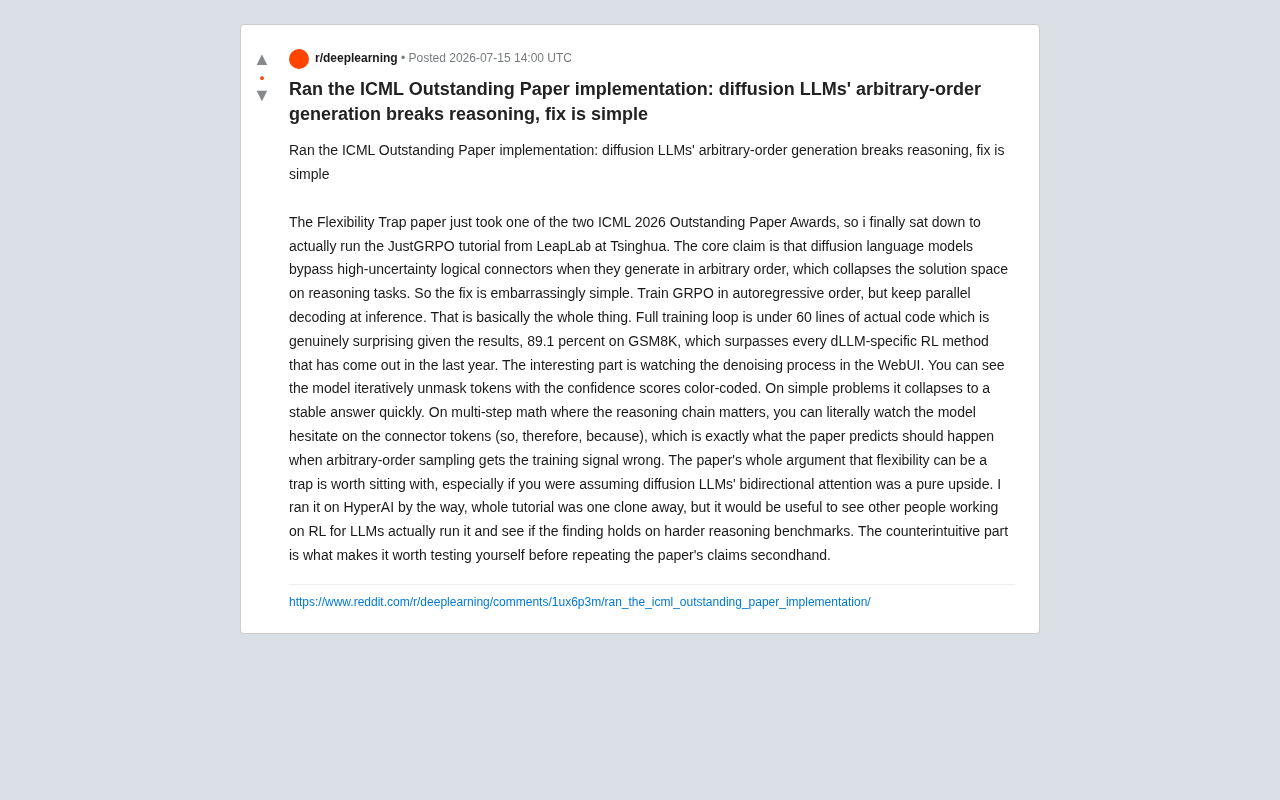
A Reddit user who ran through the JustGRPO tutorial open-sourced by Tsinghua's LeapLab team shared their experience, noting that the most striking aspect of this paper is how deeply the problem is diagnosed, yet how surprisingly simple the solution turns out to be.
The core fix is a single sentence: Train with GRPO in autoregressive order; keep parallel decoding at inference time.
Background on GRPO: GRPO (Group Relative Policy Optimization) is a reinforcement learning algorithm for large language models proposed by the DeepSeek team in 2024. It is a lightweight variant of PPO (Proximal Policy Optimization). Traditional PPO requires maintaining a separate value network (critic) to estimate baseline rewards during LLM training, which is computationally expensive. GRPO's key innovation is sampling a group of outputs for the same question and using the group's average reward as the baseline, eliminating the need for an independent critic network. This significantly reduces memory usage and training complexity, making it highly effective on tasks with clear verification signals such as mathematical reasoning and code generation — DeepSeek-R1's training relies on this algorithm. JustGRPO's contribution is migrating the GRPO training paradigm to dLLMs, with one critical twist: training forces autoregressive order rather than dLLM's native arbitrary order, ensuring logical connectives receive correct training signals.
The actual training loop is under 60 lines of code — a level of conciseness that is genuinely surprising given the performance gains it delivers.
Empirical Validation: 89.1% Accuracy on GSM8K
According to test records, this method achieves 89.1% accuracy on the GSM8K mathematical reasoning benchmark, surpassing all reinforcement learning methods specifically designed for dLLMs over the past year.
About GSM8K: GSM8K (Grade School Math 8K) is a dataset of elementary school math word problems released by OpenAI in 2021. It contains approximately 8,500 problems requiring multi-step arithmetic reasoning, with each problem averaging 2–8 reasoning steps and integer answers. GSM8K has become one of the standard benchmarks for evaluating LLMs' basic mathematical reasoning ability. Early GPT-3 scored under 5% on this dataset; with instruction fine-tuning and Chain-of-Thought prompting, modern models commonly exceed 80%. It's worth noting that GSM8K is considered a relatively "lenient" reasoning benchmark — problems have regular structure, short reasoning chains, and simple numerical computation. Therefore, while 89.1% accuracy leads among dLLM methods, its generalizability to harder benchmarks such as MATH, AIME, or multi-hop reasoning tasks remains to be validated.
The significance of this result isn't in how many percentage points were gained, but in what it confirms causally: if the problem stems from "training order mismatch," then simply aligning training-phase order to the autoregressive pattern lets the inference phase still enjoy the speed advantages of parallel decoding. Training and inference are decoupled — you can have it both ways.
"Seeing" the Model Hesitate in the WebUI
The most intuitive part is observing the denoising process through the WebUI. dLLM generation is fundamentally iterative unmasking — the model progressively reveals masked tokens, with each token's confidence encoded by color.
Technical Meaning of Denoising Visualization: In each denoising iteration, the model outputs a probability distribution over all masked positions and unmasks tokens whose confidence exceeds a threshold, while the rest remain masked for the next iteration. Through color encoding — typically deep colors for high confidence and light or flickering effects for low confidence — users can directly see which tokens the model "hesitated" over for multiple rounds before finally committing. Logical connectives (so, therefore, because) exhibit high uncertainty in multi-step reasoning because their semantics depend not just on local word co-occurrence, but on the logical relationship between preceding and following reasoning steps. If this relationship isn't correctly modeled during training, the model cannot make high-confidence predictions. This visualization is not merely a presentation tool — it serves as direct experimental evidence for the paper's causal claims.
The tester described two distinctly different behavioral patterns:
- Simple questions: The model quickly converges to a stable answer, with a clean and decisive denoising process.
- Multi-step math problems: When the reasoning chain is truly engaged, you can directly observe the model repeatedly hesitating at connectives like so, therefore, and because.
This is exactly the phenomenon predicted by the paper — arbitrary-order sampling misaligns training signals, and the model loses confidence precisely at logical junctions. The alignment between theoretical prediction and visualization observation is one of the most compelling pieces of evidence in this paper.
Why It's Worth Reproducing Yourself
The user particularly emphasized: the counterintuitive nature of the finding is precisely why it deserves independent validation.
If you've always assumed dLLM's bidirectional attention is a pure advantage, the claim that "flexibility may be a trap" deserves serious consideration. It reminds us that architectural freedom doesn't always translate into downstream task capability — in reasoning scenarios that require strict logical ordering, it may actually become a liability.
He completed the entire tutorial on the HyperAI platform with a single clone to set up the environment. But he also honestly acknowledged the current limits of the evidence:
Whether this conclusion holds on harder reasoning benchmarks still requires more researchers working in LLM reinforcement learning to reproduce and validate.
Implications for dLLM Research
This work sends a clear message to the entire diffusion language model community. Over the past year, reinforcement learning methods for dLLMs have proliferated, most attempting to build on the native "arbitrary order" property. JustGRPO takes the opposite approach — acknowledging autoregressive order's natural advantage for reasoning tasks and reserving parallel decoding only for the inference stage.
This "aligned training, free inference" decoupling strategy may prove more promising than continuing to stack complex techniques on top of arbitrary-order generation. That said, whether the conclusion holds robustly on high-difficulty benchmarks beyond GSM8K (such as complex mathematical proofs or multi-hop reasoning) remains an open question.
Conclusion
The value of The Flexibility Trap lies not just in a method that achieves high scores, but in its challenge to a widely assumed premise: architectural flexibility is not necessarily a free lunch. When a model is free to "choose" its generation order, it may selectively avoid the hardest and most critical reasoning nodes.
For developers working on dLLMs or RL for LLMs, this open-source implementation — with under 60 lines of core code and one-command reproducibility — is an excellent hands-on starting point. Before treating the paper's conclusions as secondhand conventional wisdom, consider running it yourself and seeing firsthand whether the model truly hesitates on the word "therefore."
Key Takeaways
Related articles

The Truth Behind Codex 'Build a Website in 5 Minutes': AI Isn't Creating Sites—It's Helping You Copy Them
Exposing the truth behind viral Codex 5-minute website videos: creators aren't building original sites with AI—they're copying shared prompts or scraping others' work. Learn AI coding tools' real limits.

Getting Started with AI Agent Development: A Complete Guide from Concept to Practice
A comprehensive guide to AI Agent architecture and development, covering automated marketing, intelligent customer service, and investment analysis scenarios with single and multi-agent collaboration.

The Truth Behind Codex 'Build a Website in 5 Minutes': AI Isn't Creating Sites — It's Helping You Copy Them
Exposing the truth behind viral Codex 5-minute website videos: creators aren't building original sites with AI — they're copying shared prompts or scraping others' work.