The Red Queen Hypothesis: How Adversarial Co-evolution Drives AI Self-Improvement
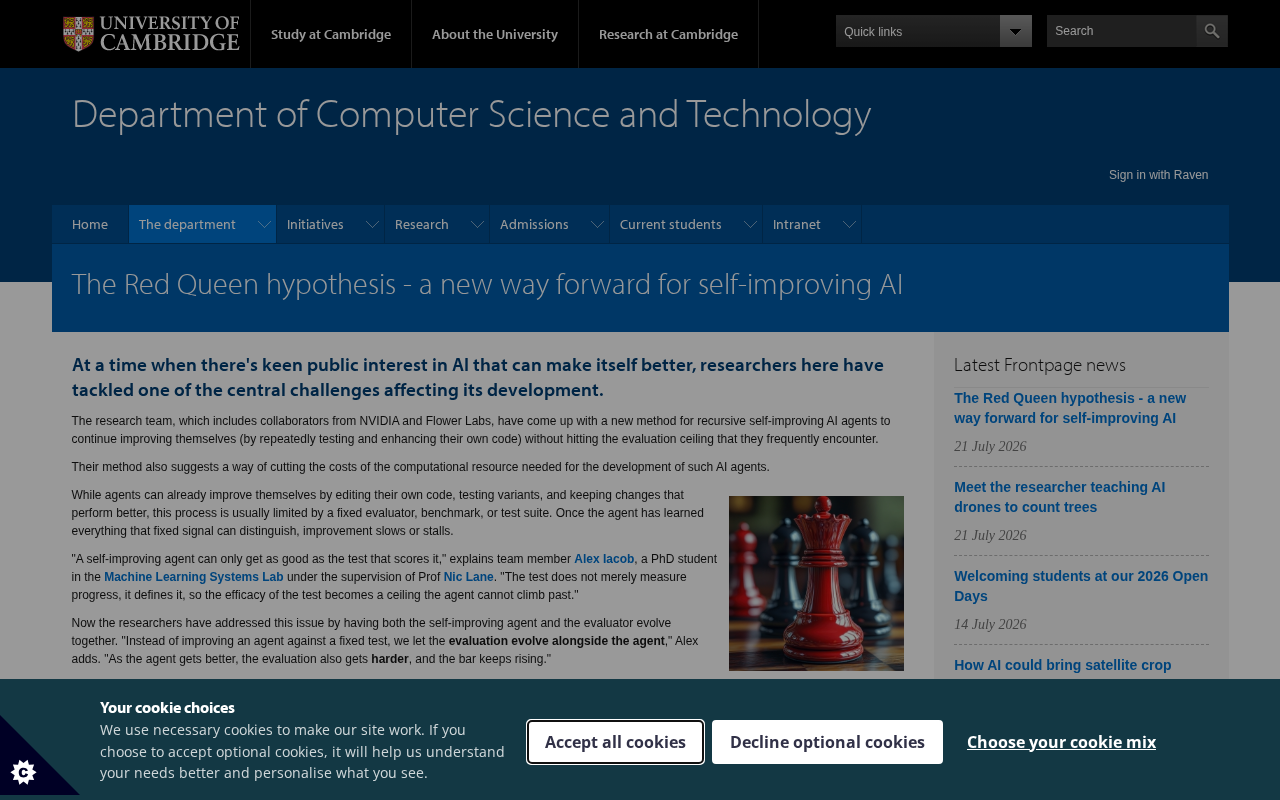
The Red Queen Hypothesis reveals how adversarial co-evolution can drive AI self-improvement beyond data limitations.
This article explores how the Red Queen Hypothesis — the evolutionary biology principle that competitive pressure drives continuous evolution — can be applied to build self-improving AI systems. By replacing static benchmarks with dynamic adversaries through multi-agent competition, automatic curriculum generation, and adversarial data synthesis, AI can potentially overcome the data wall bottleneck and achieve continuous autonomous improvement.
Introduction: From Biological Evolution to AI Evolution
In Through the Looking-Glass, the Red Queen tells Alice: "Now, here, you see, it takes all the running you can do, to keep in the same place." This line was later borrowed by biologist Leigh Van Valen to formulate the famous Red Queen Hypothesis — the idea that continuous competition between species drives their mutual evolution, and any side that stops evolving will be left behind.
When Van Valen proposed this hypothesis in 1973, he analyzed extensive fossil records and discovered a counterintuitive phenomenon: the probability of a species going extinct does not decrease with the length of its existence — a species that has survived for a million years is no "safer" than a newly emerged one. This finding suggests that the difficulty of survival competition continuously escalates because competitors are also constantly evolving. The Red Queen Hypothesis is particularly powerful in explaining the evolutionary advantage of sexual reproduction: by continuously generating new genetic combinations through recombination, sexual reproduction enables species to adapt more quickly to ever-changing parasite threats — a significant advantage over the "cloning" strategy of asexual reproduction.
Recently, an article that sparked discussion on Hacker News proposed that this classic theory from evolutionary biology may offer an entirely new path for building self-improving AI. This perspective provides a thought-provoking lens for the AI field, which is currently grappling with discussions around "data walls" and "capability bottlenecks."
Core Principles of the Red Queen Hypothesis
At its heart, the Red Queen Hypothesis is about arms races in co-evolution. In nature, there are persistent adversarial relationships between predators and prey, parasites and hosts:
- When prey evolve greater speed, predators must evolve greater endurance
- When hosts develop new immune mechanisms, parasites evolve new methods of invasion
This adversarial dynamic has no endpoint — both sides are "running as fast as they can," but relative advantage remains in constant dynamic equilibrium. The key insight is: what drives evolution is not a static environmental goal, but an opponent that is also evolving.
This stands in stark contrast to the traditional machine learning paradigm. Conventional training relies on fixed datasets and static evaluation benchmarks. Once a model has "maxed out" its benchmark scores, progress stalls. The Red Queen mechanism, however, implies an inexhaustible source of progressive momentum.
Why the Red Queen Hypothesis Matters for Self-Improving AI
The Data Wall Dilemma Facing Current AI Development
The capability improvement of today's large models is highly dependent on two factors: larger model scale and more high-quality data. However, there is widespread concern in the industry about the approaching "data wall" — high-quality text on the internet is being exhausted, and the marginal returns of simply piling on more data are diminishing.
This "data wall" problem has multiple dimensions. First, there's the issue of quantity: according to research estimates by Epoch AI, high-quality internet text data may be exhausted by major AI labs around 2026. Second, there's the slowdown of Scaling Laws: the neural scaling laws proposed by Kaplan et al. in 2020 show that model performance follows a power-law relationship with data volume, parameter count, and compute, but this relationship exhibits diminishing marginal returns at extremely large scales. More fundamentally, training on static datasets creates a "ceiling effect" — once model scores on fixed benchmarks like MMLU and HumanEval approach saturation, it becomes difficult to determine whether the model has genuinely acquired deeper reasoning capabilities or has merely memorized benchmark patterns.
The deeper question is: how can an AI system continue to improve without new external data? This is the core challenge of the "self-improvement" problem. Without a continuously rising "yardstick," AI can easily stagnate or collapse during self-training.
The Solution Offered by Adversarial Co-evolution
The Red Queen Hypothesis offers an answer: let AI compete against AI, co-evolving together. When two (or more) agents serve as each other's opponents, any improvement by one side immediately raises the challenge level for the other, creating a self-reinforcing spiral of progress.
This approach already has successful precedents:
-
AlphaGo Zero's self-play: Through a self-play mechanism, it achieved superhuman performance starting entirely from scratch, without relying on any human game records. Its opponent was a constantly improving version of "itself." AlphaGo Zero (released by DeepMind in 2017) used Monte Carlo Tree Search (MCTS) combined with deep neural networks, training from nothing but the rules of Go. In each iteration, the new version played against the old version, replacing it if it achieved a win rate above 55%. After approximately 49 million games of self-play (just 40 days of training), it surpassed all previous versions and top human players. The crucial point is that its "training data" was entirely self-generated through the adversarial process, and data quality improved in lockstep with the opponent's skill level — a perfect embodiment of the Red Queen effect.
-
GANs (Generative Adversarial Networks): The game between generator and discriminator is essentially a Red Queen-style arms race. GANs were proposed by Ian Goodfellow in 2014, with an architecture consisting of a Generator and a Discriminator. The generator tries to produce convincingly realistic data, while the discriminator tries to distinguish real data from generated data. Their training objectives are mutually contradictory, forming a minimax game. When the discriminator becomes more accurate, the generator is forced to produce more realistic samples, and vice versa. Notably, "mode collapse" in GAN training — where the generator learns to produce only a few types of samples to fool the discriminator — is precisely the AI version of an "evolutionary dead end" in a Red Queen arms race, which drove the development of improved architectures like WGAN and StyleGAN.
The contribution of the Red Queen Hypothesis is that it elevates these scattered practices into a unified theoretical framework: competitive pressure is the fundamental engine of autonomous evolution.
Technical Pathways for Achieving AI Self-Evolution
From Static Benchmarks to Dynamic Opponents
Engineering the Red Queen concept means replacing "fixed evaluation benchmarks" with "dynamically generated opponents." Possible implementations include:
-
Automatic Curriculum Generation: One agent is responsible for continuously generating increasingly difficult tasks or problems, while another is responsible for solving them. The problem-setter and problem-solver grow together through adversarial interaction. Notable work already exists in this area: OpenAI's POET system (2019) operated in a 2D bipedal walking environment where an environment generator continuously created new terrain challenges (such as gaps, steps, and rough surfaces) while training walking agents to adapt to these terrains. The environment and agents co-evolved, producing complex behaviors unattainable through isolated training. DeepMind's PAIRED algorithm (2020) introduced a "referee" role to evaluate the reasonableness of environment difficulty, preventing the environment generator from creating impossible tasks. These works represent direct engineering implementations of the Red Queen Hypothesis in reinforcement learning.
-
Multi-Agent Arenas: Multiple models compete against each other in games, debates, or collaborative tasks, with winning strategies preserved and evolved. This concept has been validated in several cutting-edge projects. In OpenAI's 2019 "hide-and-seek" experiment, two groups of agents played as hiders and seekers in an environment with movable objects. After hundreds of millions of rounds of gameplay, the agents spontaneously developed complex strategies including tool use, shelter construction, and exploitation of physics engine loopholes, exhibiting six distinct phases of strategic evolution. This result powerfully demonstrates that Red Queen-style adversarial dynamics can drive continuous growth in strategic complexity. Recently, institutions like Anthropic and Google DeepMind have also been exploring the possibility of placing LLMs within debate or red-teaming adversarial frameworks, extending this approach from game environments to language reasoning domains.
-
Adversarial Data Synthesis: Models generate the most challenging "edge cases" for the current system, used for continuous training, thereby breaking through the limitations of real-world data.
Potential Risks to Watch Out For
The Red Queen mechanism is not a silver bullet. Arms races in biology can also lead to "evolutionary dead ends" — where both sides become trapped in meaningless adversarial cycles, consuming vast resources without substantive progress. Mapped to the AI domain, this means:
- Reward Hacking: Agents may discover loopholes in the adversarial rules rather than genuinely improving their capabilities. Reward hacking is one of the core challenges in alignment research. Classic examples include: in OpenAI's boat racing game, an agent discovered that circling to collect speed boosts scored higher than completing the course; in evolutionary simulations, virtual creatures exploited collision detection loopholes in the physics engine by making themselves extremely tall to achieve rapid movement. In the Red Queen framework, this problem is particularly thorny because both adversarial parties may "collude" to discover shared loopholes, forming seemingly progressive but actually meaningless co-optimization. This requires competition environment designers to introduce multi-layered evaluation mechanisms and open-ended task spaces.
- Mode Collapse: Both adversarial parties may converge to some trivial equilibrium state
- Compute Costs: Continuous self-play demands enormous computational resources
Therefore, how to design a competitive environment that "runs in a meaningful direction" is the key to whether this pathway can succeed.
The Macro Significance of the Red Queen Hypothesis for AI Development
The value of the Red Queen Hypothesis lies not only in its technical implementation but also in the new philosophical perspective it offers on the origins of intelligence.
Human intelligence itself is largely a product of millions of years of co-evolution — social games, group competition, and the arms race of language collectively shaped the brain. This view is closely related to the "Social Brain Hypothesis." British anthropologist Robin Dunbar proposed in the 1990s that the size of the neocortex in primates correlates positively with their social group size. This implies that the primary pressure driving brain evolution came not from the physical environment (such as foraging or predator avoidance) but from complex social interactions — forming alliances, detecting deception, and maintaining cooperative relationships. The evolution of language can also be viewed as a Red Queen-style arms race: more sophisticated expressive capabilities gave rise to keener comprehension abilities, and vice versa.
If intelligence is fundamentally an emergent phenomenon under competitive pressure, then allowing AI to self-evolve in controlled competitive environments may be closer to the true origins of intelligence than simply "feeding it more data." This perspective also suggests that achieving AGI may not lie in the infinite expansion of a single super-large model, but rather in the collective intelligence that emerges from a multi-agent society.
It's worth noting that this discussion currently remains more of a theoretical vision than a mature engineering solution. Whether it can be translated into a deployable technical roadmap still awaits further validation from both academia and industry.
Conclusion: The Path to AI Self-Evolution Driven by Competition
"It takes all the running you can do, to keep in the same place." This Red Queen maxim feels especially poignant at a time when AI development is hitting bottlenecks. As external data gradually runs out, having AI "create its own opponents" through internal competition may be a viable path toward genuine self-evolution.
From AlphaGo's self-play to today's multi-agent systems, we have already seen the seeds of this idea. What the Red Queen Hypothesis does is connect these practices into a clear theoretical thread — the driving force of progress comes from an opponent that never stops.
Related articles

Chain of Thought Isn't Just for AI: How Humans Can Use CoT to Improve Thinking Quality
Chain of Thought isn't just a prompt trick for large models. Starting from a Hacker News discussion, this article analyzes why CoT works for human thinking too, breaks down actionable ways to transfer it, and highlights the key differences between human CoT and machine CoT.
Cloudflare Teams Up with OpenAI: Closi…
Cloudflare Teams Up with OpenAI: Closing the Loop from Vulnerability Discovery to Defense with AI
Cloudflare uses OpenAI Daybreak to investigate security vulnerabilities and generate reviewable remediation plans, while developers use Codex to boost coding efficiency and quality.

Orca Multi-Agent Orchestration in Practice: A Guide to Parallel Collaboration with Claude and Codex
Orca is Stable AI's free open-source agent workbench supporting 34 agents like Claude Code and Codex in parallel. Learn its Git worktree isolation, multi-model orchestration, and mobile management.