The Reverts Never End: The Dilemma of Repeated Code Rollbacks in Open Source Projects

Frequent reverts expose process and communication problems, erode open source morale, and require records and verification to break the cycle.
Using Peter Eisentraut's blog title as a starting point, the article discusses the phenomenon in open source projects where code is repeatedly submitted and then reverted. Reverting is a safe and traceable operation in Git workflows, but when it becomes the default damage-control measure rather than the exception, teams fall into a cycle. The root cause is usually not technical but rather insufficient code review, inadequate test coverage, and a lack of risk consensus between submitters and maintainers. Repeated reverts erode contributors' intrinsic motivation and maintainers' energy, and unexplained reverts are especially damaging to morale. The article suggests making reverts carry memory, strengthening pre-change verification, establishing clear criteria for revert decisions, and improving the quality of revert descriptions. Revert frequency and follow-up practices can serve as reference signals for evaluating a project's maintainability.
A Discussion Sparked by a Title
Peter Eisentraut's blog post "The reverts will continue until morale improves" received 200 points and 37 comments on Hacker News. The title itself has become a kind of dark humor in the tech community. It plays on the classic slogan "The beatings will continue until morale improves," swapping in "revert" to precisely hit a pain point for many open source contributors: code is repeatedly submitted and then reverted, over and over, while morale declines.
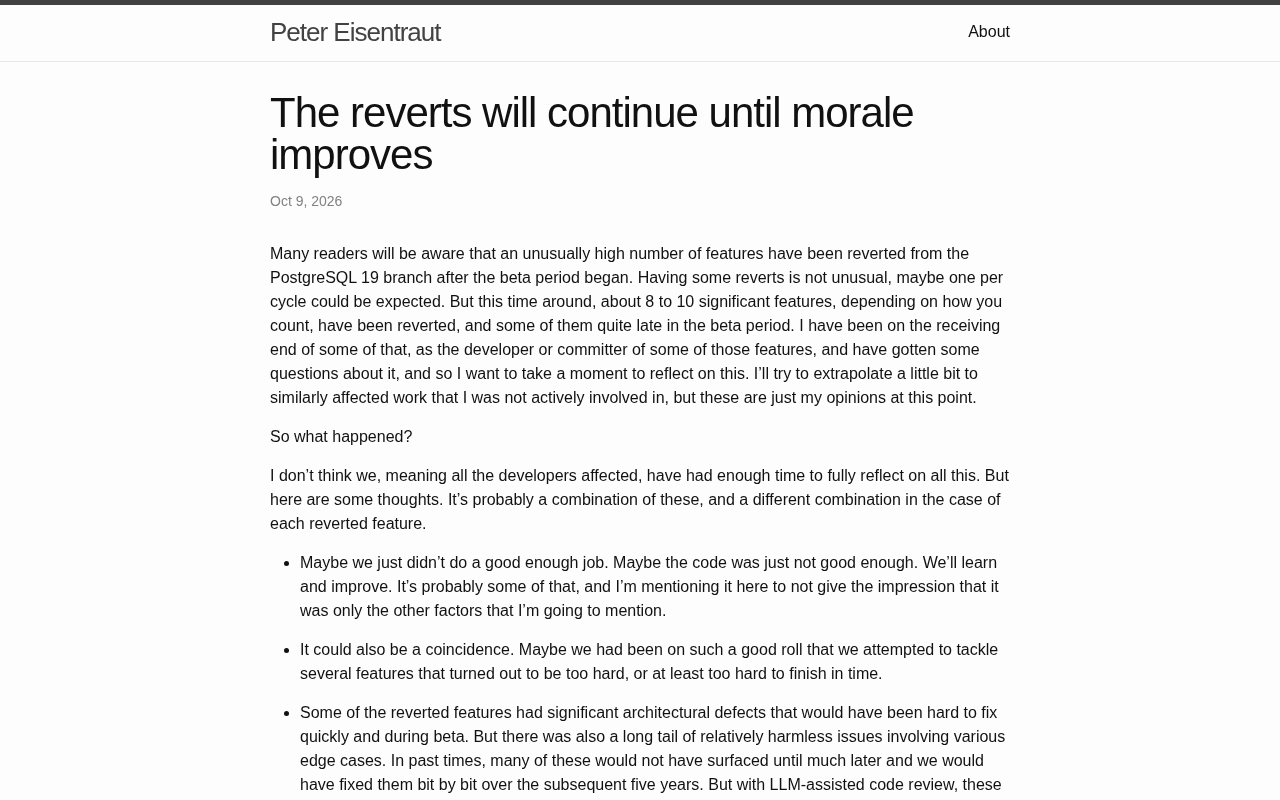
From the link information alone, this is just an aggregated blog post entry with no summary or body details. But the title and the level of discussion are enough to show that this issue resonates strongly in the developer community. Reverting is a routine operation in version control, but when it happens frequently, it often exposes deeper problems in process, communication, or culture.
Why Reverts Happen Repeatedly
In Git workflows, git revert is a safe and traceable operation: it undoes previous changes by creating a new commit and does not rewrite history. Because of this, it is often used as a tool for "quick damage control." The problem is that when reverting becomes the default way to solve problems rather than the exception, teams fall into a cycle: someone submits a change, someone discovers a destructive impact, and the change is reverted; after a while the same change is submitted again and reverted again.
The root of this cycle is usually not technical. It may be insufficient code review, inadequate CI test coverage, or a lack of consensus between the submitter and the maintainer about the scope and risk of the change. Every revert consumes trust and energy, and if the reason for the revert is not recorded, reviewed, and followed up, the next submission will repeat the same mistake.
git revert and git reset are often confused, but they are fundamentally different: git revert creates a new commit that applies the reverse of the original commit and does not modify history, so it can be safely used on public branches that have already been pushed; git reset moves the branch pointer, and using it on a shared branch will destroy history that others have already pulled. It is precisely because git revert is "traceable and does not destroy history" that it is naturally suited as a damage-control tool in collaborative environments. But this also has a side effect: the revert operation seems "too convenient," lowering the psychological threshold for making the decision. When a team lacks an evaluation step before reverting (for example, confirming the scope of impact and notifying relevant parties), git revert turns from an exceptional measure into a default reaction, which in turn creates the "submit—revert—resubmit" cycle. Understanding the semantics of this tool helps determine whether the problem lies in the operation itself or in a missing process.
Impact on Project Morale
The word "morale" in the title is not a rhetorical flourish. Most open source contributors participate out of interest and reputation, and the frustration caused by repeated reverts directly erodes this intrinsic motivation. If a patch a contributor spent time writing is reverted without a clear explanation and constructive feedback, they will likely choose not to contribute again. Maintainers are exhausted too—they must constantly review, judge, revert, and deal with the resulting arguments.
Although the content of the 37 comments on Hacker News is unknown, the volume of discussion itself shows that this topic touches on a shared experience in the community. In open source projects, revert disputes often turn into discussions about "who has the right to decide" and "how to measure the value of a change," and these discussions are often harder to resolve than the code itself.
The motivational structure of open source contributors differs from that of employment relationships. Researchers broadly divide these motivations into intrinsic motivation (learning, interest, sense of accomplishment) and extrinsic motivation (reputation, career signals, peer recognition). A revert itself does not necessarily discourage contributors; what truly causes frustration is the lack of explanation and feedback after the revert—contributors cannot tell whether their patch was misunderstood, ignored, or actually flawed. If a revert comes with clear review comments and a path to resubmit, it can instead become an effective learning opportunity. Conversely, an unexplained revert sends the signal that "your work is not valued," which directly weakens intrinsic motivation and may cause contributors to move to other projects. Therefore, the cultural effect of reverts depends more on the quality of communication after the revert than on the number of reverts itself.
Breaking the Cycle Through Process
To reduce repeated reverts, several steps can be taken. First, make reverts carry "memory": every revert should be linked to a specific problem description and recorded in the issue tracking system, so that the same change is not resubmitted without explanation. Second, strengthen verification before changes, including more granular tests and targeted review checklists, especially for high-risk modules. Third, establish clear criteria for revert decisions, distinguishing between cases that "must be reverted immediately" and cases that "can be discussed and fixed," reducing overreactions caused by poor communication.
Another often overlooked point is the quality of feedback. If the description of a revert commit only says "Revert ...," it is almost useless to later readers. Including the reason for the revert, the scope of impact, and the preconditions for resubmission allows the whole team to learn from a revert rather than merely repeating an operation.
Insufficient CI (continuous integration) test coverage is one of the common technical triggers for repeated reverts. When tests cover only the happy path and lack boundary conditions, integration scenarios, and regression cases, destructive changes are hard to detect before merging and only surface in production or through downstream user feedback—at which point reverting becomes the only option. In contrast, granular tests and review checklists for high-risk modules can intercept problems before changes enter the main branch. Another often overlooked mechanism is controlling the scope of changes: overly large commits touch multiple modules at once, making it difficult to undo only part of them during a revert, so the entire change must be rolled back, causing collateral damage. Splitting changes into small, independently verifiable commits makes reverts more precise and reduces the adversarial decision pressure of "all or nothing."
A Signal Worth Watching
The fact that this blog post attracted attention on Hacker News shows that "revert culture" has become an engineering management topic worth public discussion. For teams using open source projects, this is also a reminder: when choosing dependencies, the maturity of a project's change management—including the frequency of reverts and how they are followed up—is a real indicator for evaluating its long-term maintainability.
Reverts will not disappear, nor should they. A healthy project needs reverts as a safety net, but when the safety net is triggered frequently, what needs to be examined is the tightrope walker, the rope, or the arrangement of the entire performance.
One-line Summary
Frequent reverts expose process and communication problems, erode open source morale, and require records and verification to break the cycle.
Paragraph Summary
Using Peter Eisentraut's blog title as a starting point, the article discusses the phenomenon in open source projects where code is repeatedly submitted and then reverted. In Git workflows, reverting is a safe and traceable operation, but when it becomes the default damage-control measure rather than the exception, teams fall into a cycle. The root cause is usually not technical but rather insufficient code review, inadequate test coverage, and a lack of risk consensus between submitters and maintainers. Repeated reverts erode contributors' intrinsic motivation and maintainers' energy, and unexplained reverts are especially damaging to morale. The article suggests making reverts carry memory, strengthening pre-change verification, establishing clear criteria for revert decisions, and improving the quality of revert descriptions. Revert frequency and follow-up practices can serve as reference signals for evaluating a project's maintainability.
Related articles

Chain of Thought Isn't Just for AI: How Humans Can Use CoT to Improve Thinking Quality
Chain of Thought isn't just a prompt trick for large models. Starting from a Hacker News discussion, this article analyzes why CoT works for human thinking too, breaks down actionable ways to transfer it, and highlights the key differences between human CoT and machine CoT.
Cloudflare Teams Up with OpenAI: Closi…
Cloudflare Teams Up with OpenAI: Closing the Loop from Vulnerability Discovery to Defense with AI
Cloudflare uses OpenAI Daybreak to investigate security vulnerabilities and generate reviewable remediation plans, while developers use Codex to boost coding efficiency and quality.

Orca Multi-Agent Orchestration in Practice: A Guide to Parallel Collaboration with Claude and Codex
Orca is Stable AI's free open-source agent workbench supporting 34 agents like Claude Code and Codex in parallel. Learn its Git worktree isolation, multi-model orchestration, and mobile management.