The Rise and Fall of LeapPad: Why a Smart Book Lost to the iPad

LeapPad dominated early ed-tech but was swallowed whole when the iPad made dedicated learning devices obsolete.
LeapPad, LeapFrog's interactive smart book device, dominated the U.S. educational toy market in the early 2000s through a closed hardware-plus-paid-content ecosystem backed by strong parental trust. Its success hinged on "educational legitimacy" that justified premium pricing. But the iPad's arrival as a general-purpose platform — delivering richer content at lower marginal cost — dismantled LeapPad's technological edge and business logic simultaneously. LeapPad's fall is not an isolated case; it mirrors the broader tech pattern of GPS devices, cameras, and MP3 players all being absorbed by general-purpose platforms, serving as a lasting cautionary tale for hardware entrepreneurs.
A Talking Book That Was Once America's Hottest Toy
In the years before tablets became ubiquitous, America's most coveted toy was, remarkably, a book. But not just any book — it was a "smart book" that could speak, respond to touch, and help children learn to read. With its learn-through-play philosophy, LeapPad became the educational device that nearly every parent was willing to buy.
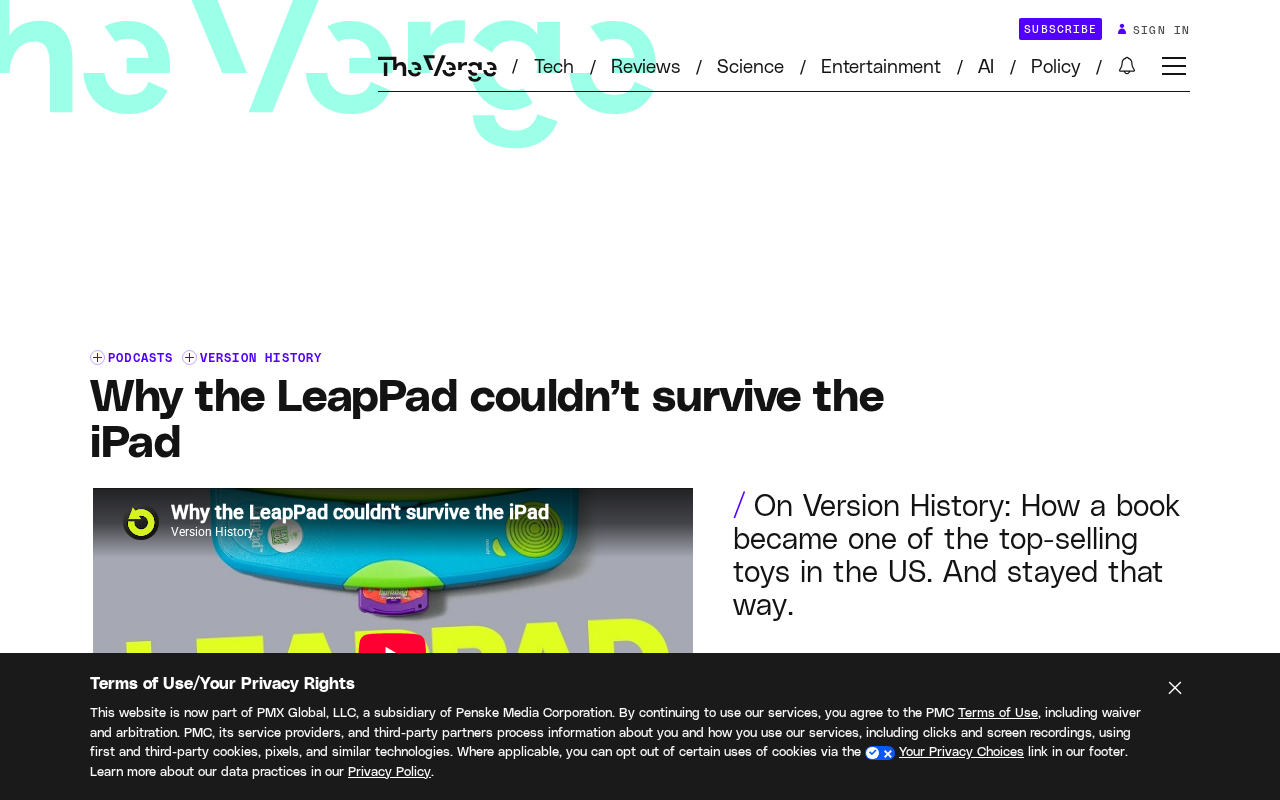
For parents of that era, LeapPad represented an ideal product: part toy, part learning tool — something that kept children engaged while giving parents peace of mind. This "educational legitimacy" was the cornerstone of its early success. Unlike video games, which carried the stigma of being a waste of time, LeapPad was seen as a worthwhile investment in a child's development.
The Business Logic Behind the High Price
As the original piece notes, this product "came with a high price." Dedicated hardware combined with separately purchased companion books and content cartridges formed a relatively closed and expensive ecosystem.
This business model made perfect sense at the time: the hardware was just the entry point, and the real profit came from continuously selling content. Each new interactive book and each new learning cartridge was a recurring revenue stream — the same logic as printers and ink cartridges, or game consoles and game cartridges. For LeapFrog (LeapPad's manufacturer), this appeared to be a solid and sustainable business.
The problem, however, was that every bit of value in this closed ecosystem rested on a single assumption: the necessity of a dedicated device. The moment a general-purpose device appeared that could deliver richer content at a far lower marginal cost, the entire business model would face an existential challenge.
LeapFrog was founded in 1995 by Michael Wood, who originally invented the "touch-and-sound" technology to help his own son learn to read. LeapPad's core technology relied on a specially designed stylus and pages printed with proprietary encoding — when the stylus tip touched specific areas on a page, the device would play the corresponding word pronunciation, sentence reading, or interactive question. This technology held significant patent barriers in the early 2000s, making it difficult for competitors to directly replicate. LeapFrog went public in 2002, reached a peak market cap of over $1 billion, and built a content library spanning hundreds of interactive books across subjects from alphabet recognition to math and science. This dual-engine "platform + content" model allowed LeapFrog to dominate the U.S. educational toy market from 2003 to 2007.
The iPad Changed Everything
The iPad was exactly that general-purpose device. It wasn't designed specifically for children's learning, yet it could do virtually everything LeapPad could — and more, and better.
Once a family owned an iPad, a child's interactive reading, learning games, and drawing activities could all be handled by the abundance of apps in the App Store. Those apps were often cheap or free, updated rapidly, and offered visual and interactive experiences that far exceeded what dedicated devices could provide. LeapPad's proud "smart interactivity" advantage was instantly neutralized by a general-purpose tablet with fluid touch response and a thriving ecosystem.
More critically, the nature of consumer purchasing decisions shifted. Parents who previously had to specifically buy a LeapPad for their child now already owned an iPad at home, or were willing to buy a single device the whole family could share. An expensive, single-purpose toy simply couldn't compete with a general-purpose device that met everyone's needs. LeapPad lost not just its technological edge — it lost its reason for existing.
The Inevitable Fate of Single-Purpose Devices
LeapPad's decline is a classic story that has played out repeatedly throughout tech history. When a general-purpose computing platform becomes powerful enough and widespread enough, single-function dedicated devices are almost always absorbed. Standalone GPS navigators lost to smartphones. Point-and-shoot cameras, MP3 players, and PDAs all met the same fate.
LeapPad's particular tragedy was that its "educational toy" positioning was, at its core, a software and content problem — and software and content are precisely what general-purpose platforms excel at delivering. It had no irreplaceable physical attributes and no core capability that an iPad couldn't replicate. Once a general-purpose device dramatically reduced the cost of delivering the same content, there was nothing left to justify the premium of specialized hardware.
This story also serves as a warning for today's hardware entrepreneurs: if a device's core value can be fully replicated in software, it can be displaced by a more general-purpose device at any time. The products that truly withstand the pressure of general platforms are those with unique physical interactions, exclusive use cases, or deep emotional value.
Economists refer to this phenomenon as platform consolidation: once a general-purpose platform crosses a certain performance threshold, it progressively internalizes the functions of surrounding specialized devices, systematically compressing their market space. Researcher Clayton Christensen described something similar in his theory of disruptive innovation — disruption rarely comes from direct frontal competition, but from a "good enough" and lower-cost alternative flanking the incumbent. The iPad was not built to replace LeapPad, but its combined advantages in touch experience, content ecosystem, and household penetration effectively wiped out LeapPad's niche market within just a few years. LeapFrog's revenue peaked around 2012 and then dropped sharply. The company was acquired in 2016 for approximately $72 million — a decline of more than 90% from its peak valuation.
Epilogue: A "Smart Book" Overtaken by Time
LeapPad was not a failed product — it genuinely accompanied a generation of children through their early years and validated the market demand for interactive educational devices. It was simply a product that found itself standing in front of the rising tide of general-purpose computing at the wrong moment.
Its story reminds us that a product's success or failure depends not only on how well it's made, but on whether the technological environment it inhabits is undergoing a fundamental shift. When the iPad defined an entirely new computing paradigm, that once-amazing "talking book" could only become a warm memory for a generation.
Related articles

Understanding DeepSeek in 3 Minutes: The Rise from a Quant Hedge Fund to an Open-Source AI Leader
DeepSeek's history in 3 minutes: from High-Flyer Quant's compute build-up to V2's MLA inference cost cuts, V3's $5.576M training bill, R1's open-source global shock, and V4 with a $7B Series A.

Local Creative Writing Model Showdown: Fine-tuned Qwen3.8 27B Wins, DeepSeek v4.1 Underwhelms
Bilibili creator tests seven local creative writing models: Hemingway and HumanLike Chat based on Qwen3.8 27B perform best, DeepSeek v4.1 is plain, Dongfang Shuo ranks last with confused characters. Includes three test prompts, scores, and usage advice.

Liang Wenfeng's Three Big Bets: Why Did DeepSeek Open-Source Its 82% Gross Margin?
Why did DeepSeek open-source DeepInfer, its 82% gross margin inference framework, and then launch a hundred-billion funding round? An analysis of Liang Wenfeng's three big bets and the open-source strategy.