The Rise of AI Reverse Engineering: Cloning Adobe Software Without a Single Line of Source Code

AI is democratizing reverse engineering — cloning software visually without source code, but the "totally legal" claim is dangerously misleading.
A viral video shows developers using an AI "observe–compare–iterate" loop to clone the full Adobe suite without touching any source code, claiming it's "completely legal." The GitHub project "Reverse Engineer Anything" is turning this into an accessible workflow for ordinary developers. Beyond free clones, the more compelling idea is on-demand custom software — keeping only what you need and adding personalized features. However, the legality claims are seriously flawed: the practice may violate trade dress, patents, and EULA terms, and the legal framework around AI cloning lags far behind the technology.
When AI Starts "Watching" Software to Rebuild It
A video circulating on YouTube has raised an unsettling question for the entire software industry: developers are using AI to clone the full Adobe suite — including Photoshop and Premiere — without ever touching the original source code. The even more controversial claim? That doing so is "completely legal."
The technical logic behind this isn't complex, but it is profoundly disruptive. AI observes what a software feature looks like and how it behaves, attempts to reconstruct it purely from visual and interactive cues, compares the result against the original, then iterates until it achieves pixel-perfect fidelity. This is the new face of Reverse Engineering in the age of AI.

Traditional reverse engineering typically requires decompilation, binary analysis, or source code examination — a high-barrier process with significant legal risks. When AI simply "watches" an interface and mimics its functional behavior, the process sidesteps direct copying of source code entirely. That's the foundation for the "it's legal" argument made in the video — though that claim deserves serious scrutiny, which we'll address shortly.
The technical path to pixel-perfect cloning typically chains together several steps in an AI toolchain: first, a multimodal large language model (such as GPT-4o or Claude) visually interprets screenshots or screen recordings of the software, identifying layout, control types, and interaction logic; next, a code generation model (such as Cursor or GitHub Copilot) translates that understanding into runnable frontend or application code; finally, an automated testing framework compares the visual output of the original and the clone, feeding differences back to the model for the next round of refinement. This "perceive–generate–compare–iterate" loop essentially treats the software itself as an "executable specification document" that never needs to be read. Importantly, this approach can only capture the behavioral surface of software — it cannot reconstruct internal data structures, optimization algorithms, or low-level rendering pipelines. That's the fundamental capability gap between this method and true reverse engineering.
"Reverse Engineer Anything": A New Trend on GitHub
The video highlights an open-source project called Reverse Engineer Anything that's trending on GitHub, claiming to walk anyone through how to use AI to reverse-engineer and rebuild software features. The emergence of projects like this signals that skills once belonging to a small circle of security researchers and reverse engineering specialists are being tooled, systematized, and made accessible to ordinary developers.
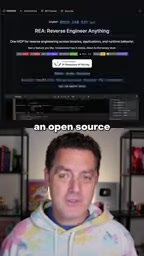
From a technical evolution standpoint, this is a natural extension of AI code generation capabilities. Where we once talked about "generating a function from natural language," the current frontier is "using a finished product as the specification document and letting AI reverse-engineer and rebuild the entire application." AI here is no longer playing a supporting role in autocomplete — it's acting as an engineer capable of observing, understanding, and reproducing complex interactive systems.
A clear-eyed assessment is warranted: current demonstrations tend to focus on "pixel-perfect recreation" of individual features or interfaces. There remains a vast gulf between that and stably cloning something like Photoshop — industrial-grade software built over decades, with massive underlying algorithms covering image processing, color management, and filter engines. Interfaces can be imitated, but the underlying performance, algorithmic precision, and edge-case handling cannot be solved by "watching and rebuilding."
More Imaginative Than Cloning: Building Software Tailored to You
The most inspiring idea in the video isn't actually "getting Adobe for free" — it's a reimagination of what software could look like. The creator uses a clever analogy: have you seen those game mashups — Mario in Elden Ring, Minecraft inside GTA?

Translate that thinking to productivity tools, and the possibilities open up: you could rebuild only the features from Photoshop that you actually need, strip away the bloat, and add capabilities the original never had — ones designed specifically for your workflow. That's software completely customized for the individual.
This points to a deeper trend — software could shift from a model where "vendors define features and users passively accept them" to one where "users define needs and AI assembles on demand." When the cost of rebuilding a feature approaches zero, the monopoly logic of "large, all-encompassing general-purpose software" begins to erode. You no longer need to subscribe to an entire suite just to use 10% of its features.
Legality and Ethics: The Part That Gets Glossed Over
The video repeatedly insists this approach is "completely legal" — but this is the weakest claim in the entire piece, and the one readers should be most skeptical of.
The legal definition of reverse engineering varies enormously across jurisdictions. Even without directly copying source code, cloning software can still implicate trademark law, trade dress, patents, and anti-reverse-engineering clauses in End User License Agreements (EULAs). Recreating an interface at pixel-perfect fidelity could itself constitute infringement of protected visual design. Describing this kind of activity as "legally obtaining something for free" is dangerously misleading.
From an industry perspective, if these tools mature, they pose a genuine threat to commercial software companies' business models — and the inevitable response will be stricter legal action, technical countermeasures (such as obfuscation and server-side processing), and licensing model adjustments. This looks less like a settled fait accompli and more like the opening move in a long-running battle over software ownership.
Trade dress is an important concept under U.S. trademark law, referring to a product or service's overall visual appearance — including color schemes, layout structures, and icon styles — which is legally protected as long as consumers can use it to identify the source. This means that even if a cloner never looks at a single line of source code, highly faithful recreation of an interface alone may constitute trade dress infringement against the original vendor. Furthermore, most commercial software EULAs contain explicit anti-reverse-engineering clauses that users agree to upon installation, which carry contractual force in many jurisdictions. The EU Software Directive (2009/24/EC) does provide limited exemptions for reverse engineering undertaken for interoperability purposes, but activities aimed at commercial cloning generally fall outside those exemptions. The assertion that "not touching the source code equals legality" is a severe oversimplification of intellectual property law.
Final Thoughts: The Real Questions Beneath the Hype
Strip away the clickbait packaging of "never pay for software again," and there are three things genuinely worth paying attention to: AI is democratizing reverse engineering; on-demand software customization may become a new paradigm; and the legal and ethical frameworks surrounding AI cloning are lagging dangerously behind the technology.
For developers, this represents an expansion of capability. For software vendors, it's an alarm bell for their moats. For ordinary users, rather than waiting for "free Adobe," it's worth focusing on a more realistic future — software that becomes increasingly tailored to individual needs. As for that phrase "completely legal" — treat it as marketing copy, not legal advice.
Related articles

How Big Can Stars Really Get? The Physical Limits of the Largest Stars
Red supergiants are the largest stars by volume, with radii up to 2,000 times the Sun, engulfing the inner solar system. But there is no precise upper limit on stellar size—models predict up to 15,000 solar radii. The most massive blue stars are far smaller than red supergiants—biggest and heaviest are two different things.

Apple HomeView Smart Display Full Feature Breakdown: Wall-Mount or Desktop, $299
Apple launches HomeView, a $299 smart display with wall-mount and desktop options, 12MP camera for facial recognition, smart home control, music playback, and recipe step-by-step cooking. Full breakdown of watch faces, apps, privacy, and cooking integration.

Where Did the Promised New Studio Go? Craft Computing Answers After Five Years
Craft Computing's host responds to viewer questions: the new studio promised five years ago was shelved as construction costs soared from $30,000 to $75,000, and was replaced by a 168-square-foot garage conversion.