The Rise of Chinese Open-Source AI Models: A Head-On Challenge to Closed-Source Dominance

Chinese open-source AI models are catching up to closed-source leaders, reshaping global AI competition.
Chinese open-source models like DeepSeek and Qwen are rapidly closing the gap with top closed-source AI, shaking OpenAI and Anthropic's valuation logic amid IPO pressure. This deep dive covers the six-year open-vs-closed rivalry, US-China AI competition, and Google's uniquely dominant position.
Six Years of Open-Source vs. Closed-Source Rivalry
Since ChatGPT sparked the generative AI wave in late 2022, the rivalry between open-source and closed-source models has raged on for more than six years. Generative AI refers to artificial intelligence systems capable of automatically producing text, images, code, and other content based on input prompts, with large language models (LLMs) at their technical core. These models are almost uniformly built on the Transformer architecture—first proposed by Google in the 2017 paper Attention Is All You Need. Its core innovation, the "self-attention mechanism," allows the model to dynamically capture dependencies between any two positions in a sequence, completely replacing the previously dominant recurrent neural networks (RNNs). At their essence, LLMs are ultra-large-scale Transformers pretrained on massive text corpora, typically with parameter counts ranging from billions to trillions.
Open-source models are those whose model weights and architecture are publicly available, allowing anyone to download, modify, and redeploy them; closed-source models, by contrast, keep their weights strictly confidential and offer inference services only through API interfaces. "Model weights" are the numerical matrices obtained through gradient-descent optimization during training, encoding the entirety of a model's "memory" of language patterns—once weights are made public, anyone can run inference locally without retraining, which is precisely the technical crux of the open-source-versus-closed-source debate. The core appeal of the open-source route lies in freedom: users can deploy models on local devices or private servers, completely escaping dependence on third-party cloud interfaces, while their data never has to leave the private environment.
The reality, however, is that since 2022, leading closed-source labs have generally chosen to privatize high-performance models, opening them via API at near-cost pricing. This strategy allowed the closed-source camp to long dominate in consumer-grade experience and frontier capabilities, and the capability gap between open and closed source once stretched to as much as a year and a half.
But that gap is narrowing at an astonishing pace: from a year and a half, to a year, to a few months—and now it has all but vanished. With the successive release of several flagship-caliber open-source models, open-source capabilities are now strong enough to go head-to-head with any frontier closed-source model.

The DeepSeek Moment and the Rise of Chinese AI
The first key signal that open-source models had caught up with closed-source models was the industry-shaking "DeepSeekAd moment." DeepSeek's impact stemmed first from its architectural innovation: it adopted a Mixture of Experts (MoE) architecture. Unlike traditional dense Transformer models that activate all parameters during every inference, the core design of the MoE architecture replaces the original single feed-forward network (FFN) layer with multiple parallel "expert" subnetworks and introduces a lightweight "gating network." On each forward pass, the gating network dynamically selects and activates the Top-K experts based on the input token's features, while the parameters of the remaining experts lie completely dormant during that computation. DeepSeek-V3 has a total parameter count of roughly 671B, yet only about 37B parameters are activated per token—preserving the model's upper limit of knowledge capacity while drastically compressing the actual computational load (FLOPs) of both inference and training. According to reports, DeepSeek achieved a capability level comparable to OpenAI's reasoning models at a training cost of only about $6 million, whereas the latter's training investment is estimated to be dozens of times higher.
This "efficiency miracle" simultaneously relied on the innovative Multi-head Latent Attention (MLA) mechanism. Traditional multi-head attention, during autoregressive inference, must cache the Key-Value matrices for every attention head in every layer. As sequence length grows, the memory footprint of the KV Cache expands linearly, becoming the core bottleneck constraining long-text inference speed and concurrency. MLA uses low-rank joint compression to project Keys and Values into a low-dimensional latent space for caching, reducing KV Cache memory usage to roughly 5% to 13% of standard MHA while incurring almost no loss in model performance—directly boosting inference throughput on the same hardware. Combined with system-level engineering optimizations, this capability demonstration ultimately triggered nearly a trillion dollars in market-cap shockwaves across global tech stocks.
Before this, the industry generally believed there was a 4-to-6-month technological time lag between Chinese models and top American models—a fairly comfortable lead window. But the emergence of models like Qwen 3 not only achieved capability parity across multiple benchmarks, but also completed—within just one month of a model's launch—a capability leap that should have taken years to accumulate.
Here lies a paradox worth noting: starting in October 2022, the U.S. Department of Commerce imposed a series of high-end AI chip export controls on China, with core targets including data-center-grade GPUs such as NVIDIA's A100 and H100. The core technical metrics of the controls were the "Total Processing Performance" (TPP) and "performance density" thresholds—the restricted chips held decisive advantages across three key specifications: 80GB of HBM2e high-bandwidth memory (with 2TB/s memory bandwidth, determining how fast large-model weights can be loaded), NVLink high-speed interconnect (allowing direct card-to-card communication at 600GB/s bandwidth, a prerequisite infrastructure for thousand-GPU-scale parallel training), and the BF16/FP8 mixed-precision compute of Tensor Cores. The down-spec A800 limited NVLink bandwidth to 400GB/s, and while China's domestic Huawei Ascend 910B claims comparable nominal compute power, it still exhibits clear gaps in software ecosystem maturity and multi-machine interconnect stability, potentially extending the training time of same-scale models by several fold. Yet it was precisely under this constraint of "compute poverty" that Chinese open-source models traded algorithmic innovation for compute efficiency, completing a paradigm shift amid adversity—and now pose a substantive challenge to the U.S. AI industry.
Valuation Anxiety for Closed-Source Under IPO Pressure
Why is the present moment so sensitive? The answer is closely tied to capital-market expectations.
Both OpenAI and Anthropic are counting on the valuation payoff of an initial public offering (IPO). Tech company IPO valuations typically use the "Revenue Multiple" method, pricing the company by multiplying current or projected annual recurring revenue (ARR) by an industry premium coefficient. For AI foundation-model companies, this coefficient can reach dozens of times, supported by three core narratives: the scarcity of technological barriers, user lock-in driven by network effects, and the optionality value of expanding into the application layer. OpenAI's IPO target valuation is set at the trillion-dollar level, while Anthropic's latest valuation has approached $965 billion, with plans to pursue a listing as soon as possible.
As these companies move toward the public market, they must prove to investors that, in the face of head-on competition from free open-source models, their business models still possess a durable moat. The reality, however, is exactly the opposite—the strong catch-up of open-source models is triggering the "Commoditization Risk" that investment-bank analysts fear most: as open-source model capabilities continue to close in on closed-source models, the "scarcity of technological barriers" narrative is the first to erode, prompting analysts to lower the probability weight of sustainable differentiation and compress valuation multiples. Core products gradually evolve from differentiated competitors into homogenized commodities, users' willingness to pay drops rapidly, in turn triggering price wars, compressing profit margins, and shaking the very foundation of the entire valuation logic. This dynamic has ample precedent in the SaaS industry: when the infrastructure layer commoditizes, vertical companies relying purely on technology premiums often face valuation repricing.
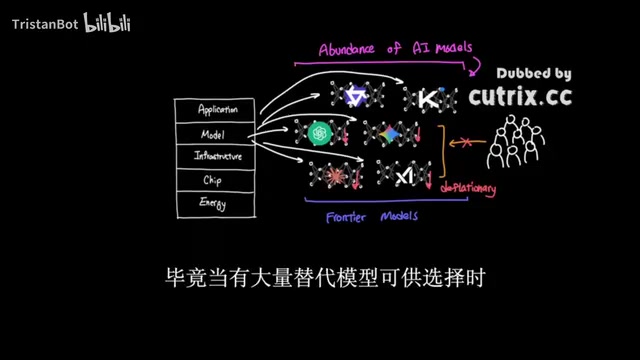
Revenue Structure Determines the Direction of Pressure
OpenAI's revenue relies primarily on its subscription business, while Anthropic depends more on API pricing and enterprise services. As long as open-source models continue to draw user attention, they will directly impact subscription retention and API revenue—especially on the API side where early adopters cluster, users have every incentive to switch platforms for the sake of cost advantages.
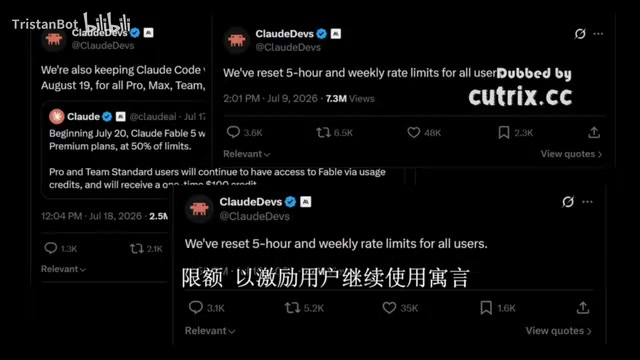
To counter this pressure, closed-source vendors keep refreshing token quotas and usage incentives, essentially conveying a signal to users: stay here, no need to look elsewhere.
China's Other Challenge: A Severe Compute Shortage
Unlike the valuation anxiety of U.S. closed-source labs, Chinese labs face the exact opposite dilemma—a severe shortage of compute.
Due to the surge in user demand triggered by their new-generation models, labs such as Moonshot have had to limit new-user subscriptions, because their existing infrastructure can no longer bear the exploding concurrency demand. This predicament of being "forced to throttle because of overwhelming popularity" is precisely the most powerful market endorsement of a model's competitiveness—it also demonstrates that Chinese open-source models have become mainstream options worthy of serious consideration, not mere also-rans.
"Open Source Is Decelerationism"? A Contentious Debate
So great is the competitive threat of Chinese open-source models that OpenAI's head of research strategy even wrote an article in response. The core argument in the piece is rather pointed: open-source models essentially fuel "decelerationism."
Understanding this argument requires knowledge of the long-standing ideological divide within the AI community. "Effective accelerationism" (e/acc), a technological philosophy that rapidly spread through Silicon Valley tech circles around 2022, holds at its core that the acceleration of technological progress is inherently good, and that any constraint attempting to "pause" or "slow down" AI development is a suppression of human potential. In opposition, "decelerationists" (represented by AI safety researchers) argue that, before the alignment problem—namely, how to ensure the goals of superintelligent AI systems align with human values—is reliably solved, accelerating the proliferation of powerful AI systems will systematically increase catastrophic risk.
Characterizing open-source models as "tools of decelerationism" is a classic rhetorical strategy of "issue framing"—it transforms what is essentially a matter of commercial competition into a dispute over safety and values, making restrictions on open source look like responsibility for overall progress rather than protection of one's own commercial interests. The core logical chain runs as follows: as more and more top-tier models become freely downloadable or modifiable, AI capabilities will tend toward "oversupply," producing a deflationary effect on the entire ecosystem—users abandon paying for expensive models, companies' expected profits decline, investors' willingness to invest capital weakens, thereby compressing investment in top talent, large data centers, and high-performance chips, ultimately slowing overall innovation as capital withdraws.
You may not have noticed, but the article also criticizes "accelerationism," arguing that if open source is pushed relentlessly at the expense of commercial sustainability, it too could drag down overall progress by losing capital drive. Notably, supporters of the open-source route such as Meta and Google hold entirely the opposite position: they argue that open source is what enhances safety through broad community scrutiny and prevents a handful of labs from gaining monopolistic control over AI capabilities.
What's Truly Needed Is a Healthy Balance
While the above views carry a clear closed-source bias, the practical considerations within them should not be simply dismissed. The birth of top-tier models does indeed require enormous capital investment: the collection and cleaning of vast amounts of high-quality training data, the construction of high-performance data centers, the recruitment of top architecture talent, and the continuous refinement of training techniques—these are still largely dominated by leading closed-source labs.
Thus, the ideal industry landscape may be a benign coexistence of open source and closed source: the open-source model continuously exerts competitive pressure to prevent closed-source vendors from overpricing, while the massive capital investment of the closed-source model continues to push the boundaries of capability outward.
Google: The Unique Winner in This Game
In this global tug-of-war between open source and closed source, one company appears exceptionally composed—Google.
Google's moat is built on end-to-end control over the entire technology stack. Its in-house Tensor Processing Unit (TPU) is an ASIC chip designed specifically for machine learning, with an architecture fundamentally different from general-purpose GPUs: GPUs use a SIMT (Single Instruction, Multiple Threads) architecture, executing general-purpose computation in parallel across thousands of small cores; the TPU, by contrast, uses a systolic array structure, arranging compute units into a two-dimensional grid through which data flows stage by stage to complete matrix multiplication, eliminating the overhead of frequent memory reads and writes and achieving extremely high energy efficiency on the core matrix operations of the Transformer. Developed since its first generation in 2016 through to the sixth generation (Trillium), the TPU is co-developed with the JAX/XLA compiler, which can compile high-level model code directly into native TPU instructions, eliminating the abstraction overhead of the CUDA driver layer found in the GPU ecosystem.
More importantly, Google simultaneously commands complete vertical integration—from chip design (TPU), network interconnect (the Jupiter data-center network), and distributed training frameworks (JAX/XLA), to model development (Gemini), the cloud platform (GCP), and end-user applications (Search, Workspace). This integrated "chip-compiler-framework-model" design enables Google to train larger-scale models at lower cost under the same power consumption. This means that even if the model layer ultimately commoditizes, Google will not suffer as heavily as pure model companies—and may in fact benefit from this trend, using lower-cost model capabilities to power an even larger commercial empire spanning search, cloud services, and office suites. This structural advantage makes Google the only top-tier player that can win comfortably "without having to fight all-out for the model crown."
Conclusion
The "full firepower" of Chinese open-source models is fundamentally reshaping the competitive landscape of the global AI industry. It has compressed the capability gap between open and closed source, shaken the valuation logic of closed-source giants, and forced the entire industry to re-examine the sustainable path of AI innovation. For ordinary users, this competition is undoubtedly good news—stronger capabilities, lower costs, richer choices. And for the industry as a whole, finding a sustainable balance between the inclusive value of open source and the capital-driven nature of closed source will be one of the most decisive propositions of the coming years.
Key Takeaways
Key Takeaways
Related articles

Workbuddy for Absolute Beginners: How a Desktop AI Agent Fits Into Real Workflows
A beginner's guide to the Workbuddy desktop AI agent: installation, claiming credits, file management, and building automated workflows—compared with CodeX for fit and cost, helping professionals shift from AI question-askers to AI managers.

OpenAI's New Agent Stack: Computer Use, Decisions API, and Ultra-Fast Workflows
OpenAI Dev Day unveiled a new agent stack: Computer Use outperforms humans, Decisions API delivers ultra-low-latency classification via Luna, Agents API opens the same Computer Use capabilities, and GPT-6.1 Sol costs only one-seventh of Astra. Core updates, benchmark data, and developer insights.

Liang Wenfeng Open-Sources DeepInfo Inference Framework, Takes On U.S. Ban
DeepSeek open-sources its DeepInfo inference framework after its models, featuring GPU/CPU cross-pipelining, small-model prediction with large-model verification, and full Huawei Ascend and NVIDIA chip support—facing the U.S. federal ban head-on. This article analyzes its significance for AI deployment and open-source strategy.