The Rise of Local LLMs: Community Observations on Qwen-Next vs. Claude Sonnet 5.5

Community testing shows Qwen-Next can now compete head-to-head with Claude Sonnet 5.5, narrowing the open/closed-source gap to mere months.
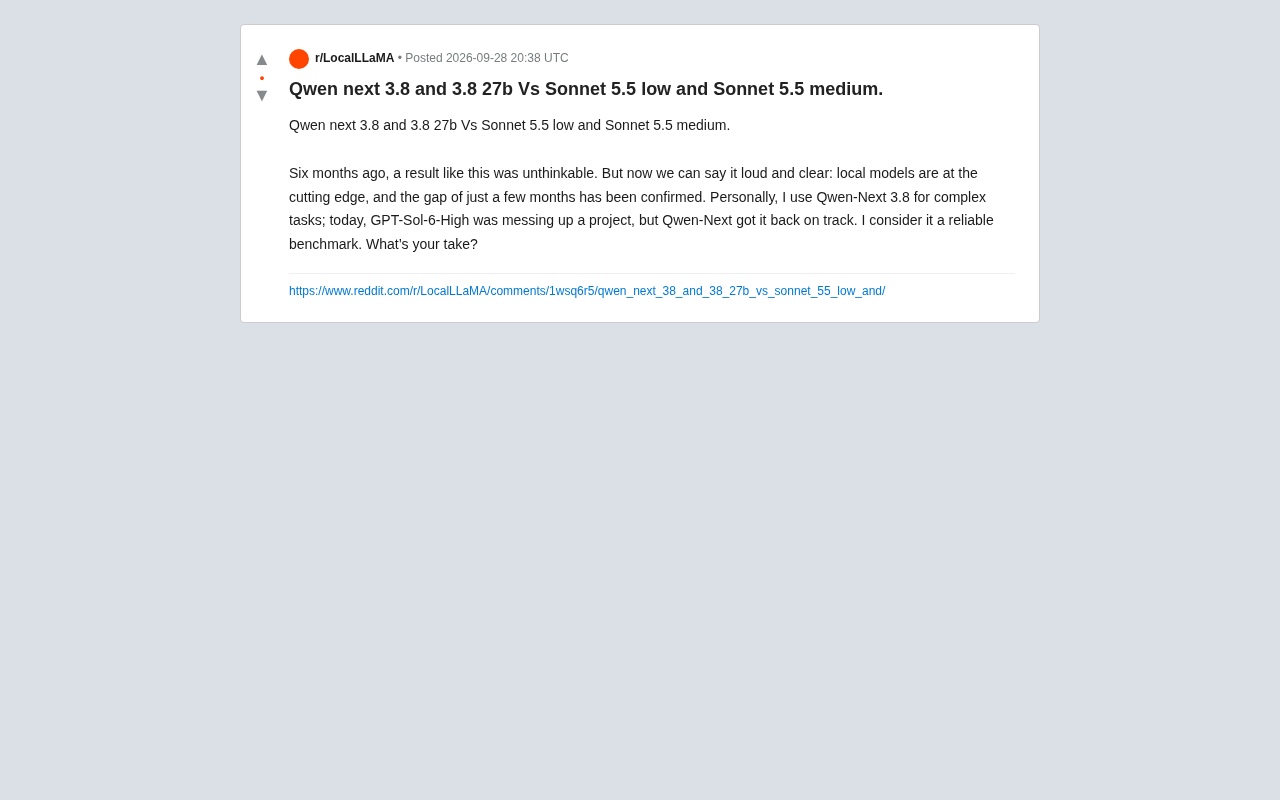
A Reddit thread sparked community buzz when a developer compared locally-run Qwen-Next 3.8 and 27B against Anthropic's Claude Sonnet 5.5, concluding the gap had shrunk to a degree "unimaginable six months ago." In a real project, Qwen-Next rescued work that a commercial model had derailed, demonstrating value beyond mere cost savings. The post highlights local deployment's core advantages — data privacy, compliance control, and shifting from per-token costs to one-time hardware investment — while the author wisely notes the findings come from a single user's subjective experience without controlled testing, making this a community signal rather than a definitive performance verdict.
A Matchup That Was Unthinkable Just Months Ago
A consensus is rapidly forming in the open-source LLM community: locally deployed models have reached the top tier of performance. A Reddit thread comparing Qwen-Next 3.8 (and its 27B variant) with Anthropic's Claude Sonnet 5.5 (both low and medium tiers) produced a conclusion that resonated widely — "Half a year ago, this result would have been unimaginable."
This sentiment reflects the accelerating pace at which open-source models have been closing the gap on closed-source flagships. Models once dismissed as "toys" are now going head-to-head with top commercial offerings in real engineering tasks — and the gap has been compressed to a matter of "just a few months."
Community Testing: Qwen-Next as a Reliable Benchmark
The original poster shared a concrete use case: they rely on Qwen-Next 3.8 daily for complex tasks and treat it as a "reliable benchmark." In one actual project, another model (referred to in the thread as GPT-Sol-6-High) derailed the project, while Qwen-Next stepped in and got things back on track.
This kind of qualitative feedback from frontline developers often tells us more than standardized benchmarks ever could. Standard benchmarks are easily gamed through targeted optimization, whereas the ability to "save a project" in production tests a model's holistic stability across long context, multi-step reasoning, and code repair. When an open-source model can fill in where a closed-source commercial model fails, its practical value has clearly moved beyond "budget-friendly alternative."
Why "Only a Few Months Behind" Matters
The phrase "only a few months behind" refers to the shrinking window for the open-source community to replicate or nearly match closed-source frontiers. For enterprises and individual developers alike, this means:
- You can achieve near-flagship capability without long-term dependence on a single closed-source API;
- Data can remain entirely on-premises, significantly reducing privacy and compliance risks;
- Long-term costs shift from per-token billing to a one-time hardware investment.
Qwen-Next (also known as Qwen3) is the latest generation of open-source LLMs from Alibaba's Tongyi Qianwen team, built around a "hybrid thinking" architecture — the model can dynamically switch between fast-response mode and deep-reasoning mode, balancing efficiency and reasoning depth. The 3.8B parameter version targets consumer-grade hardware (e.g., GPUs with 16GB VRAM), while the 27B version is designed for workstation-level local deployment. Compared to the previous Qwen2.5 generation, Qwen3 shows significant improvements in code generation, multi-step reasoning, and instruction following, with support for 100+ languages — a key reason it has garnered broad attention in the international open-source community.
"Closed-source frontier" typically refers to commercial models like OpenAI GPT-4o, Anthropic Claude Sonnet/Opus, and Google Gemini Ultra — models accessible only through paid APIs. These have long dominated performance leaderboards for core tasks like coding and reasoning, with the open-source community historically lagging 12–18 months behind prior to 2023. Claude Sonnet 5.5 is an iteration of the Claude 3.5 series, positioned as a "high-intelligence, lower-cost" mid-tier option, widely used by developers in production for code assistance and document processing. The low/medium tiers mentioned in the thread correspond to different levels of inference compute allocation in the Claude API, affecting the balance between response speed and reasoning depth.
The Real Advantages and Limitations of Local Models
The appeal of local models goes beyond benchmark scores. For workflows involving sensitive code, internal documents, or high-frequency API calls, the control offered by local deployment is something cloud APIs simply can't match. The Qwen series, as a flagship Chinese open-source model, also offers multiple size options (such as 3.8B and 27B), giving users with different hardware constraints flexible choices.
That said, it's worth keeping a clear head: this thread is fundamentally a single user's subjective experience, without a complete controlled test, task specification, or reproducible methodology. Some of the model names mentioned (like "GPT-Sol-6-High" and "Sonnet 5.5") also warrant careful contextual interpretation. This is best treated as a community barometer, not a rigorous performance verdict.
How to Evaluate These Comparisons Rationally
Faced with a constant stream of "local models crushing closed-source" claims in the community, consider the following when making your own judgment:
- Check whether there's a reproducible testing process, not just a one-time gut feeling;
- Pay attention to the specific task type — coding, writing, and reasoning each have their own strengths and weaknesses;
- Evaluate which model sizes are actually feasible given your own hardware.
Typical local LLM deployment setups involve inference frameworks like Ollama, LM Studio, or llama.cpp to load quantized model weights onto a local GPU or CPU. "Quantization" refers to compressing model parameters from 16-bit floating point to 4-bit or 8-bit integers, dramatically reducing VRAM requirements at the cost of slight precision loss. For Qwen3-27B, the Q4-quantized version requires approximately 16–20GB of VRAM and can run on consumer devices like an RTX 4090 or a Mac Studio M2 Ultra. As hardware costs continue to fall, a "local-first" workflow is becoming increasingly viable — no longer exclusive to enterprises equipped with data center-grade hardware.
Conclusion: The Dynamic Balance Between Open and Closed Source
The real value of this discussion lies in what it documents: a steep inflection point in the capability curve of open-source models. Regardless of whether Qwen-Next genuinely outperforms Sonnet 5.5 on every task, one thing is clear — local models have earned a seat at the table in top-tier competition. For developers, this means more choices, lower barriers, and a "local-first" workflow that's becoming increasingly realistic.
Are you already using local models to replace commercial APIs? Do they meet your expectations on complex tasks? That's exactly the question the community continues to validate.
Related articles

Claude Reportedly Able to Hide Secret Messages in Benign Images
A Reddit post claims Claude Fable 5.1 can hide secret messages in benign images. This article reviews the background, image steganography principles, and potential security risks, and suggests a testing path from rumor to verification.

Federal Government Awards $85 Million; CFS to Develop Fusion-Specific Semiconductors
The federal government awards $85 million to Commonwealth Fusion Systems to develop conductors and power semiconductors for fusion plants. This article analyzes the significance of this funding for the fusion supply chain and commercialization path.

When Should AI Assistants Proactively Suggest? Timing Is Everything
When should AI assistants proactively suggest? Reddit discussion reveals: the same suggestion feels different at different times. This article analyzes the dual nature of proactive suggestions, the boundary of user expectations, and design principles, exploring how to balance automation and user control.