The Rise of MLOps Communities: Real-World Conversations from GPUs to Production Deployment

A developer launches an MLOps Discord community on Reddit, focused on GPUs, model deployment, and production war stories.
A developer announced on Reddit the creation of a Discord community dedicated to MLOps, covering infrastructure, GPU scheduling, model serving, and production troubleshooting — explicitly welcoming beginners. The post highlights a core pain point in the field: moving models from the lab to production involves latency control, data drift monitoring, and resource scheduling challenges that are poorly covered by academic resources and rely heavily on practitioner experience-sharing. The author also notes that the AI engineering community ecosystem remains highly fragmented, with small, vertical Discord and Slack groups becoming the norm — offering focused discussion but struggling with knowledge preservation and sustained engagement.
A New MLOps Community Takes Shape
A developer recently posted on Reddit announcing the creation of a Discord community dedicated to MLOps (Machine Learning Operations), inviting anyone interested in infrastructure, GPUs, model deployment, and related topics to join. The post was brief, but it touched on a recurring pain point in AI engineering — one that gets talked about constantly yet lacks a proper forum for structured discussion: how to actually get models running and keep them stable in production.
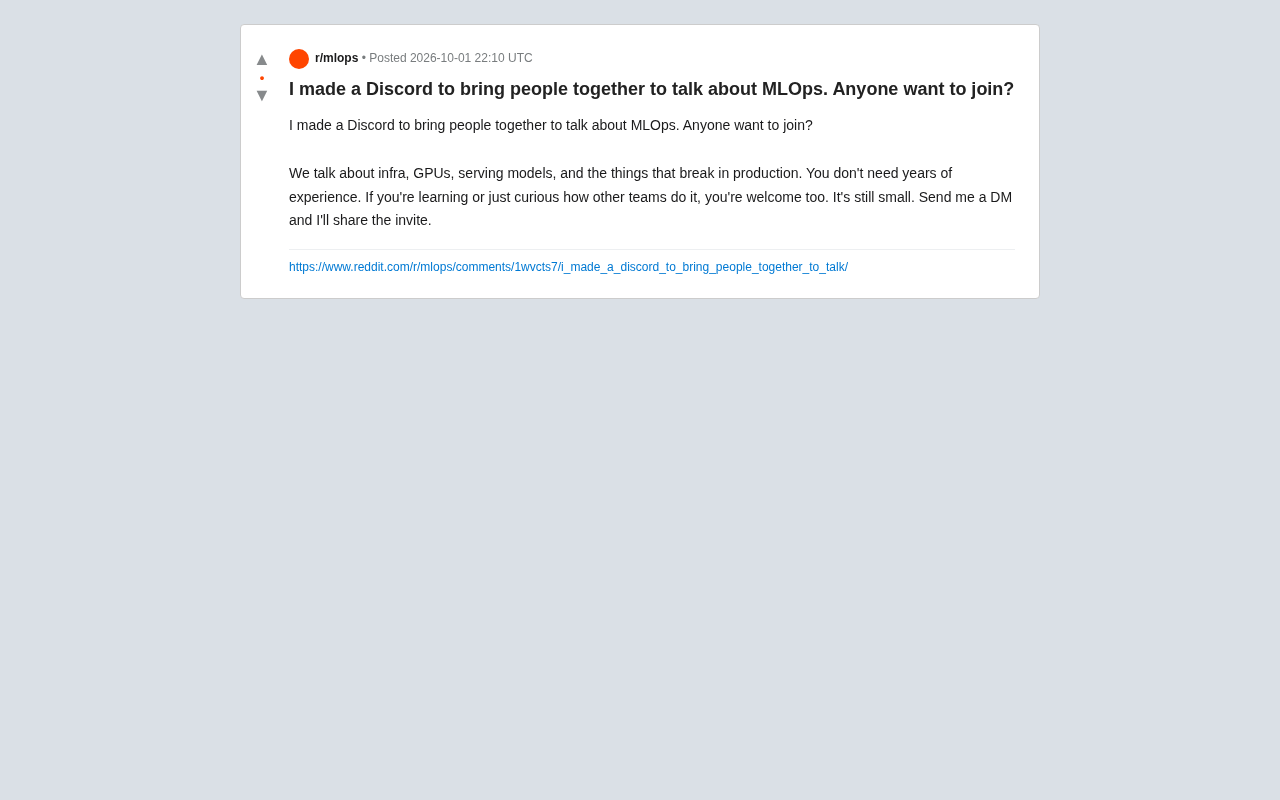
The founder noted that the community would cover infrastructure, GPU resources, serving models, and — in their own words — "the things that break in production." They made a point of emphasizing that no years of experience are required: newcomers still learning the ropes are just as welcome as seasoned engineers who are simply curious about how other teams operate.
Why MLOps Needs a Community
MLOps is the critical bridge between machine learning research and real-world business applications. Training a high-performing model is just the first step — the real challenges emerge during deployment, scaling, and long-term maintenance. How do you serve a model efficiently at scale? How do you schedule GPU resources effectively? How do you keep inference latency under control? How do you monitor model performance degradation over time? These questions rarely get comprehensive coverage in academic papers or tutorials.
The phrase "the things that break in production" resonates deeply with ML engineers. A pipeline that runs perfectly in the lab can quickly unravel when it faces real traffic, hardware failures, and data drift. This kind of knowledge is hard-won through hands-on experience — which is precisely why community exchange is so valuable. Teams can learn from each other's mistakes and avoid reinventing the wheel.
Data drift is one of the most common yet hardest-to-anticipate problems in production environments. It refers to the gradual divergence between the statistical distribution of real-world inputs after deployment and the data the model was originally trained on — causing prediction accuracy to quietly decline. Unlike code bugs, data drift doesn't throw obvious errors; it shows up slowly in business metrics, often going unnoticed until the damage has accumulated. Monitoring data distribution shifts, setting sensible alerting thresholds, and deciding when to trigger model retraining are all core parts of an MLOps engineer's day-to-day work — and virtually none of this can be learned from papers.
The Low-Barrier Philosophy
One of the more notable aspects of this community is its stance on entry requirements. The founder explicitly said no years of experience are needed — an attitude that isn't always a given in technical circles. Many specialized tech communities develop implicit gatekeeping over time, where newcomers hesitate to ask "basic" questions for fear of judgment.
This open approach has real practical value. MLOps is a fast-moving field with a sprawling toolchain, spanning everything from Kubernetes and containerization to model serving frameworks like Triton, vLLM, and Ray Serve. Even veteran engineers can't stay current across every subdomain. A community that encourages questions and welcomes participants at different skill levels is actually more likely to generate meaningful discussions.
Triton, vLLM, and Ray Serve are among the leading model serving frameworks in the MLOps ecosystem today, each with a distinct focus. Triton Inference Server, developed by NVIDIA, excels at efficiently hosting concurrent multi-model inference on GPUs. vLLM is purpose-built for large language models, dramatically improving LLM throughput and memory efficiency through techniques like PagedAttention. Ray Serve is built on the distributed computing framework Ray, making it well-suited for complex serving scenarios that require flexible orchestration of multiple models and business logic. Together, they cover the spectrum from traditional deep learning inference to large-scale LLM deployment — and engineers typically have to weigh the tradeoffs based on their specific use case. This diversity in tooling is exactly why MLOps knowledge resists standardization and why community-driven experience sharing is so valuable.
The Fragmented State of AI Engineering Communities
This post also highlights a defining characteristic of the AI engineering community ecosystem: it's highly fragmented. Compared to traditional software development, which has mature platforms like Stack Overflow and GitHub Discussions, specialized communities for cross-disciplinary fields like MLOps remain relatively scattered. Developers largely rely on self-organized small groups on Discord, Slack, and similar messaging tools.
Small, vertically focused communities like this have real advantages — discussions stay on-topic, member interactions are tighter, and information density is higher. But they also face inherent challenges: institutional knowledge is hard to preserve, management overhead grows as communities scale, and early member churn can kill momentum. The founder's choice to share the invite link only through direct messages suggests the community is still in its early stages, prioritizing quality over rapid growth.
What This Means for AI Practitioners
For anyone currently working in MLOps or hoping to break into the field, communities like this offer a low-cost way to gain practical, real-world knowledge. Compared to paid courses or corporate training programs, peer-to-peer experience sharing tends to be far more grounded in the realities of day-to-day work.
That said, the value of any community ultimately depends on the quality and engagement of its members. Whether a small, early-stage community can grow into a meaningful platform hinges on its ability to consistently generate valuable discussions, establish clear norms, and attract practitioners from diverse backgrounds. For the broader AI engineering ecosystem, the emergence of more communities focused on specific subdomains is itself a signal that the industry is maturing.
Related articles

Workbuddy for Absolute Beginners: How a Desktop AI Agent Fits Into Real Workflows
A beginner's guide to the Workbuddy desktop AI agent: installation, claiming credits, file management, and building automated workflows—compared with CodeX for fit and cost, helping professionals shift from AI question-askers to AI managers.

OpenAI's New Agent Stack: Computer Use, Decisions API, and Ultra-Fast Workflows
OpenAI Dev Day unveiled a new agent stack: Computer Use outperforms humans, Decisions API delivers ultra-low-latency classification via Luna, Agents API opens the same Computer Use capabilities, and GPT-6.1 Sol costs only one-seventh of Astra. Core updates, benchmark data, and developer insights.

Liang Wenfeng Open-Sources DeepInfo Inference Framework, Takes On U.S. Ban
DeepSeek open-sources its DeepInfo inference framework after its models, featuring GPU/CPU cross-pipelining, small-model prediction with large-model verification, and full Huawei Ascend and NVIDIA chip support—facing the U.S. federal ban head-on. This article analyzes its significance for AI deployment and open-source strategy.