The Road to Frontier AI Governance: Industry Standards Body Proposal Sparks Discussion

A tweet highlights the shift from AI technical competition to proactively building safety governance frameworks.
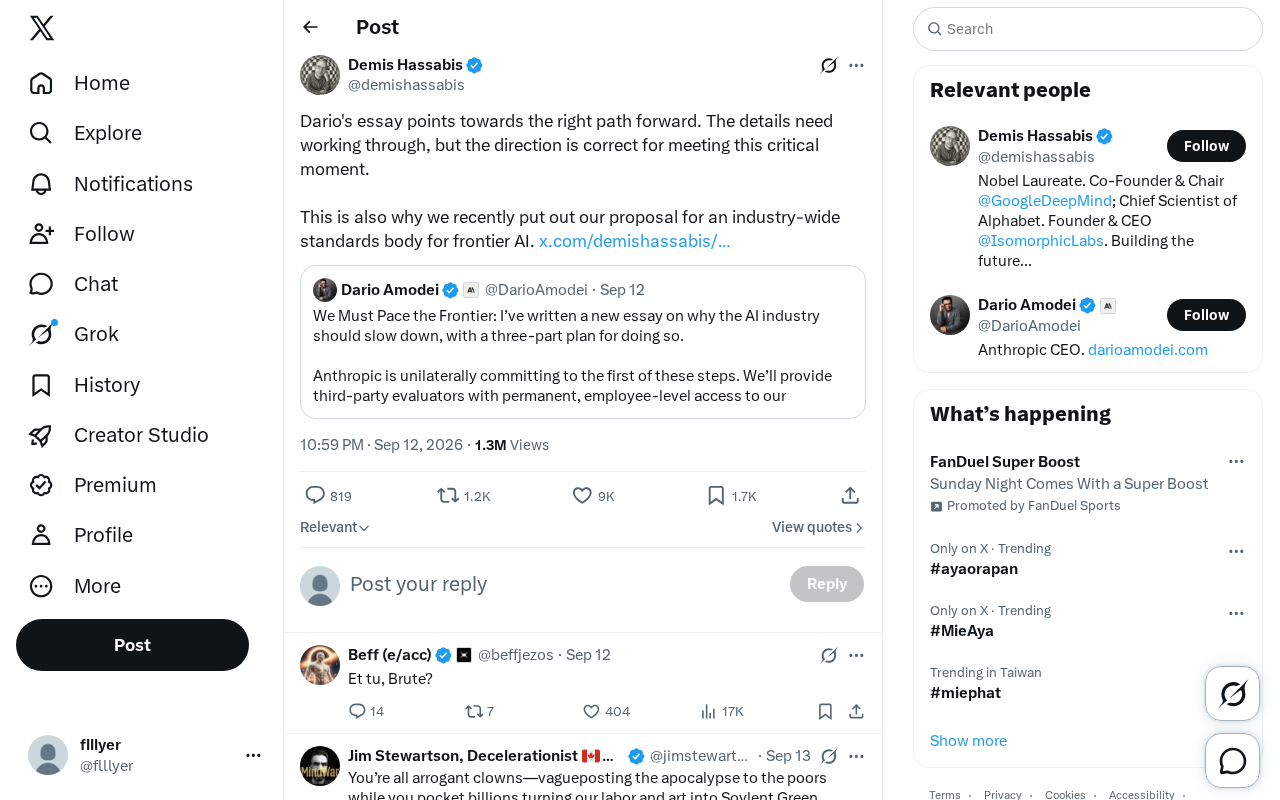
A tweet endorsing Anthropic CEO Dario Amodei's direction and referencing a frontier AI industry standards body proposal has drawn industry attention. The piece argues that company-level self-regulation cannot produce unified, verifiable benchmarks, and that a cross-company standards body could draw on models from finance and aviation. Yet the tweet's own caveat — "right direction, details pending" — exposes the vast gap between vision and execution: who leads, how standards are enforced, and whether real accountability exists will determine if such a body is genuine governance or a PR exercise. The credibility tension between industry self-regulation and external oversight remains the central challenge.
A Tweet Behind an Industry Governance Question
A tweet about AI safety governance recently sparked discussion across the industry. The author expressed agreement with Anthropic CEO Dario Amodei's writings, saying they "point in the right direction," and used the opportunity to reference a proposal for establishing an industry-wide standards body for frontier AI.
The original wording was measured: "Dario's piece points in the right direction. Details need working through, but the direction is right for this critical moment." This statement carries two layers of meaning — it affirms the overall strategic direction while acknowledging that substantial work remains to be done on implementation.
Why an Industry Standards Body Is Needed
As large model capabilities rapidly advance, the potential risks posed by frontier AI systems have become a shared concern for both industry players and regulators. "Frontier AI" generally refers to general-purpose large models whose capabilities approach or surpass existing state-of-the-art systems and could give rise to systemic risks.
The central action referenced in the tweet is the release of "a proposal for an industry-wide standards body for frontier AI." The underlying logic is straightforward: self-regulation by any single company, or siloed internal safety strategies, cannot produce unified and verifiable industry benchmarks. An inter-company standards body could, in theory, build consensus around testing protocols, risk assessment, and disclosure requirements.
This approach is well-established in other high-risk industries. Finance, aviation, and pharmaceuticals have long developed mature standardization and self-regulatory organizations. The AI industry is drawing on that experience, seeking to proactively establish guardrails before comprehensive regulation fully takes shape.
Dario Amodei's lengthy essay "Machines of Loving Grace," published in October 2024, is an important reference point for understanding this discussion. In it, he systematically laid out his assessment of AI's potential benefits and risks, argued that frontier AI companies should proactively take responsibility for safety, and called for heightened vigilance around "catastrophic risks" such as bioweapons and cyberattacks. Anthropic's internal Responsible Scaling Policy (RSP) is the concrete expression of this philosophy — using measurable capability thresholds to determine when to pause or slow model training. The industry standards body proposal can be seen as an attempt to extend this internal mechanism across the entire industry: replacing each company's self-declared safety commitments with a shared evaluation framework and disclosure requirements.
What "Right Direction, Details Pending" Actually Means
Notably, the tweet's assessment of Dario's piece affirms the direction wholeheartedly while explicitly flagging that details need working through. This actually reflects the broader state of AI governance discussions today: there is general consensus that governance is needed, and the real disagreements and difficulties are concentrated in the specifics.
Who leads standard-setting? How are standards enforced and verified? Is participation voluntary or mandatory? These questions directly determine whether an industry standards body constitutes a governance framework with genuine teeth, or merely a PR gesture. The phrase "details need working through" in the original tweet points precisely to the enormous gap between vision and execution.
The Tension Between Industry Self-Regulation and External Oversight
A standards body driven by AI companies themselves faces an inherent skepticism: isn't this a case of players also serving as referees? Proponents argue that frontier model development is highly technical, and only those at the cutting edge have the capacity to set effective standards — and that industry self-regulation can respond to technological change far faster than slow legislative processes.
Critics worry that self-regulatory mechanisms without external checks could devolve into soft constraints, or even serve as a shield for companies to fend off stricter regulation. Striking the right balance between industry expertise and external credibility will be the key to whether such proposals can actually deliver.
Several early experiments already offer reference points. The Frontier Model Forum, established in 2023 by Google, Microsoft, Anthropic, and OpenAI, is the most prominent AI industry self-regulatory organization to date — yet questions about its real-world enforcement power persist. Another reference model is the financial industry's self-regulatory organization structure, such as FINRA in the United States, whose regulatory authority derives from congressional authorization and operates under SEC oversight, forming a framework of "authorized self-regulation." The AI sector currently lacks a comparable legal foundation, which is the core reason critics argue that a purely industry-led standards body cannot truly be binding. The advancement of the EU AI Act, alongside executive order-level explorations in the United States, represents an alternative path driven by external regulation — and the tension between these two models will continue to play out over the coming years.
Conclusion
This tweet, though brief, reflects an important development in frontier AI governance: leading players are shifting from a purely technical race toward actively building safety frameworks and industry norms. Consensus on direction certainly matters, but as the original post suggests, what will ultimately determine success or failure are those details still waiting to be worked through.
(Note: This article is based on a single social media tweet. The specific content of the referenced proposal and its subsequent developments await corroboration from additional public information.)
Related articles

Workbuddy for Absolute Beginners: How a Desktop AI Agent Fits Into Real Workflows
A beginner's guide to the Workbuddy desktop AI agent: installation, claiming credits, file management, and building automated workflows—compared with CodeX for fit and cost, helping professionals shift from AI question-askers to AI managers.

OpenAI's New Agent Stack: Computer Use, Decisions API, and Ultra-Fast Workflows
OpenAI Dev Day unveiled a new agent stack: Computer Use outperforms humans, Decisions API delivers ultra-low-latency classification via Luna, Agents API opens the same Computer Use capabilities, and GPT-6.1 Sol costs only one-seventh of Astra. Core updates, benchmark data, and developer insights.

Liang Wenfeng Open-Sources DeepInfo Inference Framework, Takes On U.S. Ban
DeepSeek open-sources its DeepInfo inference framework after its models, featuring GPU/CPU cross-pipelining, small-model prediction with large-model verification, and full Huawei Ascend and NVIDIA chip support—facing the U.S. federal ban head-on. This article analyzes its significance for AI deployment and open-source strategy.