The Robot Learning Boom: Why Practitioners Are Seeking Kindred Spirits

A Reddit post seeking kindred spirits reflects the natural demand for community collaboration in robot learning.
Starting from a short Reddit post seeking kindred spirits in robot learning, the article notes that robot learning is evolving from a lab topic into a social need. It sorts out the progressive relationship among three keywords: robot learning as a method for machines to acquire skills from data, world models for internal rehearsal to improve sample efficiency, and physical AI as the higher-level goal of anchoring intelligence in the real world—forming a "method—capability—goal" throughline. It analyzes the field's strong interdisciplinary coupling and amplified value of community connection, offering entry advice on clarifying one's coordinates, communicating with concrete questions, and valuing the simulation-to-real gap.
A Signal Reflected in a Reddit Post
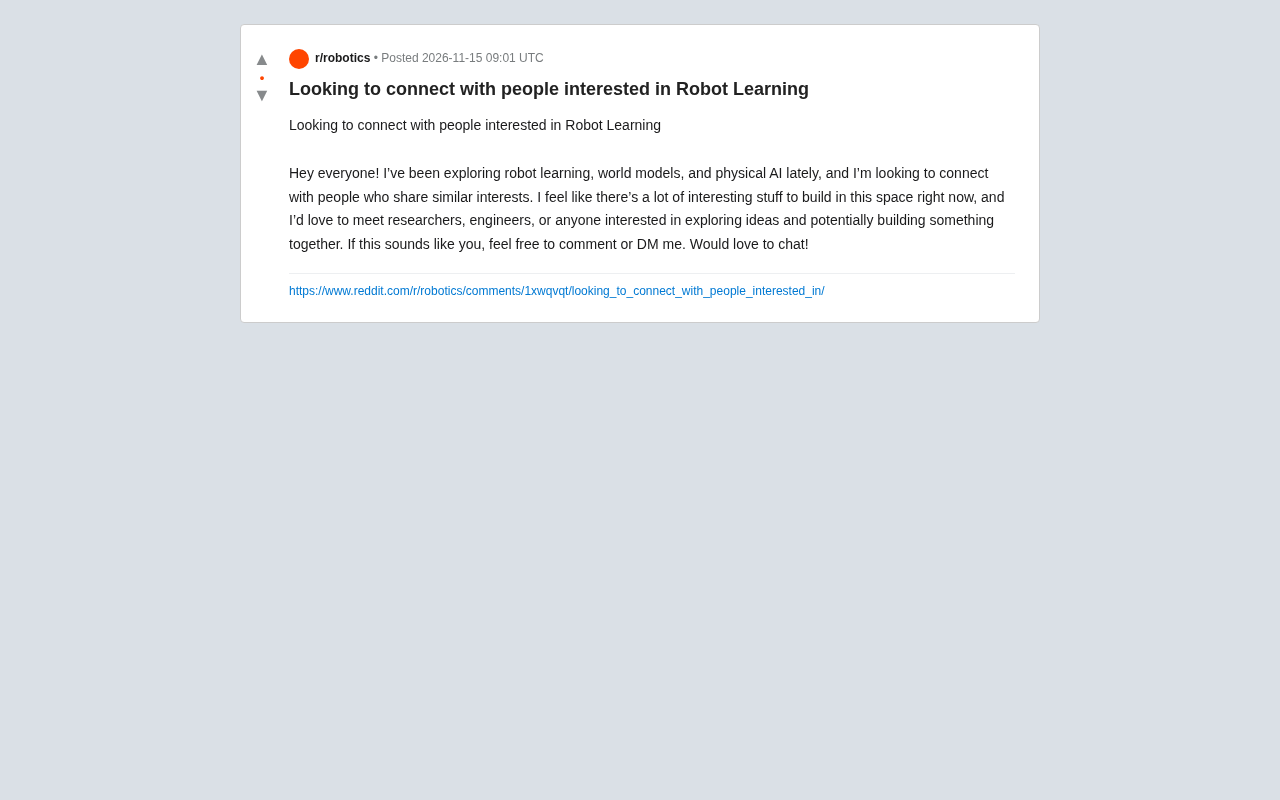
A short post recently appeared on Reddit: an enthusiast exploring Robot Learning, World Models, and Physical AI publicly sought out like-minded people, hoping to connect with researchers, engineers, or anyone interested in this direction who is willing to discuss—or even build something together (source: original Reddit post).
The post itself contains no technical details or project progress, but the signal it sends is worth pondering: robot learning is shifting from a laboratory topic into a "social need." When someone proactively posts to find kindred spirits, it shows that the knowledge barrier in this field is being gradually lowered through community-driven collaboration, and that going it alone is no longer enough to keep pace with interdisciplinary convergence.
Three Keywords, One Technical Throughline
The three concepts mentioned in the original post are not arbitrarily stacked—there is a clear progressive relationship among them.
Robot Learning: Enabling Machines to Acquire Skills from Data
Robot learning generally refers to using machine learning methods (especially reinforcement learning and imitation learning) to replace traditional hand-crafted rule-based control, enabling robots to acquire manipulation and locomotion capabilities through data or trial and error. It addresses the question of "how to make robots adapt to unstructured environments" and is also the core of current embodied intelligence discussions.
The distinction between reinforcement learning and imitation learning deserves a brief elaboration. Reinforcement learning lets an agent learn a policy through trial and error via reward signals, suited to tasks where rewards can be defined and the cost of trial and error is controllable; imitation learning directly learns a policy from human demonstration data, bypassing the reward design problem, and is widely applied in manipulation tasks. The two are often combined—for example, using imitation learning to obtain an initial policy, then fine-tuning with reinforcement learning. In addition, sim-to-real transfer is one of the core challenges of robot learning: policies trained in simulation often suffer a sharp performance drop when deployed on real hardware due to physical parameters, sensor noise, and dynamics discrepancies, and domain randomization is a common technique for addressing this.
World Models: Letting Machines Rehearse "in Their Heads"
World models focus on enabling an agent to build an internal representation of environment dynamics, so that it can predict the consequences of actions and perform planning. For robots, this means they do not have to exhaustively try everything in the real world—they can first "imagine" it within the model. The combination of world models and robot learning is regarded as a key path to improving sample efficiency and reducing the cost of real-world trial and error.
The technical lineage of world models can be traced back to model-based reinforcement learning (model-based RL), whose core is learning an environment transition dynamics model and using it for planning or generating training data. Representative recent works include the Dreamer series (learning a world model in latent space and optimizing policies) and generative world models for video prediction. Sample efficiency is the key metric for understanding their value: model-free methods often require millions of interactions, whereas with a world model, large amounts of virtual experience can be generated through internal "imagination," significantly reducing the number of real interactions. However, world models also face problems such as the accumulation of long-horizon prediction errors and model exploitation (where the policy exploits model bias)—which is the real-world context behind the "long-horizon prediction error" discussion mentioned in the original post.
Physical AI: Anchoring Intelligence in the Real World
Physical AI is a higher-level concept, emphasizing that agents need to perceive, decide, and act in the physical world rather than only processing text or images. Both robot learning and world models can be viewed as technical means of realizing physical AI. Strung together, the three恰好 form a line of "method—capability—goal."
Embodied Intelligence is highly related to physical AI but has a slightly different emphasis: embodied intelligence stresses that intelligence cannot be separated from the interaction between body and environment, and is a concept more at the intersection of cognitive science and robotics; physical AI leans more toward an industrial and engineering perspective, emphasizing the perception–decision–execution loop of AI systems in the physical world. Both point to one judgment: large models trained only on internet text and images lack direct experience with physical laws, contact mechanics, and causal consequences, so robot platforms are needed as carriers to fill this gap. This also explains why large model companies and humanoid robot companies are currently showing a clear trend of convergence in the physical AI direction.
Why There Is a Particular Need to "Find Someone to Talk To" Right Now
A practical characteristic of robot learning is extremely strong interdisciplinary coupling: control theory, reinforcement learning, computer vision, simulation, and hardware engineering are all indispensable. Someone working on algorithms may be unfamiliar with actuator latency, while someone working on mechanics may not understand policy gradients. Against this backdrop, the value of community connection is amplified.
The original poster's approach is actually quite pragmatic—build a personal network first, then talk about specific projects. This approach is not uncommon in open-source communities: ideas collide in conversation, and collaboration forms in practice. For those just entering this direction, finding one or two partners who can discuss world model training details or simulation environment setup is often more efficient than grinding through papers alone.
Advice for Those Who Want to Join the Conversation
If this post resonates with you, you can start with a few low-barrier actions.
Clarify your coordinates. Robot learning covers a broad range, so first figure out whether you lean toward algorithms, simulation, or hardware—this will help you find complementary people faster when communicating.
Connect with questions in hand. The original poster did not give specific topics, but effective communication usually stems from concrete questions, such as distribution shift in a certain imitation learning task, or the accumulation of long-horizon prediction errors in a certain world model.
Pay attention to the gap between simulation and real hardware. This is an unavoidable part of deploying robot learning, and one of the topics most likely to resonate in community discussions.
Robot learning is not a field that can be advanced by one person working in isolation. A post seeking kindred spirits reflects a natural demand for collaboration across the entire direction.
One-line Summary
A Reddit post seeking kindred spirits reflects the natural demand for community collaboration in the robot learning field.
Paragraph Summary
Starting from a short Reddit post seeking kindred spirits in robot learning, the article points out that robot learning is evolving from a laboratory topic into a social need. The author sorts out the progressive relationship among the three keywords in the post: robot learning is the method for enabling machines to acquire skills from data, world models let agents internally rehearse the consequences of actions to improve sample efficiency, and physical AI is the higher-level goal of anchoring intelligence in the real world—together forming a "method—capability—goal" throughline. The article further analyzes that the field has extremely strong interdisciplinary coupling—algorithms, control, vision, simulation, and hardware are all indispensable—so the value of community connection is amplified, and offers entry-level advice such as clarifying your own coordinates, communicating with concrete questions, and paying attention to the simulation-to-real gap.
Related articles

Abnormal Error Rate Spike in Claude Mythos 5.2 and Fable 5.2
Claude Mythos 5.2 and Claude Fable 5.2 show an abnormal spike in request error rates, marked as investigating on the official status page. This article covers the incident overview, practical impact on developers, and recommended responses.

ReAct Runtime Context Trimming: Why Claude Code Acts at 70%
A deep dive into ReAct runtime context trimming: why Claude Code compresses at ~70% usage, why tool calls dominate, why messages must be dropped in pairs, and why codebases don't need RAG.

AI Agent vs LLM: How Cursor and Claude Code Actually Work
An in-depth analysis of the essential difference between AI Agents and LLMs: LLMs generate code suggestions, while Agents modify files and run tests via tool calls. Using a Spring Boot bug fix as an example, it breaks down the workflows, permission control, and verification mechanisms of Cursor and Claude Code.