The SEO Score Trap: How to Prove Search Visibility in the Age of AI Answers

An SEO score is just a model's output; visibility is a decomposable chain, and the AI era demands evidence, not numbers.
The article argues that an SEO score is only the output of a specific tool's model—Google doesn't publish a universal 0–100 rating—so a high score can't replace diagnosis or prove AI-readiness. Visibility should be understood as a chain: access, interpretation, indexing and representation, retrieval and selection, citation and outcome, where success at one link doesn't prove another. Technical audits should start from what the server actually returns, separate observation from interpretation, and address canonicals, robots, noindex, and JavaScript rendering. In the AI search era, publish content worth citing, measure citation coverage, accuracy, prominence, and business outcomes separately, and combine first-party data from Search Console and Bing Webmaster Tools instead of relying on manual screenshots or a single score.
The SEO Score Trap: How to Prove Search Visibility in the Age of AI Answers
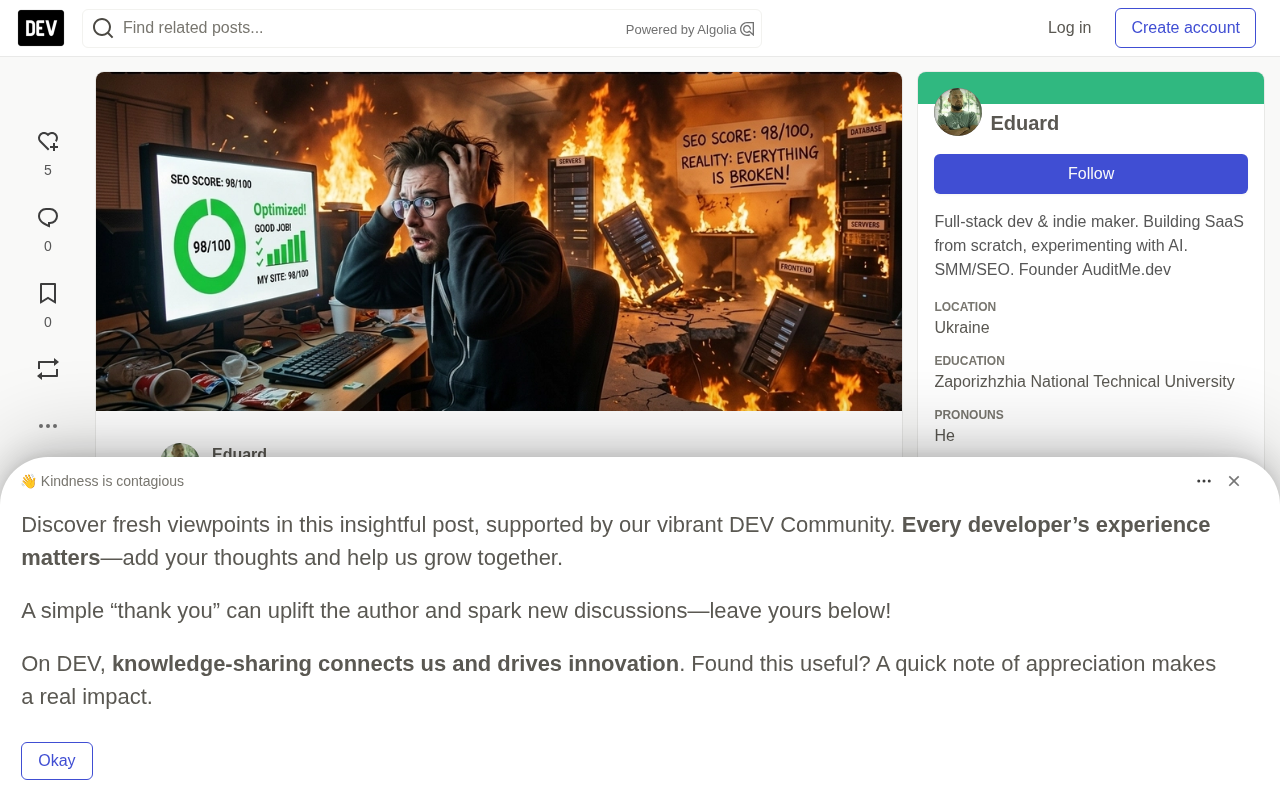
A website can score 98 in an audit and still point search engines toward the wrong URL. It can pass every automated check and still publish nothing worth citing. It can appear in AI answers and still fail to earn a single useful visit. It can even see rising citation counts while conversion rates fall.
These aren't paradoxes—they're the same system measured at different points. And that system is often compressed by the SEO industry into a single number.
An SEO Score Is a Map, Not the Territory
An SEO score is the output of one specific model. It depends on which URLs the tool accessed, which checks it ran, under what conditions, what evidence it could gather, and what weight it assigned to each finding. Two products can examine the same website, arrive at different scores, and both be arithmetically correct—they may be measuring different things.
Scoring itself isn't bad. A consistent score helps teams orient, compare the same template over time, or decide which category to inspect first. The danger lies in mistaking a summary for a diagnosis, for a Google metric, for a prediction, or for proof that a site is ready for AI search.
Consider two audit reports. The first gives a page 94 points: titles present, images sized, lab performance acceptable, nearly all on-page tests passing. But the product URL declares the homepage as its canonical, appears in the XML sitemap, and receives internal links alongside multiple parameterized versions. The number looks healthy, yet the URL signals contradict each other. The work isn't to recover the missing 6 points—it's to determine which URL the site wants search engines to treat as representative, and to make the evidence align with that decision.
The second report gives a page 63 points because automated checks find a decorative SVG missing alt text, a few heading issues, and a long script. Adding keyword-stuffed alt text to a decorative graphic may make accessibility worse; that large script may be essential to the page. The audit flagged items to inspect—it didn't prove three defects.
Google doesn't publish a universal 0–100 SEO score. Google documents technical eligibility requirements, search policies, and best practices—it doesn't certify that third-party audit ratings are a substitute for ranking. Meeting technical requirements doesn't guarantee indexing or display. The truly useful question isn't "how do I go from 82 to 95?" but "which important condition broke, how do we know, and what would prove the fix worked?"
Before treating a score as a basis for decisions, establish five things: scope (is the tool measuring one URL, a representative template, a sampled crawl, or the entire site), evidence source (raw HTML, post-render DOM, lab performance traces, field data, server logs, or heuristic inference), applicability (does this rule actually hold for this page), inference (which parts are observed and which are the tool's proposed explanation), and reproducibility (can someone else run the same test on the same URL and understand why the result occurred).
Treat Visibility as a Chain, Not a Metric
"Visibility" covers several distinct events. A page can succeed at one link and fail at the next. The chain includes: access (can the system retrieve the resource through redirects, robots rules, CDN, and firewalls), interpretation (can the system obtain key facts, or is the main content hidden in JavaScript, images, or inconsistent with structured data), indexing and representation (does the search system retain or select this URL as representative), retrieval and selection (does this page help answer this particular question), and citation and outcome (is the source actually cited, does it support the nearby claim, and did that exposure help a person).
These distinctions aren't semantics—they're practical. Crawl success doesn't equal indexing, indexing doesn't equal ranking, ranking doesn't equal citation, and citation doesn't equal conversion. Don't use evidence from one link to prove success at another.
Start With What the Server Actually Returns
A solid investigation begins with one specific URL and one reproducible request—not a hundred generic recommendations. For a first pass on a public page, curl can save response headers and body separately, recording the final URL, status code, redirect count, and total time. But this request doesn't run JavaScript, doesn't simulate Googlebot, can't prove which canonical Google selected, and won't show how each AI system views the page—it's one narrow observation.
robots.txt expresses crawl preferences to compliant crawlers; it can't reliably guarantee a URL never appears in search, since blocked URLs can still sometimes be discovered through links. The noindex directive is intended to prevent indexing, but crawlers generally must first crawl the resource to read it. So blocking a page from crawling while expecting Google to see its noindex tag can actually defeat the intended outcome.
Canonicalization is a set of signals, not a single command. Redirects, rel="canonical", sitemap entries, and internal links should all support the site's URL policy. Google describes redirects and canonical annotations as strong signals and sitemap inclusion as a weaker one. "A canonical exists" doesn't equal "the canonical is correct"—check whether the target is the intended URL, returns a valid response, is indexable, and is supported by internal links and the sitemap.
JavaScript itself isn't an SEO defect. Google can process JavaScript, but rendering adds another stage where content and signals may fail or diverge. Compare the initial response and the rendered DOM on main copy, headings, canonicals, robots directives, links, and product facts. Sitemaps help search engines discover URLs but don't command indexing; important indexable pages should also be discoverable through meaningful internal links.
Audit Findings Must Withstand Scrutiny
An audit result is only useful if someone else can understand what was observed, why it matters, and how to verify the proposed intervention. Compare two statements:
"Page speed is poor. High impact. Fix JavaScript."
"In the October 16 desktop lab run, the LCP element was the hero image. The image request began only after a client-side component executed. This test did not establish the field LCP for this URL. Check whether the image can be discovered earlier in the initial document, make one change, and repeat the same lab configuration until field data becomes sufficiently available."
The second finding isn't just more cautious—it's more actionable. It separates observation from interpretation, states its limitations, and proposes a test that could falsify the diagnosis. A strong finding record should include: target, observation (exact value or output, not just a label), method, time, expected state, interpretation, next action, verification criteria, and unknowns.
Reports should distinguish at least six states: confirmed failure, warning, pass, unknown, not applicable, and not run. "Unknown" means insufficient evidence; "not run" means the test wasn't executed; "not applicable" means the rule doesn't apply to that resource. None of these equals "failure." Severity and confidence should also be separated—a potentially severe issue with weak evidence deserves quick verification, while a low-severity but firmly observed issue can safely be deferred.
What Makes a Page Worth Retrieving and Citing
Technical access explains whether a system can reach a page—not why it should be chosen to answer a question. The weakest GEO approaches optimize for an imagined machine evaluator: repeating question phrases, adding arbitrary FAQ blocks, generating near-duplicate pages, stacking statistics without context, or treating llms.txt as a ranking switch.
The stronger approach is to make a page solve a real information need better than existing alternatives.
Product pages should clearly state identity, price, availability, compatibility, limitations, and next steps where it matters. Technical guides should explain recommended actions and the conditions under which they apply. Original research pages should disclose samples, methods, dates, exclusions, and limitations. For important claims, give readers a trail: what exactly is claimed, who's responsible, what sources support it, when and where it applies, and what might make it incomplete or wrong.
A single fact can have multiple versions: the visitor-facing page, the initial HTML versus the rendered DOM, structured data or a product feed, and claims elsewhere on the web. Search systems and AI products may encounter different subsets. When these contradict each other, adding schema won't fix the underlying information problem. Picture a product's price: $79 on the page, $69 in JSON-LD, $79 in the feed, $99 in an old comparison article—every URL loads, every piece of markup validates, yet the public record remains inconsistent. Sometimes the correct unit of audit is the fact and its source lineage, not just the URL.
Structured data gives supporting search systems explicit clues about a page's meaning and may enable eligible rich results. Valid markup doesn't guarantee that a result feature will appear, nor can it make inaccurate visible content trustworthy. Treat schema as a structured representation of real page content—not a parallel reality where you can declare better facts than visitors see.
The strongest differentiation is something competitors can't replicate by merely rewriting the same five sources: a test with measurements, a useful dataset, an insightful teardown, a decision framework, a first-hand account, or a transparent record of what failed and how it was fixed. Freshness is factual, not typographic—changing a date doesn't make a claim fresh.
SEO, AEO, and GEO: What the Evidence Shows
SEO is the mature discipline of helping people and search systems discover, understand, and select useful pages. AEO (Answer Engine Optimization) is an industry term for making information useful in answer-oriented systems. GEO (Generative Engine Optimization) generally refers to work aimed at improving a source's retrieval, mention, or citation in generative answers. Neither AEO nor GEO has a single universally accepted technical specification or scoring standard. These labels describe different measurement goals—not a reason to invent a separate rule set for each AI product.
Google's official guidance (updated July 10, 2026) states that existing SEO best practices still apply to AI Overviews and AI Mode. Pages must meet Search technical requirements and be eligible to appear in summaries; even meeting requirements and best practices doesn't guarantee crawling, indexing, or display. The guidance directly addresses several popular GEO claims: Google Search doesn't require llms.txt or other special machine-readable files, doesn't require content to be broken into tiny fragments, doesn't require a special writing style for AI, and AI Overviews or AI Mode don't need special Schema.org types. Google says it ignores llms.txt for Search visibility.
Aggarwal et al.'s "GEO: Generative Engine Optimization" (ACM SIGKDD 2024) introduced a framework and benchmark for studying how content changes affect visibility in generative answers. The authors reported up to 40% improvement from certain methods in their test setup, with effects varying by domain. Its important contribution is methodological: defining prompts and conditions, measuring visibility in the test system, and comparing interventions. That headline number isn't the expected lift for a random website, nor does it prove that adding statistics or quotes will lift any specific site by 40%.
Measurement changed in 2026. Google announced a dedicated Search Generative AI performance report in Search Console on June 3, 2026, and said it had reached global sites by August 31. The report shows impressions for generative AI features in Search (including AI Overviews and AI Mode) and related AI features in Discover, with documented dimensions including page, country, device (for Search), and date. This is more useful than inferring visibility from a handful of manually entered questions—but it isn't a record of every prompt or every internal retrieval decision.
Microsoft launched its AI Performance report in Bing Webmaster Tools in February 2026, showing citations across supported Copilot, Bing, and partner experiences. In June it announced previews for intent and topic grouping, citation share, and comparison over time. Citation share is an observational measure of a site's proportion of citations in a given grounded query—not a ranking score, traffic share, or content quality rating. On October 13, Microsoft announced a beta Topics Portfolio that groups grounded queries into broader topics, warning that topic classification and some aggregate volumes are approximations and should be treated as directional signals. These reports aren't interchangeable—different systems define and expose citation activity differently.
Crawlers, Permissions, and the False Promise of "One AI Switch"
A common mistake is treating all AI-related crawlers as one thing. Providers use different user agents for different jobs, and that distinction matters for publishers making access decisions.
OpenAI documents three relevant mechanisms: OAI-SearchBot (search discovery for ChatGPT search features—blocking it may keep a site out of ChatGPT search answers), GPTBot (crawling content that may be used to improve foundation models, with training-related controls separate from search controls), and ChatGPT-User (access tied to certain user-initiated actions, not an automated search crawler, and not something to be treated as the same control). OpenAI states that OAI-SearchBot and GPTBot settings are independent; site owners can allow the search crawler while disallowing the training crawler.
Anthropic likewise documents separate crawlers: ClaudeBot for potential model training data collection, Claude-SearchBot for search, and Claude-User for user-directed retrieval. Blocking one doesn't express the same preference as blocking all. Google's Googlebot and Google-Extended also serve different purposes. The operational lesson isn't "allow all bots"—it's to make explicit content access decisions based on use case, then verify the actual user-agent rules and any CDN or firewall behavior. robots.txt communicates instructions to compliant crawlers; it isn't authentication and isn't a substitute for protecting private data. Don't silently block search crawlers and then interpret missing citations as evidence of poor content quality.
What robots.txt Actually Does—and Its Limits
robots.txt is a plain-text file at the site root that expresses crawl preferences to crawlers via User-agent and Disallow / Allow directives. It can't enforce access control: it's a protocol crawlers voluntarily follow, and malicious scrapers can simply ignore it. A Disallow-ed URL can still be discovered through external links and appear in search results. To truly prevent indexing, use a page-level noindex directive or HTTP header—but a crawler must first crawl the page to read it, so "block crawling first, then hope it sees the noindex" is self-contradictory.
How to Measure AI Visibility Without Fooling Yourself
A screenshot of an answer is useful for debugging and terrible as a measurement procedure. Generative answers vary by wording, region, time, model version, available sources, and product behavior. One successful citation proves citation can happen—not that visibility is stable.
Define a small experiment before examining answers. Start from customer questions and important tasks, not from prompts that flatter the website. A practical exploratory pilot might use 30 fixed prompts spanning informational, comparison, and commercial intent, then run each three times across three clearly named interfaces: 270 observations total before reviewing citation quality. This is a manageable pilot, not a universal sample-size standard, and it doesn't prove statistical significance.
Keep the exact prompts, platforms, exposed product interfaces or model versions, timestamps, language, region, account state (if relevant), answers, cited URLs, and the page version being tested. Don't rewrite prompts after an unfavorable response and fold the new results into the original series.
Measure different outcomes separately: citation coverage (the proportion of eligible runs with at least one relevant target-domain citation—define "eligible" before testing and keep the denominator stable), citation accuracy (the proportion of reviewed target-domain citations that actually support the nearby claim), citation prominence (recording source placement against a consistent, documented rubric), factual fidelity (whether the answer accurately represents the source: prices, dates, capabilities, limitations, or quantities), citation share within the test set (compared against a fixed competitor set in the same prompt runs), and business outcomes (relevant referral sessions, qualified leads, signups, purchases, or other defined goals, requiring analytics or other first-party evidence).
These measures can move in different directions. Coverage may rise while citation accuracy stays flat. Citations may fall after a platform update even though the site didn't change. A small number of highly relevant citations can carry commercial value while totals remain low.
For Google AI features, combine the Search Generative AI performance report in Search Console with broader Search performance. For Microsoft's supported experiences, use the Bing Webmaster Tools AI Performance report. Manual testing supplements these provider reports when you need to inspect an individual citation or cover issues the first-party reports don't expose—it shouldn't replace provider data with a smaller but seemingly more decisive sample.
Finally, treat paraphrased growth as correlation until evidence supports a stronger claim. Retrieval can shift due to content, competitors, product updates, demand, or the platform itself. Document the timeline and possible confounders.
Citation Share and the Denominator Problem in Measurement
Citation share is a source's proportion of the citation set for a given grounded query—an observational measure, not a ranking score or traffic share. Its value depends heavily on how the denominator is defined: are you counting citations within a single answer, all answers within a session, or an aggregate across a fixed prompt set? Different denominators can produce dramatically different results. Likewise, the number of observations in manual prompt testing (e.g., 270) doesn't represent statistical significance; samples are affected by prompt selection, region, account state, and model version. First-party reports (such as the Search Console Generative AI performance report and Bing Webmaster Tools AI Performance report) offer broader coverage and more stable dimensions, and should serve as the baseline—manual testing is only for supplementing specific citation reviews.
Prioritize Causes First, Then Test Interventions
Once an issue is credible, teams still must decide what to do first. The answer shouldn't come from the brightest color on a dashboard. Evaluate findings across four dimensions: impact (if the diagnosis is correct, how important are the affected pages or user journeys), confidence (how strong is the evidence that the problem exists and that the proposed intervention would fix it), scope (how many important URLs or templates might be affected, and are there dependencies that make a global fix risky), and cost and reversibility (how hard is it to implement and verify, and how easy is it to roll back if the hypothesis fails).
Audit reports sometimes predict one fix might recover 10%, another 15%, and a third 20%—then treat the sum as expected traffic growth. Unless those estimates are independently measured and the effects are known to be additive, the sum is fiction. Interventions can overlap, share the same affected URLs, or depend on each other.
Use a baseline, a specific change, an agreed success metric, and a verification window. Don't claim a score increase itself is a business outcome. Document expected and unexpected consequences: one implementation may improve a metric while inadvertently removing useful content, changing canonicals, or slowing another template.
Work isn't done until a production change is verified at the correct level. A source file change isn't a deployed change. A deployed canonical doesn't prove Google has selected it. A content update doesn't prove an AI product has retrieved it. A citation doesn't prove business impact.
A Self-Audit and a Technical Example
The strongest way to demonstrate an evidence-first standard is to apply it to the auditor itself. A review of AuditMe's publicly visible SEO Score Checker and Website SEO Checker copy (conducted October 16, 2026) found several claims worth scrutinizing. Below is a review of statements on those pages—not a full technical crawl, not a test of the audit engine's output, and not a ranking-outcome study.
| Claim pattern on public pages | Evidence problem | More defensible treatment |
|---|---|---|
| Score components are weighted by their known impact on ranking, so raising the score directly raises ranking odds | A proprietary score is a tool-created model; its weights aren't Google's weights, and a higher composite score doesn't prove ranking effect | Explain that the score aggregates the checks the product measures, describe what each check observed, and separately verify any claimed downstream impact |
| Every page should have exactly one H1, every image should have alt text, and fixed title or content lengths indicate quality | These are too broad to serve as universal pass/fail rules; decorative images often need empty alt text, and arbitrary word-count thresholds aren't evidence of usefulness | Label thresholds as heuristics, explain the situations they help detect, and distinguish accessibility conventions from search requirements |
| Structured data can increase CTR by a fixed 20–30% | A single percentage without a clear applicable study, sample, and measurement context implies a universal effect that can't be assumed for every site or result feature | State that valid structured data can make a page eligible for supported rich results, and measure CTR for the specific implementation and query set |
"AI-ready" tiers include llms.txt, crawler access, schema coverage, and date freshness as signals determining whether engines can cite a page | Access, retrieval, selection, and citation are separate events; Google explicitly says its Search AI features don't require llms.txt; changing a date doesn't prove meaningful updates | Report provider-specific crawler access separately from measured citations; treat a file as useful only when a named system documents that it uses it; update page dates only when content meaningfully changes |
| An "SEO state of things" statistic says 68% of analyzed sites lost organic traffic due to overlooked issues | The visible page copy gives readers no link to a methodology to establish sample, time period, traffic-loss definition, exclusions, and attribution basis | Link the report and methodology, including sampling frame and limitations, or remove/qualify the statistic until details are available |
This review doesn't prove AuditMe's scoring engine is inaccurate, nor does it compare its product to competitors. It demonstrates something more limited but still valuable: even tools built to evaluate other websites must hold their own claims to the same evidentiary standard.
The Standard Worth Keeping
Stop asking whether a website is "AI-ready," as if readiness were a permanent property a tool can certify. Ask a more precise set of questions: Can the relevant systems retrieve this page? Does the page expose the facts needed for this task? Was it selected to answer a defined query? Was it cited accurately? Did that exposure help the intended audience?
These questions don't fit neatly into a score. They do lead to better engineering, better content, and more defensible decisions. Audits shouldn't promise certainty where systems are opaque. They should reduce uncertainty, one verifiable finding at a time.
Additional Context
How JSON-LD and Schema.org Work
JSON-LD (JavaScript Object Notation for Linked Data) is Google's recommended format for embedding structured data, typically placed in a <script type="application/ld+json"> block, describing page entities and properties through @context (usually https://schema.org) and @type (such as Product, Article, FAQPage). Schema.org is a vocabulary maintained jointly by Google, Microsoft, Yahoo, and others—it isn't itself a ranking factor. Google decides whether to generate rich results based on the consistency between markup and visible content; when markup contradicts page content, it may be ignored or even trigger a manual action. Validation tools (such as the Rich Results Test) only check syntax and required fields—they don't mean a page will earn a result feature.
The Difference Between Rendering and Initial HTML
Google's crawling happens in two phases: it first requests the initial HTML, then queues rendering, executes JavaScript, and obtains the final DOM. Rendering may be delayed by days and is constrained by resource budgets. If main copy, links, canonical, or robots directives are injected only by client-side scripts and missing from the initial HTML, a crawler may see a different version than users—or miss key signals entirely. Compare the initial response using curl or "view page source," and inspect the rendered DOM with browser DevTools or fetch. If the divergence is large, consider server-side rendering (SSR) or pre-rendering—but this isn't a universal solution for every site.
Related articles

Workbuddy for Absolute Beginners: How a Desktop AI Agent Fits Into Real Workflows
A beginner's guide to the Workbuddy desktop AI agent: installation, claiming credits, file management, and building automated workflows—compared with CodeX for fit and cost, helping professionals shift from AI question-askers to AI managers.

OpenAI's New Agent Stack: Computer Use, Decisions API, and Ultra-Fast Workflows
OpenAI Dev Day unveiled a new agent stack: Computer Use outperforms humans, Decisions API delivers ultra-low-latency classification via Luna, Agents API opens the same Computer Use capabilities, and GPT-6.1 Sol costs only one-seventh of Astra. Core updates, benchmark data, and developer insights.

Liang Wenfeng Open-Sources DeepInfo Inference Framework, Takes On U.S. Ban
DeepSeek open-sources its DeepInfo inference framework after its models, featuring GPU/CPU cross-pipelining, small-model prediction with large-model verification, and full Huawei Ascend and NVIDIA chip support—facing the U.S. federal ban head-on. This article analyzes its significance for AI deployment and open-source strategy.