The Signal-to-Noise Ratio Crisis in Academic Communities: How Conference Season Drowns Out Technical Discussion

Conference submission cycles flood NLP communities with noise, driving away users seeking technical discussion.
A Reddit user's exit from an NLP community highlights a structural crisis: ARR and EMNLP submission cycles flood forums with homogeneous, emotionally-driven posts about scores and rebuttals, drowning out valuable technical content. This article analyzes why conference seasons devastate community signal-to-noise ratios and proposes governance solutions including megathreads, flair-based filtering, and temporal moderation strategies.
A Community Exit Declaration About "Signal-to-Noise Ratio"
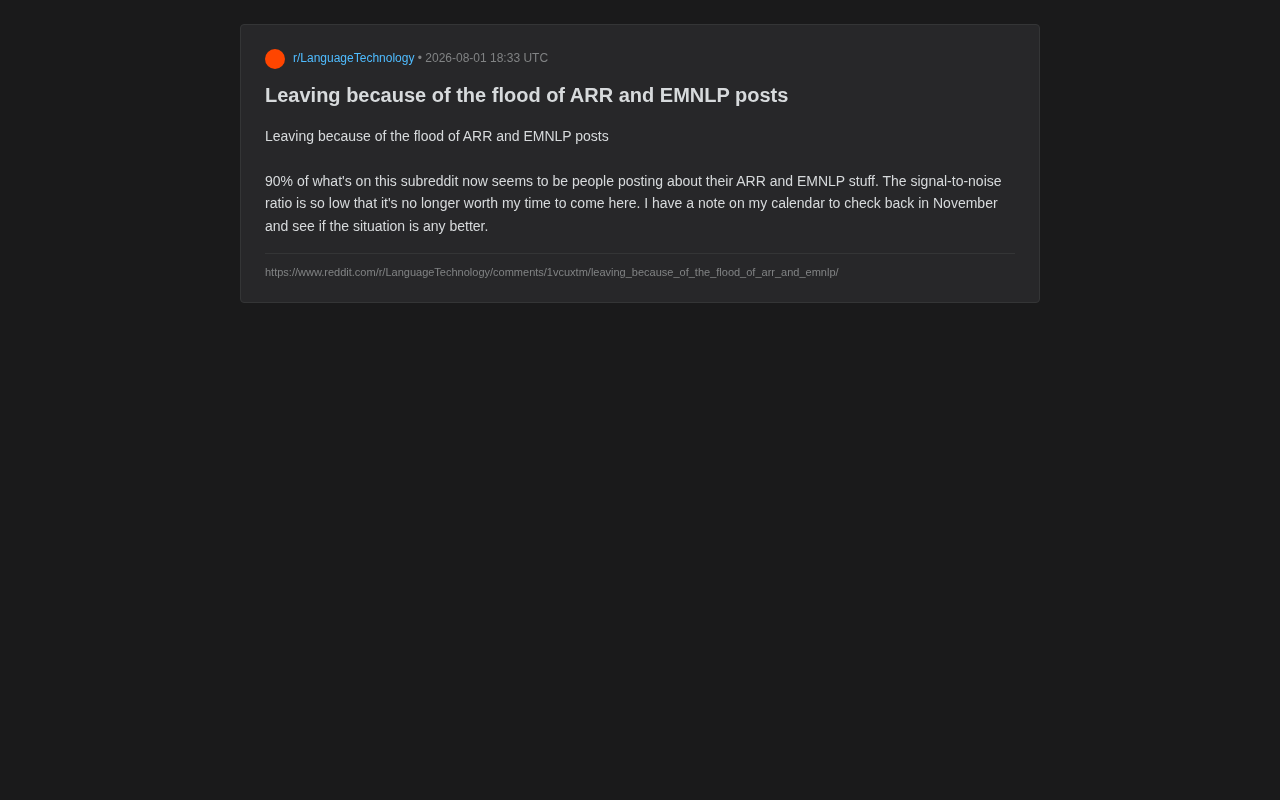
Recently, an active user on a machine learning technical community (Reddit) posted a resonant "exit statement." The core argument was concise and sharp: the community is flooded with posts about ARR (ACL Rolling Review) and EMNLP conference submissions, severely diluting valuable technical discussion to the point where it's "no longer worth the time."
The user stated that "90% of the content" in the community now revolves around people discussing their ARR and EMNLP submissions, with a signal-to-noise ratio so low it's unbearable. They even marked their calendar, planning to return in November to see if things had improved.
Signal-to-Noise Ratio (SNR) was originally a core metric in signal processing and communications engineering, measuring the ratio of useful signal power to background noise power. In information science and community governance contexts, this concept is borrowed to describe the proportion between valuable content and irrelevant or low-value content. When SNR drops too low, recipients must expend more cognitive effort to extract useful information, ultimately causing a sharp decline in information acquisition efficiency—a concept directly aligned with Shannon's information theory and channel capacity.
This post may seem like mere personal venting, but it reflects a widespread structural problem in today's AI/NLP academic communities—how professional communities can maintain content quality under the high-pressure cycles of top conference submissions and reviews.
ARR and EMNLP: Understanding the Context
To understand this "exit" in full context, we need to first understand two key terms and the broader academic ecosystem they're embedded in.
The Academic Standing of ACL Conference Series
ACL (Association for Computational Linguistics) is the most authoritative academic organization in computational linguistics and natural language processing, founded in 1962. Its conference system includes the ACL annual meeting, EMNLP, NAACL (North American chapter), EACL (European chapter), AACL (Asia-Pacific chapter), and others, forming the most central publication channels in the NLP field. Under the current "conference-driven" paradigm of AI research, the number of top conference papers directly impacts researchers' career development, lab rankings, and project funding, making each submission cycle accompanied by enormous collective anxiety.
ACL Rolling Review (ARR) Mechanism
ARR is the rolling review mechanism adopted by ACL conference series. Unlike the traditional one-shot "deadline—review—acceptance" process, ARR decouples paper review from specific conferences. Authors first submit papers to ARR for peer review, then after receiving reviewer feedback, decide which specific conference (such as ACL, EMNLP, NAACL, etc.) to "commit" their paper to.
This mechanism officially launched in 2021, with its design partly inspired by journal rolling submission models. Under the traditional model, a paper rejected by one conference had to undergo the complete review process again at the next conference, creating massive redundant work. ARR makes review results "portable," allowing authors to reuse review feedback across different conferences, with the original intent of reducing redundant reviews and improving review quality and efficiency.
But the side effects are also significant: the review cycle has shifted from a few concentrated bursts per year to sustained high pressure roughly every two months. Additionally, due to the commit mechanism, authors must make strategic decisions within a short time window after review scores are released—whether to commit with current scores or revise and resubmit. This further intensifies discussion heat around score interpretation and submission strategy in the community. Around every review milestone, large numbers of authors concentrate their discussions on review scores, rebuttal strategies, meta-review results, and similar topics.
EMNLP's Influence as a Top Conference
EMNLP (Conference on Empirical Methods in Natural Language Processing) is one of the most important top conferences in the NLP field, hosted by ACL's SIGDAT special interest group. Since its inaugural meeting in 1996, it has become a core publication platform for NLP research. During submission seasons and acceptance notification periods, discussions around it explode in volume.
When the cycles of these two overlap, communities naturally experience a flood of conference-related posts during specific periods—"My scores are X, do I have a chance of acceptance?" "How should I write this rebuttal?" "The reviewer clearly didn't read my paper," and so on.
Why Conference Season Posts Severely Lower Community SNR
Content Homogenization and Emotionalization
Conference season posts share a common characteristic: high homogeneity and emotional drive. Most are expressions of anxiety, complaints, or seeking comfort about personal submission outcomes, lacking reusable technical value. For users hoping to access cutting-edge methods, engineering practices, or in-depth discussions, this content indeed constitutes "noise."
When such posts dominate the vast majority of community space in a short period, truly valuable technical sharing—such as model reproduction experiences, algorithm implementation details, or open-source tool usage tips—quickly gets buried at the bottom of the information feed.
Notably, Reddit's voting mechanism (upvote/downvote) should theoretically enable natural content filtering, but when posters of a particular topic type form an overwhelming majority, the voting mechanism actually reinforces rather than suppresses content homogenization—because the preferences of active voters themselves are biased toward conference discussions, and they're more likely to empathize with similar anxieties and upvote accordingly.
The Scarcity of Community Attention
The core resource of any community is user attention. When high-value content creators find their posts can't get the exposure and discussion they deserve, their motivation to post declines. When high-value readers (who are often potential creators) leave due to low SNR, the community falls into a negative cycle of "bad money driving out good."
This phenomenon is known in community research as the "Eternal September" effect, originating from the historical event in September 1993 when AOL opened access to Usenet, flooding it with new users and irreversibly changing community culture. In academic communities, this effect manifests as: when discussion thresholds lower and emotional content increases, high-quality contributors' willingness to participate drops nonlinearly. Research shows that the top 10% of active contributors in a community often produce over 70% of high-value content, and their departure causes quality loss far exceeding their proportion of the population.
This user's exit is a microcosm of this cycle: the loss of quality users is itself a signal of declining community quality. This also explains why one user's "exit statement" could resonate so widely—it represents the silent exodus of a much larger group.
Cyclical Content Floods and Community Governance Strategies
This Is a Predictable Cyclical Problem
One telling detail: this user didn't completely abandon the community but chose to "come back in November." This shows they clearly recognize that this content flood has obvious cyclicality—it subsides as conference review milestones pass.
This points directly to the essence of the problem: this isn't permanent community decline, but rather a lack of effective content channeling mechanisms. When a community can't separate cyclical, topic-concentrated content from routine technical discussions, the former periodically "pollutes" the entire information feed.
Actionable Solutions
From a community governance perspective, this type of problem has mature approaches:
- Establish dedicated discussion spaces: Create dedicated megathreads or sub-forums for ARR/EMNLP score discussions and rebuttal exchanges, separating them from the main feed. Megathreads are a common content governance tool on platforms like Reddit, with the core idea of concentrating all discussion on a specific topic into a single post. Successful examples include r/MachineLearning's official discussion threads when NeurIPS, ICML, and other conference acceptance results are announced. However, megathreads have their limitations: overly long comment threads reduce discoverability, and Reddit's comment sorting algorithm favors earlier comments, making later discussions hard to notice.
- Tagging and filtering mechanisms: Require conference-related posts to add specific tags (flair), allowing users to independently block them for personalized information filtering. Reddit's flair system allows users to filter content by tag, but this requires moderators to strictly enforce tagging rules, and the filtering experience on mobile is often inferior to desktop.
- Temporal management: Strengthen moderation during review peak periods, guiding discussions to designated locations.
The core logic of these mechanisms is: don't eliminate the demand, but isolate the interference. Conference season discussions have real value for those involved; the problem is simply that they shouldn't monopolize everyone's attention.
Conclusion: Balancing Openness and Professionalism in Technical Communities
This brief exit statement essentially raises a proposition that all professional communities must face—how to strike a balance between openness and professionalism.
Openness means anyone can post, including anxious venting during conference season; professionalism requires the community to maintain a sufficiently high SNR so that genuine knowledge can accumulate and flow. When these two conflict, if a community cannot actively intervene through governance measures, it can only rely on users "voting with their feet" to complete self-selection—and each such vote is a small erosion of the community ecosystem.
This tension is particularly acute in the AI/NLP field. With the explosion of large language models, NLP-related communities have experienced orders-of-magnitude growth in user scale over the past two years. Newly arriving user groups—including career changers, students, and entrepreneurs—bring more diverse discussion needs but also dilute the original community's technical discussion density. This mirrors the broader trajectory of the entire AI field moving from a "small circle" to "mainstream."
For AI and NLP practitioners, this is also a reminder: as the field grows explosively, information overload has become the norm. Learning to actively build your own information filtering system—whether through RSS subscriptions, curated newsletters, or small private communities—may be more pragmatic than complaining about community noise. For community operators, this post serves as a timely warning—the silent departure of quality users is more alarming than the clamor of noise.
Related articles

Genetic Algorithm + Neural Network: Boarding Efficiency Beats Steffen Method by 9.6%
A Reddit developer used genetic algorithms combined with MLP to optimize airplane boarding order, achieving 9.6% faster results than the Steffen Method in simulation. We break down the technical approach, significance, and limitations.

DeepSeek V4 Pro and Grok 4.6 Launch on the Same Day: The AI Industry's Agent War Has Officially Begun
DeepSeek V4 Pro, Grok 4.6, Tencent Hunyuan WorldCloud, and Alibaba's trillion-parameter open-source model all launched on the same day. Agent capabilities are the new battleground as price wars intensify.

Paritok: An Open-Source Tool That Saves 85% Token Costs Through Local Context Compression
Paritok is an open-source local tool that compresses coding agent tool definitions, file contents, and conversation history, saving up to 85% token costs and extending sessions 3x longer.