DeepSeek V4 Pro and Grok 4.6 Launch on the Same Day: The AI Industry's Agent War Has Officially Begun

Four major AI launches in one day signal Agent capabilities and price wars as the new industry battleground.
DeepSeek V4 Pro, xAI's Grok 4.6, Tencent's Hunyuan WorldCloud, and Alibaba's trillion-parameter open-source model all launched on the same day, marking a pivotal moment in AI competition. Agent capabilities have become the primary battleground, with DeepSeek achieving 1/60th competitor costs and Grok landing in Cursor on day one. Tencent pushes into 3D world generation while Alibaba democratizes top-tier AI through open source.
Four Launches in One Day: A Concentrated Explosion in AI
DeepSeek, xAI, Tencent, and Alibaba—four leading AI companies—released new products on the same day, spanning flagship large models, Agent systems, 3D world generation frameworks, and trillion-parameter open-source weights. Together, they covered nearly every cutting-edge direction in AI today.
This phenomenon of simultaneous launches itself reflects that the large model race has entered a white-hot phase—iteration cycles are being compressed, and price wars and capability wars are being waged simultaneously. Below, we break down the core highlights and industry significance of each of the four releases.
DeepSeek V4 Pro: Agent Coding Capabilities Skyrocket at 1/60th the Cost of Competitors
The most noteworthy aspect of DeepSeek V4 Pro's official release wasn't its base parameters, but rather its significant breakthrough in Agent capabilities. An Agent here refers to an AI system with autonomous decision-making, planning, and execution abilities—unlike traditional "Q&A-style" large models, an Agent can decompose a complex goal into multiple subtasks, autonomously invoke tools, write code, access external APIs, and dynamically adjust execution strategies based on intermediate results. A typical workflow for a coding Agent involves: receiving a software engineering task description, automatically analyzing the code repository structure, locating relevant files, writing and modifying code, running tests and fixing errors—all without step-by-step human guidance.
Its coding agent DeepSWE surged from a preview score of 12.8 directly to 62.7—a truly remarkable leap. This kind of capability breakthrough signals that AI is undergoing a qualitative shift from "assistive tool" to "autonomous workforce."
Even more noteworthy is its benchmark performance. V4 Pro has caught up with or even surpassed Claude's flagship model in coding capabilities. If these numbers hold up, it means domestic Chinese models now have the strength to compete head-on with top closed-source models in the high-value Agent coding scenario.
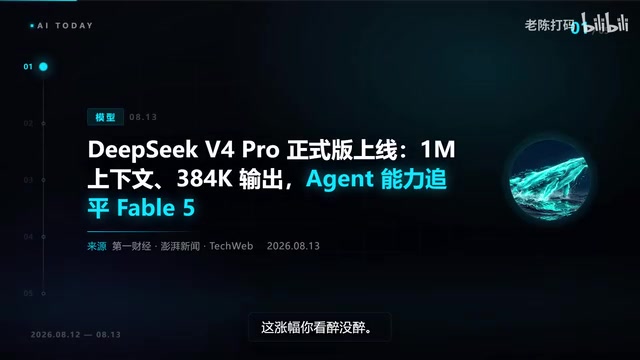
However, the real "killer feature" is the price. For the same task, DeepSeek costs only about one-sixtieth of its competitors. To understand what this gap means, you need to know how large models are priced: A token is the basic unit of measurement for text processing in large models—roughly every 750 English words or 400 Chinese characters corresponds to 1,000 tokens. Currently, API calls to top-tier models are billed by token count, and over the past two years, the cost of using top models has dropped by one to two orders of magnitude. DeepSeek has pushed this trend to its extreme—when capabilities are comparable but prices differ by an order of magnitude, cost-effectiveness becomes the overwhelming decision factor. This continues DeepSeek's consistent "high performance, low cost" strategy.
Grok 4.6: xAI Bets on Long-Horizon Agent Tasks, Lands in Cursor on Day One
Grok 4.6, released by xAI on the same day, also focuses squarely on Agent capabilities, with particular emphasis on "long-horizon task" execution—completing complex tasks with dozens of consecutive steps in a single run. This aligns perfectly with DeepSeek V4 Pro's approach, demonstrating that Agent-ification is becoming the core battleground for large model competition.
Grok 4.6's composite intelligence index score is 61 points, essentially matching GPT-5.6's level with minimal gap. What you might not have noticed is that it entered Cursor's model list on its very first day—an important signal for the developer ecosystem. Cursor is the fastest-growing AI-native code editor in recent years, deeply customized on top of VS Code with built-in AI-assisted programming features, boasting millions of active developer users. Its model list functions like an "app store"—being integrated into Cursor means developers can directly invoke the model during their daily coding. For AI model vendors, getting into mainstream IDE toolchains like Cursor, GitHub Copilot, and Windsurf is the most efficient channel for reaching the developer community. Developer tools have become a core distribution channel for large models.
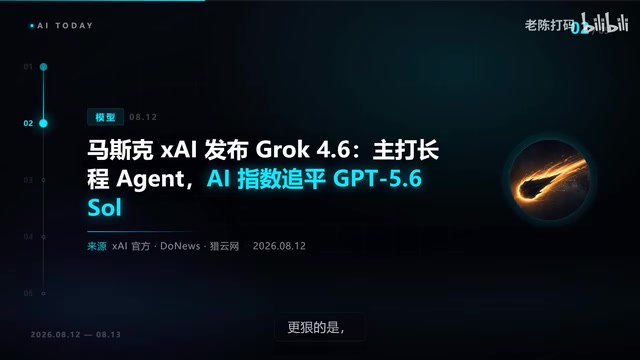
On pricing, Grok 4.6 is equally aggressive: input costs just $2 per million tokens, output $6. For comparison, OpenAI's GPT-4 was initially priced at $30 per million tokens for input and $60 for output—meaning processing approximately 750,000 English words of input costs only $2. Whether it's DeepSeek or xAI, both are using aggressive pricing strategies to compete for market share in Agent scenarios. The ultimate beneficiaries of this price war are undoubtedly developers and small-to-medium enterprises.
Tencent Hunyuan WorldCloud: Generate an Editable 3D Open World with a Single Sentence
Compared to the first two companies' "model + pricing" playbook, Tencent Hunyuan took a differentiated route this time, launching a 3D open world generation framework called WorldCloud. Its core capability: users simply input a single sentence, and the system generates a freely explorable 3D world that supports further editing.
The technical highlight of this framework lies in its multi-Agent collaboration mechanism. Internally, multiple agents divide the work: some are responsible for terrain planning, others for placing buildings, and still others specialize in arranging scene elements like vehicles. After generation is complete, the system automatically checks for common issues like "clipping" and "floating." "Clipping" is a common defect in 3D graphics where two 3D objects unrealistically interpenetrate each other in space (such as a tree growing inside a building or a vehicle embedded in the ground); "floating" refers to objects not properly resting on the ground or support surfaces. These issues are extremely common in procedurally generated 3D scenes, and traditional methods require artists to manually adjust each one. WorldCloud uses dedicated checking Agents to automatically detect and fix these problems, meaning the system can not only "create" 3D content but also "understand" physical spatial relationships and perform validity checks.
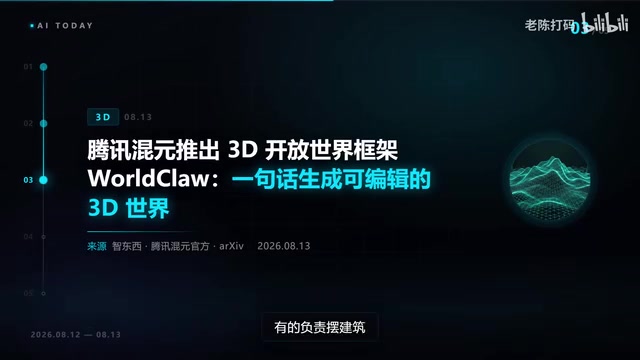
More critically, the output format is highly practical—everything generated consists of independent 3D assets that can be directly imported into mainstream engines like Blender and Unity. This means WorldCloud isn't just a demo project but a productivity tool that can truly integrate into existing game and content production pipelines. For game development, virtual scene construction, and similar fields, this text-to-3D-world capability has the potential to dramatically lower the barrier to creation.
Alibaba Open-Sources a Trillion-Parameter Flagship Model: Making Top-Tier AI Accessible to Small Teams
Alibaba's move this time carries even greater industry impact—the first-ever open-sourcing of trillion-scale flagship model weights. The model has 2.4 trillion total parameters with approximately 95 billion parameters activated per token, using a typical MoE (Mixture of Experts) sparse architecture. The core idea behind MoE is dividing the model into multiple "expert" sub-networks, activating only a small subset of experts to process each input during inference. This means the model possesses enormous knowledge capacity (determined by 2.4 trillion total parameters) while keeping actual inference computation relatively manageable (determined by 95 billion activated parameters). DeepSeek's earlier V2/V3 series also adopted the MoE architecture, which has become the mainstream technical approach for current ultra-large-scale models. The model natively supports a 262,000-token context window, extensible to 1 million.
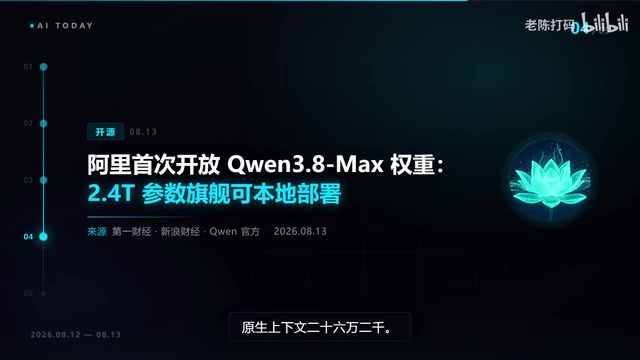
Previously, trillion-scale flagship model weights were typically kept firmly in vendors' hands as closed-source core assets. Alibaba's open-sourcing means small and medium teams can now deploy locally and independently control top-tier capabilities—a major boost to the entire open-source ecosystem.
Separately, Alibaba also open-sourced a multimodal plugin suite called QNMM Plugins under the Apache 2.0 license. Apache 2.0 is one of the most permissive open-source licenses, allowing anyone to freely use, modify, and commercially distribute code, with the only requirement being retention of the original copyright notice. By comparison, some open-source projects using the GPL license require derivative works to also be open-sourced, and certain "semi-open" models publish weights but restrict commercial use. Choosing Apache 2.0 means enterprises can directly integrate it into commercial products without additional authorization, significantly reducing legal risk and compliance costs for enterprise adoption—it's truly "unconditional open source."
This plugin suite enables text-only agent frameworks like Claude Code and Codex to directly read images, videos, documents, and even process 3D and CAD files, as well as remotely operate professional software like Blender and FreeCAD. It's essentially "giving eyes and ears to text-only Agents"—one installation adapts to six major frameworks.
Three Trend Signals in the AI Competitive Landscape
Synthesizing all four launches from this single day, three clear trends emerge:
First, Agent capabilities have become the primary battleground. Whether it's DeepSeek V4 Pro's coding agent or Grok 4.6's long-horizon tasks, leading companies have shifted from "competing on conversation" to "competing on getting work done." Agents are so important because they represent the most direct path to AI commercialization—an AI system that can independently complete tasks has commercial value far exceeding a chatbot that can only answer questions.
Second, the AI price war has fully erupted. DeepSeek's one-sixtieth cost and Grok's extremely low token pricing are pushing the barrier to accessing top-tier AI capabilities to historic lows. Behind this price competition lies the combined effect of hardware efficiency improvements, architectural innovation (like MoE), and economies of scale, signaling that AI services are rapidly becoming "utility-like" infrastructure.
Third, open source and multimodality are advancing in parallel. Alibaba's trillion-parameter weight release breaks down the closed-source barriers around top-tier models, while Tencent's 3D world generation and Alibaba's multimodal plugins collectively point toward AI's next phase—moving from "text" toward "multimodal, 3D, and real-world interaction."
For developers and enterprises, this intensive release cadence represents both opportunity and challenge—there are more options than ever, but finding the optimal balance between capability, cost, and ecosystem will become the new puzzle to solve.
Related articles

Fei-Fei Li on AI: Visual Intelligence, the Boundaries of Creativity, and Human Agency
Stanford professor Fei-Fei Li discusses AI and visual science on Huberman Lab, explaining how ImageNet ignited modern AI, AI's capability boundaries, healthcare applications, and why human agency is the central question in AI development.

DeepSeek Harness Hands-On Review: Core Advantages of a Plugin-Based Agent Framework
Hands-on review of DeepSeek Harness open-source Agent framework, analyzing its plugin architecture, coding capabilities, deployment, and comparison with Claude Code.

Building a 500K Domain Search Engine for $10: Lessons from an Indie Developer's Weekend Project
An indie developer built a 500K domain vertical search engine in one weekend for $10. We analyze the tech stack, vertical search opportunities, and rapid validation methodology.