The Smallest Dual-Band Aircraft Tracker: A New Breakthrough in Portable ADS-B Reception Technology

A new miniature dual-band ADS-B/UAT tracker brings portable aircraft tracking to aviation enthusiasts.
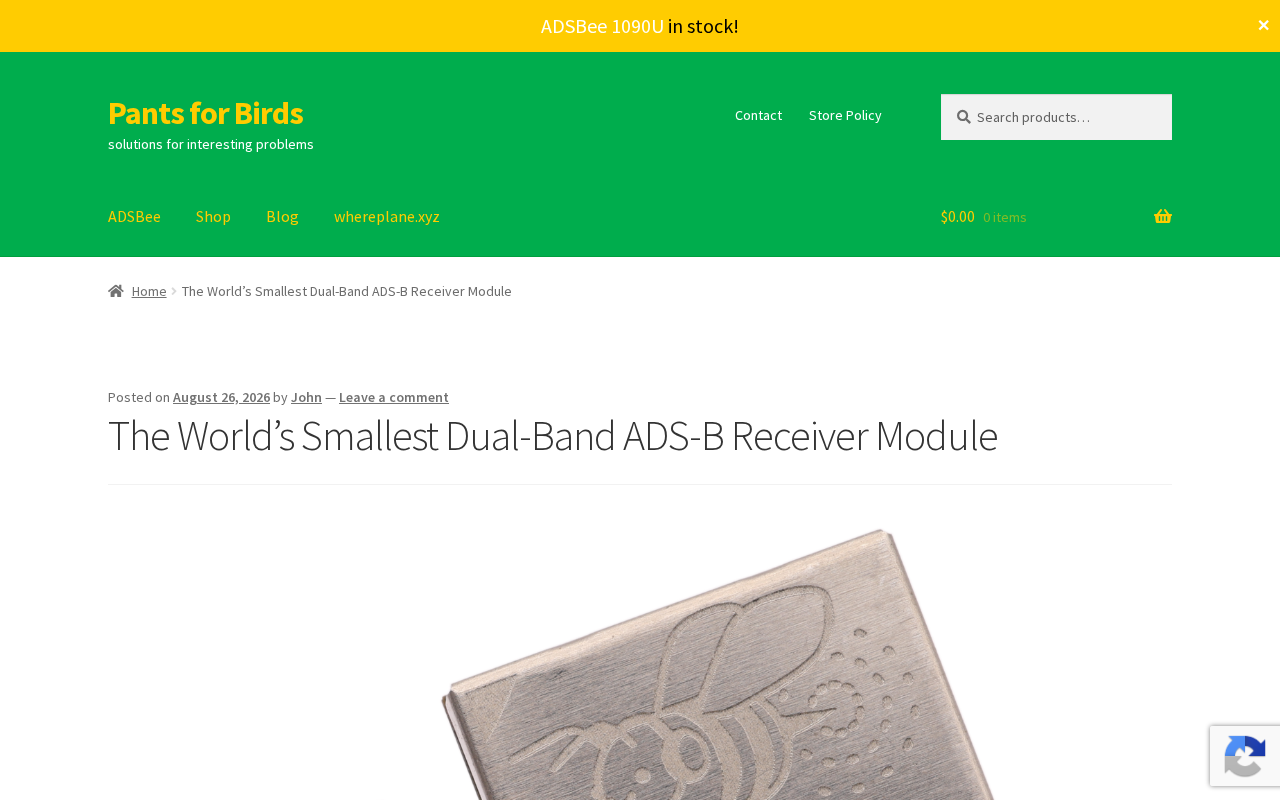
A development team has unveiled what they claim is the world's smallest dual-band aircraft tracker, capable of receiving both 1090 MHz ADS-B and 978 MHz UAT signals in a highly compact form factor. The device represents a significant miniaturization achievement, integrating RF front-end, antenna, and signal processing that traditionally required bulky SDR setups with Raspberry Pi computers, potentially expanding crowdsourced aviation tracking networks.
Aviation Tracking Goes Miniature: The Smallest Dual-Band Aircraft Tracker Debuts
On Hacker News' Show HN section, a development team showcased their latest creation—claimed to be "the world's smallest dual-band aircraft tracker." This device compresses the aviation signal reception work that previously required professional receiving stations into an extremely compact hardware form factor. Its technical direction represents a long-standing important trend in the amateur aviation tracking (ADS-B and related frequency band monitoring) community: democratizing and making portable complex RF reception capabilities.
What Is a Dual-Band Aircraft Tracker
Two Key Frequency Bands for Aviation Signals
Modern civil aircraft broadcast their information across multiple radio frequency bands. The most mainstream is the 1090 MHz ADS-B (Automatic Dependent Surveillance–Broadcast) signal, through which aircraft automatically broadcast GPS positioning, altitude, speed, heading, and other data. This is also the core data source for flight tracking platforms like Flightradar24 and FlightAware.
ADS-B is a core component of the next-generation air traffic surveillance technology promoted by the International Civil Aviation Organization (ICAO). Unlike traditional radar surveillance, ADS-B is a "cooperative" surveillance method—aircraft actively broadcast their position information rather than passively waiting for radar scans. In its name, "Automatic" means no pilot intervention is needed; "Dependent" means it relies on onboard GPS and other navigation systems for positioning; "Surveillance" refers to its monitoring function; and "Broadcast" indicates the signal is broadcast in all directions, receivable by any capable device. Since January 1, 2020, the US FAA has mandated ADS-B Out equipment for most aircraft flying in controlled airspace, and Europe's EASA has similar requirements, meaning ADS-B signal coverage continues to improve.
Another common frequency band is 978 MHz UAT (Universal Access Transceiver), primarily used in US low-altitude airspace, serving general aviation (small private aircraft, etc.). The 978 MHz UAT is a US FAA-specific ADS-B implementation, existing as an alternative to 1090 MHz ES (Extended Squitter). The FAA allows aircraft flying below 18,000 feet that don't enter Class A airspace to choose UAT instead of 1090ES to meet ADS-B mandate requirements. UAT's unique advantage is that it also provides FIS-B (Flight Information Services–Broadcast) and TIS-B (Traffic Information Services–Broadcast)—the former delivers free weather radar imagery, meteorological reports, and other information to pilots, while the latter broadcasts radar-detected non-ADS-B target information to nearby aircraft. This makes UAT particularly attractive to general aviation pilots, who typically fly at low altitudes with limited resources.
A "dual-band" tracker is precisely a device capable of simultaneously receiving both the 1090 MHz and 978 MHz frequency bands. Compared to single-band ADS-B receivers supporting only 1090 MHz, the dual-band approach covers more complete airspace, especially general aviation aircraft flying at low altitudes in the US. This is significant for the tracking community's data completeness.
Why "Smallest" Is a Technical Challenge
Packing dual-band reception capability into an extremely small volume is no easy feat. The RF front-end, antenna design, signal demodulation chips, power supply, and thermal management all need to work together under size constraints.
The RF Front-End is the part of the receiver closest to the antenna, typically including a Low Noise Amplifier (LNA), bandpass filters, mixers, and other components. In miniaturized designs, one of the biggest challenges is antenna efficiency—an ideal quarter-wavelength antenna for 1090 MHz is approximately 69mm long, and achieving acceptable antenna gain in a compact package requires innovative antenna topology designs (such as chip antennas, PCB antennas, or folded antennas). Additionally, the two frequency bands (978 MHz and 1090 MHz) are only 112 MHz apart, requiring filter designs that balance selectivity and insertion loss. Modern highly-integrated RF SoCs (such as dedicated ADS-B receiver chips) integrate these functions into a single chip, serving as key enabling technology for miniaturization.
Traditional solutions often rely on RTL-SDR software-defined radio plus a Raspberry Pi or computer, with relatively considerable volume and power consumption. RTL-SDR stands for RTL2832U Software Defined Radio, originating from an accidental discovery—around 2012, security researchers found that the Realtek RTL2832U chip, originally designed for digital TV (DVB-T) reception, could be reprogrammed as a general-purpose wideband RF receiver covering approximately 24MHz to 1.7GHz. A TV dongle costing only $10-30 suddenly became a powerful RF analysis tool, completely transforming the amateur radio and signal monitoring ecosystem. The emergence of RTL-SDR made ADS-B reception go from requiring hundreds of dollars in dedicated equipment to an affordable experiment accessible to everyone, directly spawning today's massive amateur aviation tracking community.
Miniaturizing the entire system means making precise trade-offs between hardware integration, antenna efficiency, and signal sensitivity.
Technical Significance of Miniature ADS-B Receivers
From Desktop Receiving Stations to Portable Tracking Devices
In the past, setting up an ADS-B receiving station typically required: an external antenna, an SDR receiver dongle, an always-on host machine (like a Raspberry Pi), plus a software stack (such as dump1090).
dump1090 is an open-source Mode S/ADS-B decoder developed in 2013 by Salvatore Sanfilippo (also known as antirez, the author of the Redis database). It can read raw IQ sample data at 1090MHz directly from RTL-SDR devices, demodulate and decode ADS-B messages in real-time, output aircraft position, altitude, speed, and other information, and provide a built-in web map interface for visualization. dump1090 later spawned several active forks (such as dump1090-mutability, dump1090-fa, etc.), becoming the standard software foundation for virtually all amateur ADS-B receiving stations. Crowdsourcing clients like FlightAware's PiAware and Flightradar24's fr24feed are all built on dump1090 or its variants.
While this combination isn't expensive, it still presents a barrier for average aviation enthusiasts, and it's inconvenient for mobile deployment.
The value of this smallest dual-band tracker lies in its high integration of these components, lowering the barrier to participation. Users can place the device by a window, in a car, or even carry it with them, receiving aviation signals from surrounding airspace at any time. This portability opens doors to multiple new application scenarios:
- Airspace monitoring for temporary events
- Mobile observation for aviation enthusiasts
- Increased density for distributed crowdsourced receiving networks
An Important Supplement to Crowdsourced Aviation Data Networks
The reason platforms like Flightradar24 can achieve near-global coverage is largely due to ADS-B reception data contributed by volunteers worldwide. Major global crowdsourced aviation tracking platforms include Flightradar24 (Sweden), FlightAware (US), ADS-B Exchange (community-driven), and RadarBox, among others. Each platform has its own characteristics: Flightradar24 has over 35,000 receiver contributors covering the vast majority of land areas globally; FlightAware provides free hardware and paid account benefits to contributors through its PiAware project; ADS-B Exchange is known for not filtering military and government aircraft data, making it an important data source for the open-source intelligence (OSINT) community. Data from these platforms serves not only aviation enthusiasts but is also widely used by airlines, airport operators, insurance companies, and news media.
The smaller and easier to deploy a device is, the more likely it is to attract more users to join crowdsourced networks, thereby filling coverage blind spots. A sufficiently compact, plug-and-play dual-band receiver could theoretically significantly improve data density in edge areas and low-altitude airspace.
What to Look for When Choosing a Dual-Band Tracker
For this type of aviation tracking hardware, the community typically cares about several core issues:
- Reception sensitivity and antenna performance: Does miniaturization come at the cost of reception range? Generally speaking, a full-size external antenna ADS-B station can cover aircraft within a 200-400 km range, while miniaturized devices with built-in antennas may see significantly reduced effective reception distances.
- Whether it's open-source: Are the hardware design and firmware open, and can they be improved by the community? Open source is highly valued in this community because it allows users to customize data processing workflows, add new features, or adapt to different data feeding platforms.
- Data usage and privacy: How received signals are processed, whether data is sent back to third-party platforms. It's worth noting that ADS-B signals themselves are unencrypted public broadcasts, and receiving these signals is legal in most countries. However, the public release of tracking data for specific aircraft (such as government planes, celebrity private jets) has sparked increasing legal and ethical controversies.
- Compliance: Different countries have varying regulations on radio reception and aviation data.
- Value for money: How does the overall cost compare to existing RTL-SDR + Raspberry Pi solutions?
These are all key dimensions for judging whether an aviation tracking hardware product is worth purchasing.
The Big Ecosystem Behind a Small Device
This smallest dual-band aircraft tracker is a typical case of combined hardware-software innovation. The device itself may just be a compact receiving unit, but behind it connects a vast aviation data ecosystem—from amateur radio enthusiasts, to global crowdsourced tracking networks, to aviation safety and research domains.
Against the backdrop of continuous advances in software-defined radio and low-cost RF chips, these miniaturization efforts deserve attention. They lower the barrier for ordinary people to access the world of aviation signals, and bring the vision of "everyone can build an aviation receiving station" gradually closer to reality. Of course, as a project still in its early demonstration stage, its actual performance and ecosystem impact still need more technical details and user feedback for validation.
Related articles

Workbuddy for Absolute Beginners: How a Desktop AI Agent Fits Into Real Workflows
A beginner's guide to the Workbuddy desktop AI agent: installation, claiming credits, file management, and building automated workflows—compared with CodeX for fit and cost, helping professionals shift from AI question-askers to AI managers.

OpenAI's New Agent Stack: Computer Use, Decisions API, and Ultra-Fast Workflows
OpenAI Dev Day unveiled a new agent stack: Computer Use outperforms humans, Decisions API delivers ultra-low-latency classification via Luna, Agents API opens the same Computer Use capabilities, and GPT-6.1 Sol costs only one-seventh of Astra. Core updates, benchmark data, and developer insights.

Liang Wenfeng Open-Sources DeepInfo Inference Framework, Takes On U.S. Ban
DeepSeek open-sources its DeepInfo inference framework after its models, featuring GPU/CPU cross-pipelining, small-model prediction with large-model verification, and full Huawei Ascend and NVIDIA chip support—facing the U.S. federal ban head-on. This article analyzes its significance for AI deployment and open-source strategy.