The Sprout Experiment: Exploring Deterministic Symbolic Reasoning AI Without Neural Networks

Sprout explores deterministic symbolic reasoning AI without GPUs or neural networks, prioritizing auditability over fluency.
Sprout is a two-year research experiment asking whether AI can learn incrementally through deterministic symbolic reasoning without any neural networks or GPUs. Unlike LLMs that generate probabilistic outputs, Sprout maintains an auditable knowledge base and refuses to answer when evidence is insufficient — prioritizing explainability and governance over fluency, with potential relevance to regulated industries.
A Contrarian AI Research Experiment
While the entire industry races toward larger parameter counts and more powerful compute stacks, one researcher has chosen a radically different path. On Reddit, a research project called Sprout has sparked widespread discussion — built around a boldly provocative question: Can an AI learn incrementally through deterministic symbolic reasoning, without any reliance on GPUs or neural networks?
The project's author openly acknowledges this has been a two-year research experiment. He isn't trying to launch yet another large language model (LLM), nor does he believe Sprout represents the future of AI or can replace existing LLMs. What he genuinely wants to explore is whether a slower, more governance-constrained, deterministically traceable approach can offer unique value outside the modern AI paradigm.
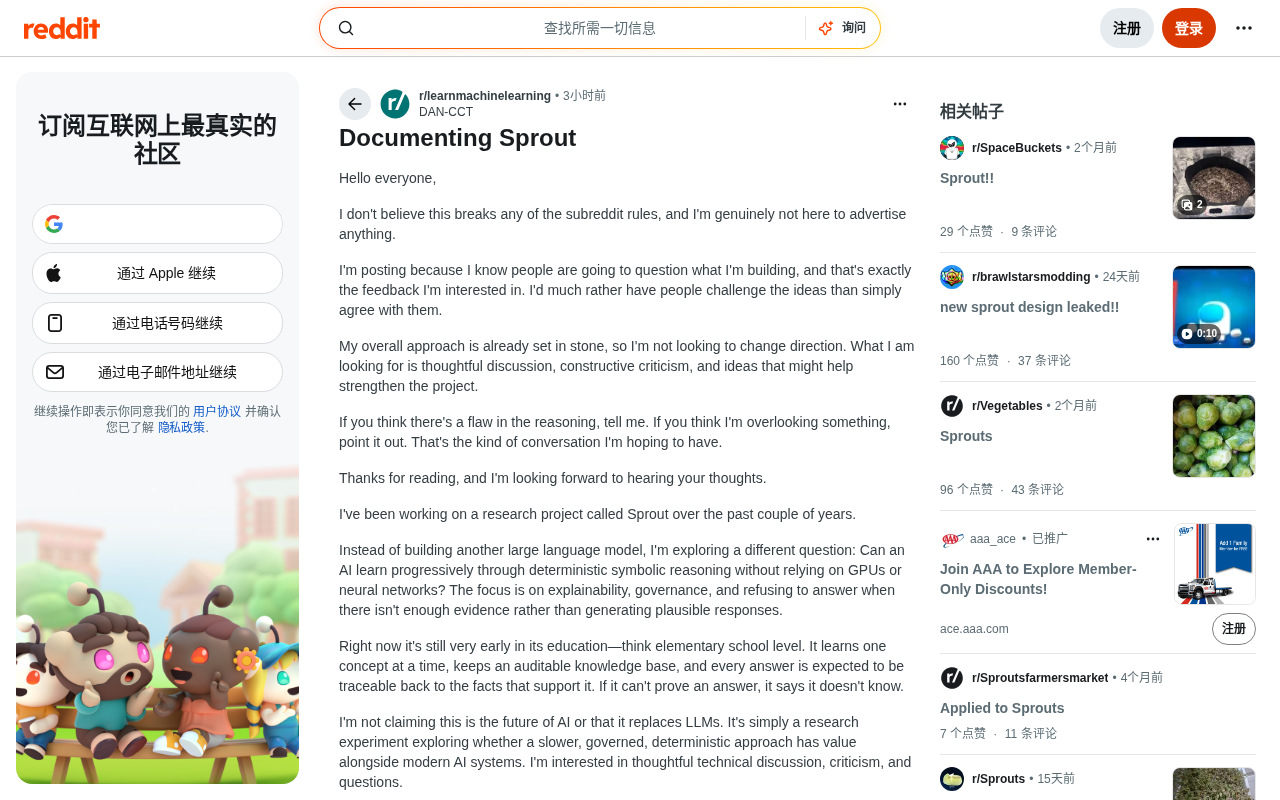
Notably, the author explicitly stated in his post that he wasn't seeking validation — he wanted critical feedback: "If you think there's a flaw in the reasoning, tell me. If you think I'm missing something, point it out." This posture of actively inviting scrutiny stands in sharp contrast to today's hype-saturated AI promotion culture.
Deterministic Symbolic Reasoning vs. Probabilistic Generation: Two Fundamentally Different Paths
How Mainstream Large Language Models Work
To understand Sprout's significance, we first need to see how it fundamentally differs from mainstream LLMs. Current large language models are essentially probabilistic models — they predict the next most likely token based on training data, generating answers that "look plausible." This mechanism delivers impressive fluency and generalization, but also brings well-known problems: hallucination, inexplicability, and the inability to verify the true source of an answer.
The hallucination problem in LLMs has deep technical roots: the model's optimization objective is to maximize the probability of predicting the next token, not to ensure factual accuracy. The model cannot distinguish between "I genuinely know this" and "this looks statistically reasonable" during generation. This fundamental flaw stems from the Transformer architecture's auto-regressive generation mechanism — at each step, the model relies only on the already-generated context to predict the next token, with no external fact-checking mechanism involved. More insidiously, this problem does not disappear as model scale increases: larger models sometimes generate incorrect information with even greater confidence, a phenomenon researchers call "Confident Hallucination." A 2023 Stanford study found that even top-tier LLMs had factual error rates as high as 20–40% in medical and legal domains. In high-stakes decision-making scenarios, a fluent but wrong answer is far more dangerous than a silent admission of ignorance — and this is precisely the core motivation behind systems like Sprout that pursue verifiability.
Sprout's Symbolic Reasoning Approach
Sprout follows a rigorous path of Symbolic Reasoning. It's worth noting that symbolic reasoning is not a new concept — it was the dominant paradigm in the earliest days of AI, traceable back to the "GOFAI" (Good Old-Fashioned AI) era of the 1950s–1980s. AI researchers of that period believed intelligence could be achieved through explicit logical rules and symbol manipulation, producing landmark work including the LISP language, Expert Systems, and the Prolog logic programming language.
The theoretical foundation of symbolic reasoning is rooted in formal logic and first-order predicate logic. Its core idea is to use symbols to represent objects and relationships in the world, use logical rules to express knowledge, and use an inference engine to manipulate these symbols to draw conclusions. This paradigm is naturally interpretable: every step of reasoning is explicit and traceable. IBM's MYCIN medical diagnosis system and XCON configuration system are classic examples — MYCIN even surpassed the average performance of human medical experts on certain bacterial infection diagnostic tasks. However, these systems ultimately declined due to the Knowledge Acquisition Bottleneck: as the problem domain expanded, the cost of maintaining the rule base grew explosively, directly driving the research community to shift toward data-driven machine learning in the late 1980s. Sprout's exploration reassesses the contemporary value of the symbolic approach against this historical backdrop.
Every answer Sprout produces is required to be traceable back to the facts that support it. In other words, the system is not "guessing" a plausible answer — it is "proving" one. These are two fundamentally different cognitive paradigms.
Core Design Principle: If It Can't Be Proven, Say "I Don't Know"
Sprout's most striking design principle is: when evidence is insufficient, it refuses to answer.
This stands in sharp contrast to LLM behavior. When an LLM encounters a question beyond its knowledge, it often generates an answer that sounds authoritative but is entirely wrong — a hallucination. Sprout's logic is: if a conclusion cannot be proven through an auditable knowledge base, explicitly state "I don't know."
In formal logic, this principle corresponds to the Closed World Assumption (CWA): any proposition that cannot be derived from known facts is treated as false or unknown. This contrasts sharply with the Open World Assumption (OWA) implicitly adopted by LLMs — which allows models to generate "reasonable inferences" even when information is incomplete. From an epistemological standpoint, these two assumptions represent radically different attitudes toward ignorance: CWA treats what cannot be proven as untrustworthy; OWA treats what is unknown as potentially existing. SQL database query languages, knowledge graph reasoning engines, and traditional expert systems all adopt CWA, whose core advantage lies precisely in avoiding misleading outputs based on insufficient information. This orientation of "staying silent rather than fabricating" places credibility above fluency, cutting directly to the greatest weakness of current generative AI.
Explainability and AI Governance: An Alternative Value Orientation
The Unique Advantages of an Auditable Knowledge Base
Sprout maintains an Auditable Knowledge Base. This means every piece of knowledge it holds and every inference it makes is theoretically transparent, inspectable, and explainable — a stark contrast to neural network models with hundreds of billions of parameters whose internal mechanisms are nearly opaque black boxes.
The technical implementation of auditable knowledge bases typically relies on structured knowledge representation forms such as Knowledge Graphs, Ontologies, or rule databases. With knowledge graphs, tech giants including Google, Microsoft, and Meta have all built large-scale knowledge graphs as infrastructure for their search and recommendation systems — Google's Knowledge Graph contains over 500 billion facts, while Wikidata maintains structured relationships for over 100 million entities through open collaboration. Unlike neural networks where knowledge is implicitly encoded in weight matrices, every piece of knowledge in a knowledge graph has explicit source annotations, confidence scores, and update records, naturally supporting auditing and provenance. This transparency has unique appeal in sectors like finance, healthcare, and law, where compliance and traceability requirements are extremely high. When an AI system can clearly show "why I'm saying this, what my reasoning is, and where the knowledge comes from," its regulatory value may far exceed that of a more accurate but inexplicable black-box model.
The AI Philosophy of Governance-First
The author repeatedly emphasizes three key concepts: Explainability, Governance, and the ability to refuse to answer. Together, these three points outline an AI philosophy fundamentally different from the mainstream — not pursuing omnipotence, but pursuing clearly defined boundaries and controllable behavior.
Sprout's emphasis on explainability is timely and backed by concrete regulatory context. The EU's AI Act officially came into effect in 2024, becoming the world's first comprehensive legislation governing AI. The Act classifies AI systems into four risk tiers: unacceptable risk (prohibited), high risk (strict regulation), limited risk (transparency obligations), and minimal risk (voluntary compliance). AI systems in medical diagnosis, credit scoring, critical infrastructure management, and judicial assistance are all classified as high-risk and must satisfy mandatory explainability requirements, human oversight mechanisms, and data governance standards — with non-compliant companies facing fines of up to 7% of global turnover. The US FDA is simultaneously advancing a regulatory framework for medical AI, and the Fed and OCC require banks to be able to explain the basis for credit decisions — requirements that black-box neural networks struggle to meet. This global regulatory trend gives the "auditable AI" approach that Sprout represents real commercial applicability beyond pure academic exploration.
An Early-Stage System at "Elementary School Level"
The author remains admirably honest about the project's current state. He describes Sprout as still in a very early "educational phase" — roughly equivalent to elementary school level.
It learns one concept at a time, accumulating knowledge gradually. This incremental learning approach resonates with the Continual Learning research agenda in machine learning, but differs entirely in its technical path. In neural networks, continual learning faces the problem of "Catastrophic Forgetting" — first systematically described by McCloskey and Cohen in 1989: when a neural network learns a new task, gradient updates modify the shared weight matrix, interfering with or even overwriting old knowledge, causing the model's performance on old tasks to degrade sharply. Researchers have developed mitigation approaches such as Elastic Weight Consolidation (EWC) and Progressive Neural Networks, but catastrophic forgetting remains a fundamental challenge for continual learning in neural networks. By contrast, in symbolic systems, new knowledge can in principle be accumulated incrementally without loss, as long as it doesn't create logical conflicts with existing rules — there is no analogous forgetting mechanism.
This incremental learning approach reflects the characteristics of a deterministic method: knowledge growth is controllable, verifiable, and cumulative, rather than completed through one-shot pretraining on massive data. This also means that, at its current pace and capability, Sprout is nowhere near comparable to mature LLMs on general tasks. The author makes no attempt to hide this — and this is precisely what earns the project respect: no exaggeration, no hype, just a clear framing of its identity as a research experiment.
Classic Challenges for Symbolic AI: Issues That Deserve Honest Examination
Examined from a technical perspective, Sprout and projects like it still face the historical difficulties of symbolic AI — and these are the most worthwhile directions for deeper discussion in the community:
-
Scalability Bottleneck: In symbolic systems, as the knowledge base grows, the complexity of rules and reasoning tends to explode. This was an important reason why expert systems eventually declined — DEC's XCON system, for example, contained over 12,000 rules at its peak; maintenance costs were staggering, and as business requirements changed, updating the rule base and resolving conflicts required continuous involvement from large teams of experts. This phenomenon is known as the Knowledge Acquisition Bottleneck, with its philosophical roots in the "Tacit Knowledge" concept described by philosopher Michael Polanyi: much of what human experts know is implicit and difficult to articulate, and cannot simply be captured through interviews and rule writing. "We know more than we can tell" — this aphorism profoundly reveals why machine learning based on big data ultimately outperformed hand-written expert systems on most tasks. For Sprout to break through this historical barrier, innovation in automated knowledge formalization methods will be necessary.
-
The Knowledge Acquisition Problem: The "one concept at a time" approach is rigorous, but efficiently formalizing fuzzy real-world knowledge into reasoning-ready symbols has always been a formidable barrier. Real-world knowledge is often ambiguous, context-dependent, and full of exceptions — the word "high" means something completely different when describing a mountain versus describing a temperature, and symbolic systems need precise formal treatment of such ambiguities, requiring substantial Ontology Engineering work. Large ontology projects like SNOMED CT (medical terminology) and WordNet (lexical semantics) each required decades of expert labor, amply demonstrating the scale of this challenge.
-
The Potential for Complementarity with LLMs: Sprout's real value may lie not in replacing LLMs, but in serving as a verification or governance layer in a "hybrid architecture" — using deterministic reasoning to check the outputs of probabilistic generation, achieving complementary strengths. This line of thinking closely aligns with Neuro-Symbolic AI, currently one of the hottest research directions in AI. DeepMind's AlphaGeometry project, by combining neural network intuitive search with a symbolic geometry proof engine, successfully solved plane geometry problems from the International Mathematical Olympiad, reaching gold-medalist level — widely considered a milestone achievement in neuro-symbolic integration. IBM's Neuro-Symbolic Concept Learner and MIT's probabilistic programming language Gen are also exploring similar integration paths. Meta AI Chief Scientist Yann LeCun has explicitly stated that purely auto-regressive language models cannot achieve genuine reasoning and that a structured symbolic representation layer needs to be introduced, proposing the "World Model" architecture as a candidate direction for next-generation AI. Sprout's experiment is testing the independent value of the symbolic approach in its purest form, providing a baseline reference for hybrid architecture design.
Slow Is Fast: Another Possibility for Trustworthy AI
Sprout is not a revolutionary manifesto — it is a measured exploration. At a time when "bigger, faster, stronger" has become the industry's default narrative, it reminds us that AI development need not follow only one path.
From a broader perspective, the history of AI itself is a history of competing paradigms rising and falling in succession: symbolic AI and connectionism (neural networks) have traded places multiple times over decades, each experiencing peaks and troughs. The 1956 Dartmouth Conference established symbolic AI's early dominance; the commercial boom of expert systems in the 1980s was followed by an "AI Winter" cooling, after which connectionism staged a comeback via backpropagation and big data, ultimately igniting the current deep learning wave with AlexNet's ImageNet breakthrough in 2012. The current deep learning-dominated "third wave of AI" has produced remarkable results, but history shows that the limitations of any paradigm will eventually surface at some critical point. Just as the glory of expert systems in their day could not prevent the rise of connectionism, the prosperity of today's LLMs does not mean that symbolic methods have no room for development — especially in high-stakes domains like healthcare, law, and finance where strict reliability guarantees are required.
Explainable, auditable, and knowing when to say "I don't know" — these seemingly conservative qualities may be precisely the key pieces needed to build trustworthy AI. Regardless of whether Sprout ultimately succeeds at scale, the questions it raises are ones the entire industry should take seriously.
Key Takeaways
Related articles

PGP-Clinical-TimeKAN: A Detailed Guide to the Multivariate Physiological Indicator Joint Prediction Framework
An in-depth analysis of the PGP-Clinical-TimeKAN framework for joint probabilistic prediction of multivariate physiological indicators, covering trajectory-first paradigm, KAN message passing, MIMIC-IV validation, and ablation studies.
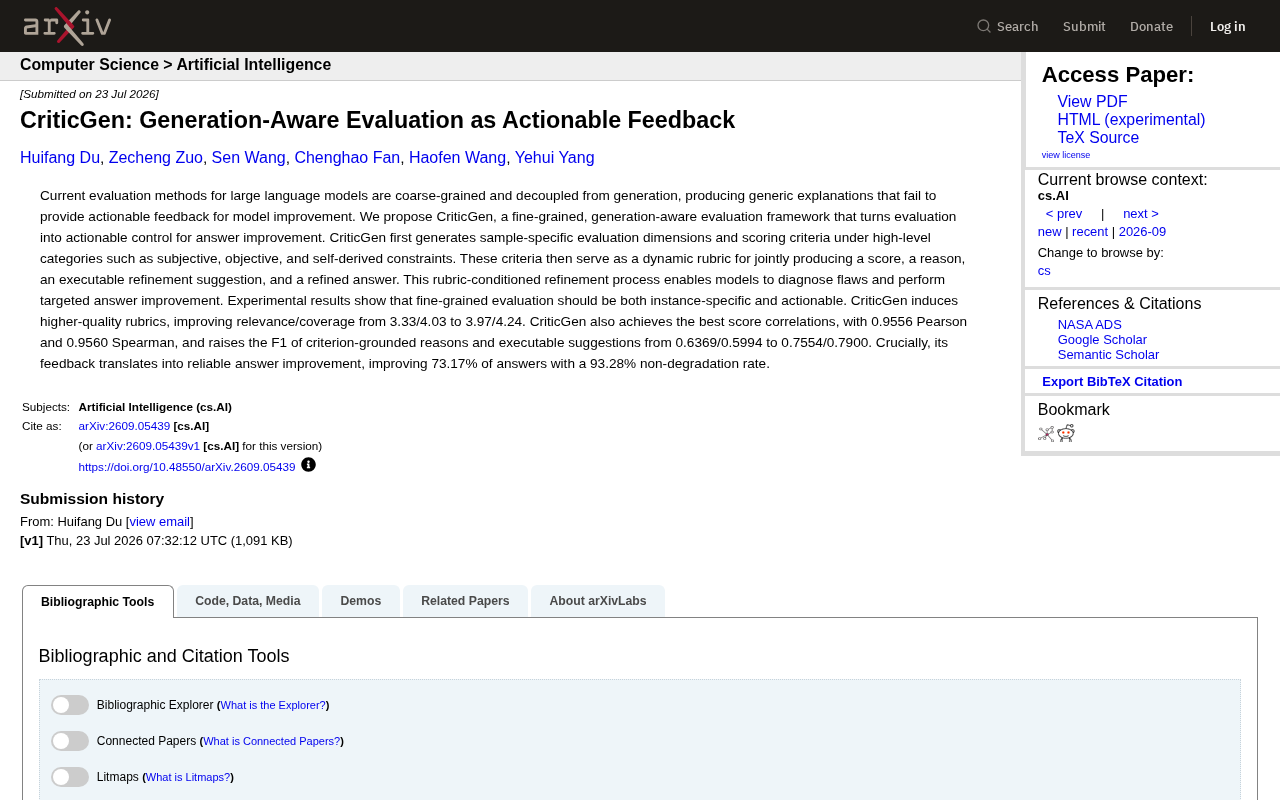
CriticGen: A New Framework That Transforms AI Evaluation into Actionable Improvement Feedback
CriticGen proposes a generation-aware evaluation framework that transforms AI assessment from passive scoring to an active optimization loop, achieving 73.17% answer improvement and 93.28% non-degradation rate.

Vercel AI SDK workflow-harness Update Analysis
Deep analysis of Vercel AI SDK workflow-harness 1.0.107 update: architecture design, engineering practices, and developer value for building reliable AI apps.