The Stale Context Trap in AI Agents: How to Clean Up Outdated Memory

Long-running AI Agents are haunted by stale memory — making "memory governance" an unavoidable engineering challenge.
As AI Agents move from short demos to long-term use, a hidden problem grows: stale context. Most Agent memory systems use vector databases for semantic retrieval but lack temporal awareness, allowing obsolete decisions to resurface and skew current behavior. Developers have explored three approaches: externalizing authoritative state into a single source of truth, attaching timestamps and active expiration to memory entries, and building layered memory architectures to down-weight stale information. The article argues that memory governance must be a first-class design concern — separating overwritable state from read-only history, triggering explicit cleanup on key decision changes, and preserving a human intervention point.
When an Agent Remembers What It Shouldn't
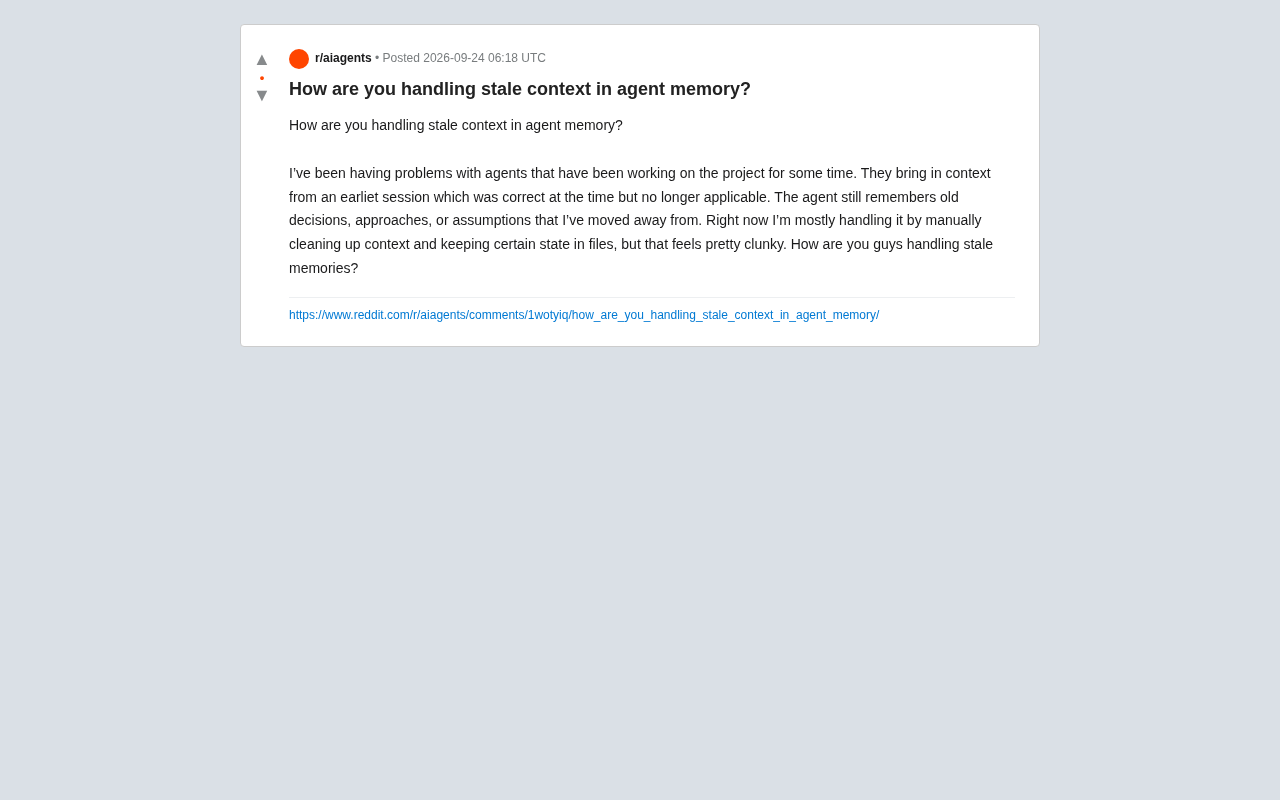
In long-running AI Agent projects, a subtle yet thorny problem is becoming increasingly apparent: stale context. One Reddit developer described his predicament — after working on a project for a while, his Agent kept pulling in information from early sessions that was accurate at the time but no longer applied. Old technical decisions, abandoned implementation approaches, project assumptions that had long since changed: all of it lingered in the Agent's memory, continuously distorting its current judgment.
His workaround was blunt: manually pruning the context and storing key state in files. In his own words, the approach was "pretty clunky." That frustration points to a structural problem in current Agent memory systems that hasn't been well solved yet.
Why Memory Goes "Stale"
Human memory naturally carries a sense of time and self-correction — we know a decision was made three months ago, and we know it was later reversed. But most Agent memory systems lack this kind of temporal awareness and version consciousness.
They typically store all historical information with roughly equal weight in a vector database or context window, retrieving entries by relevance at query time — with little regard for whether a given piece of information has been superseded by a later decision. The result: an old decision that is semantically highly relevant but factually obsolete can easily be retrieved and influence current behavior.
This problem is almost invisible in short conversations, but it gets dramatically amplified in projects that span days or weeks. The project itself is evolving, requirements are changing, yet the Agent's memory behaves like an ever-growing archive that's rarely cleaned — full of both current truths and long-expired "historical documents," all mixed together and hard to tell apart.
Vector databases are the most common underlying storage format for Agent memory systems today. They encode text as high-dimensional numeric vectors and retrieve "semantically related" historical information by computing cosine similarity between vectors. This mechanism is naturally good at capturing content similarity, but it's completely blind to the temporal dimension of information — a technical decision written three months ago will be recalled with nearly the same weight as the most recent entry, as long as it's semantically close enough to the current query. Traditional databases, by contrast, can easily sort by time or set expiration fields. But a vector database is designed to "find the most similar," not "find the most recent." This structural mismatch is the technical root cause of the stale context problem: relevance-based retrieval and freshness management are two separate mechanisms that need to be layered on top of each other — and most existing implementations only address the first.
Common Approaches
The developer community has explored several practical directions around this problem, each with its own trade-offs.
Externalizing State with a Single Source of Truth
The original poster's approach of "storing state in files" is a crude but effective idea: separating the project's current valid state from conversation history, and maintaining an independent, explicitly updatable "single source of truth." The Agent prioritizes reading this up-to-date state at decision time, rather than relying on the fuzzy memory of past sessions.
The downsides are obvious — it requires manual maintenance, is easy to miss, and doesn't scale well. That's exactly why the author found it "clunky." But it reveals a key principle: authoritative state and historical records should be kept separate.
Adding Timestamps and Expiration to Memory
A more systematic approach is to attach metadata to each memory entry: creation time, last-confirmed time, and a validity flag. When a new decision is made, actively mark conflicting older memories as expired or archive them. This resembles the "cache invalidation" strategy in software engineering — memory isn't an append-only log, but an asset whose lifecycle needs to be actively managed.
Cache invalidation is a classic hard problem in computer science, famously summarized in the quip: "There are only two hard things in computer science: cache invalidation and naming things." The core logic of a cache is to store expensive-to-compute results for reuse, while the invalidation mechanism determines when old results should be discarded and fresh data fetched. Common strategies include time-based TTL (Time-To-Live), event-driven active invalidation, and synchronous updates on write. Applying this thinking to Agent memory management means that each memory entry should carry not just its content, but also its "expiration" or a reference to which later decision overrode it. The value of this analogy is that it reminds developers: memory management is fundamentally a problem with mature engineering precedents to draw from — not a brand-new challenge unique to AI.
Layered Memory Architecture
Another approach is to organize memory into layers: short-term working memory, medium-term project memory, and long-term general memory. Actively active decisions live in the highest-priority working memory, while historical content gradually sinks down. Different weights are applied to different layers during retrieval, reducing the chance that stale information gets mistakenly recalled.
Why This Problem Matters
Stale context may look like an engineering detail, but it cuts to the heart of whether an Agent can remain genuinely useful over the long term. An Agent that cannot "forget" incorrect assumptions becomes less and less reliable as a project progresses — it accumulates noise, not experience.
For teams building production-grade Agents, it's worth treating "memory governance" as a first-class design concern rather than an afterthought. Concretely, consider:
- Clearly separating authoritative state from historical records — the former is overwritable and updatable; the latter is read-only and traceable
- Introducing temporal metadata and active invalidation mechanisms into memory, rather than relying on relevance retrieval as a safety net
- Triggering explicit cleanup or archiving of related old memories whenever a key decision changes
- Keeping a low-friction intervention point for humans, since fully automated memory governance is still not mature enough
There's no standard answer to this Reddit developer's question, but his frustration makes the stakes clear: as Agents move from demos to long-term real-world use, the "freshness" of memory is becoming an engineering challenge that can't be ignored. Whoever elegantly solves "how to make an Agent forget what it should forget" will be that much closer to building a truly reliable autonomous agent.
Related articles

Chain of Thought Isn't Just for AI: How Humans Can Use CoT to Improve Thinking Quality
Chain of Thought isn't just a prompt trick for large models. Starting from a Hacker News discussion, this article analyzes why CoT works for human thinking too, breaks down actionable ways to transfer it, and highlights the key differences between human CoT and machine CoT.
Cloudflare Teams Up with OpenAI: Closi…
Cloudflare Teams Up with OpenAI: Closing the Loop from Vulnerability Discovery to Defense with AI
Cloudflare uses OpenAI Daybreak to investigate security vulnerabilities and generate reviewable remediation plans, while developers use Codex to boost coding efficiency and quality.

Orca Multi-Agent Orchestration in Practice: A Guide to Parallel Collaboration with Claude and Codex
Orca is Stable AI's free open-source agent workbench supporting 34 agents like Claude Code and Codex in parallel. Learn its Git worktree isolation, multi-model orchestration, and mobile management.