The State of Pawn: The Survival Question for a Niche Game Mod Ecosystem

Pawn survives as an active legacy ecosystem sustained by the GTA modding community's transition from SA-MP to Open.mp.
The Pawn scripting language, despite being invisible in mainstream rankings, maintains an actively evolving ecosystem in 2026 thanks to the GTA: San Andreas modding community. With Open.mp carrying forward SA-MP's legacy, modern tools like web-based Pawn Studio and PawnPlus 1.5.3, the language exemplifies how niche long-tail technologies survive through demand-driven community self-maintenance rather than commercial backing.
A Language Marginalized by Time — So Why Is It Still Being Updated?
In the world of programming languages, Pawn has never been mainstream. It doesn't appear in any prominent position on the TIOBE index, and it's rarely mentioned by tech media. The TIOBE Programming Language Index measures language popularity based on search engine query volume, but this methodology systematically underestimates languages in highly vertical domains — languages like Pawn, whose communities are primarily active on specific forums and Discord channels, have extremely low search engine visibility, making them virtually invisible in mainstream metric systems. Yet a Reddit user's observation reveals an intriguing phenomenon: this scripting language that many consider "legacy technology" has an ecosystem far from dormant — it's actively evolving.
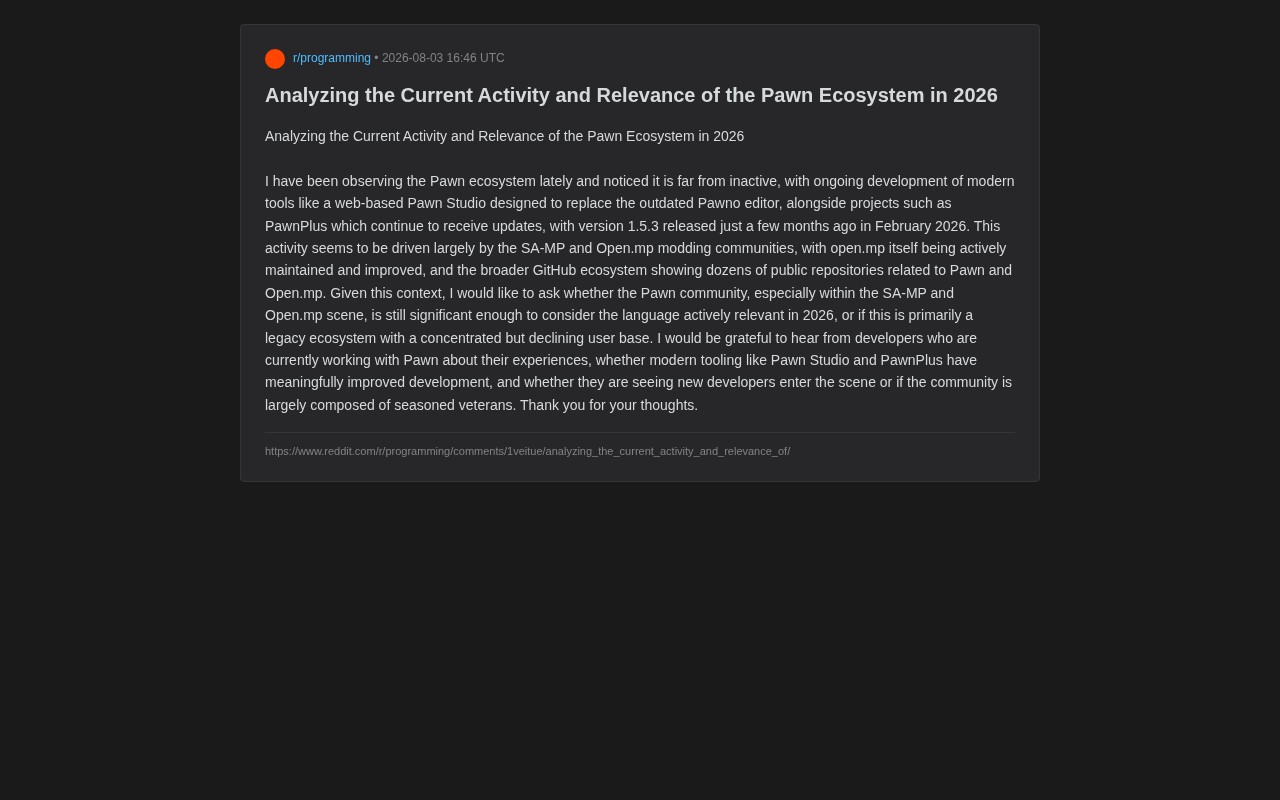
This developer noted that while recently observing the Pawn ecosystem, they discovered multiple active modernization tool projects, including a web-based Pawn Studio aimed at replacing the outdated Pawno editor, as well as PawnPlus still receiving updates — the latter's version 1.5.3 was released as recently as February 2026. This raises a question worth exploring: Is Pawn still an actively relevant language, or is it a nostalgic ecosystem with a concentrated but shrinking user base?
Pawn and the Game Mod World Behind It
The Lineage from SA-MP to Open.mp
To understand why Pawn is still alive, you must first understand the soil it's rooted in. Pawn (formerly known as Small) is a compact, C-like embedded scripting language developed by Thiadmer Riemersma of ITB CompuPhase. It runs on a lightweight Abstract Machine, executing via bytecode interpretation, stripping away complex features like pointers and structs — all variables are fixed-width cell types. While this design limits expressiveness, it delivers predictable performance, extremely low runtime overhead, and minimal memory footprint, making it highly suitable for embedding in host applications. Pawn's vitality comes almost entirely from the game modding community, particularly SA-MP (San Andreas Multiplayer) — a multiplayer mod for Grand Theft Auto: San Andreas.
SA-MP was released in 2006 by Dutch developer Kalcor, injecting multiplayer networking functionality into the original GTA: San Andreas client through hook techniques. At its peak, SA-MP had tens of thousands of concurrent players online, with thousands of active servers worldwide. Over the years, SA-MP allowed countless players to build custom servers in the GTA:SA world — roleplay, racing, survival, and other gameplay modes flourished endlessly. The language used to write all this server logic was Pawn. Server administrators wrote .pwn script files to define game logic, mission systems, economic models, and more. This low-barrier scripted approach spawned a massive mod ecosystem, particularly popular in Eastern Europe, South America, and Southeast Asia, forming unique regional technical communities. In essence, Pawn's user base isn't really "programmers" — they're mod developers who love GTA multiplayer gaming.
Open.mp: The Open-Source Successor Carrying the Torch
As official SA-MP development stagnated, the community spawned Open.mp (Open Multiplayer) as an open-source alternative. The Open.mp project began around 2019, with the core goal of creating a fully open-source, backward-compatible multiplayer game server implementation for SA-MP scripts. It rewrote the server core in C++ while maintaining complete support for Pawn AMX scripts, meaning tens of thousands of existing SA-MP scripts could be migrated without modification. Open.mp uses the Mozilla Public License 2.0, with community governance conducted through a GitHub organization and Discord server. The project also introduced a modern component system, allowing developers to write high-performance plugins in C++, addressing many limitations of the original SA-MP plugin system. Open.mp itself is being actively maintained and improved, injecting new vitality into the entire Pawn ecosystem. Dozens of public repositories related to Pawn and Open.mp exist on GitHub.
This point is crucial: A language's survival often depends on whether the platform it serves still has demand. Open.mp picking up the torch means Pawn will have stable use cases for the foreseeable future.
Modern Toolchain: New Growth on Old Branches
Pawn Studio and Farewell to the Pawno Editor
For a long time, Pawn developers were bound to the feature-poor, visually dated Pawno editor — a pain point shared by many veteran players. The web-based Pawn Studio that has now emerged attempts to fundamentally change this situation.
The shift from "outdated desktop editor" to "web-based modern IDE" reflects that even niche communities are chasing modern development experiences. This kind of tooling renewal is typically a signal that the community still has real production needs, rather than purely nostalgic maintenance. It's worth noting that embedded scripting languages (like Pawn, Lua, Squirrel) have a fundamentally different design philosophy from general-purpose programming languages — they don't pursue powerful expressiveness in the Turing-complete sense, but rather emphasize minimal runtime size, controllable execution sandboxing, and simple host interfaces. Pawn doesn't even have a native string type; strings exist as packed/unpacked arrays. This minimalist design is reasonable in game server scenarios: servers need to reliably execute large volumes of simple logic, not handle complex data structures. Precisely because improvements to the development experience can only come from the external tooling layer, modern IDEs like Pawn Studio become particularly important.
PawnPlus's Continued Version Iterations
PawnPlus is a library/plugin project that extends Pawn's language capabilities. Its version 1.5.3 was released in February 2026. For a third-party tool of a niche language, maintaining a steady version iteration cadence is itself an important indicator of ecosystem health.
Continued tool updates demonstrate two things: first, there are still enough users who need these features; second, there are still maintainers willing to invest time. Both are indispensable.
Active or Legacy? Key Dimensions for Judging Niche Language Ecosystems
Three Core Questions for Assessing Ecosystem Vitality
The original poster raised three highly insightful questions worth borrowing for anyone observing niche technology ecosystems:
- Do the tools genuinely improve the development experience? Do Pawn Studio and PawnPlus make development more efficient, or are they merely superficial updates?
- Are new developers entering? An ecosystem with only veterans, even if active, can hardly be called healthy; the influx of new blood is the key to sustainability.
- What's the community composition? Is it growing continuously, or is it a group of seasoned players maintaining a gradually closing circle?
"Active" and "Relevant" Are Not Synonymous
There's a subtle but important distinction here: An active ecosystem (with updates, repositories, and maintenance) does not equal broad relevance for a language. A highly concentrated, extremely loyal but limited-scale community can absolutely maintain long-term activity, yet this doesn't necessarily mean the language holds significance for the broader developer world.
Pawn is likely in exactly this state — it's not a dead language, but its value is highly bound to specific game mod scenarios. For people within the SA-MP/Open.mp circle, it's irreplaceable; for those outside the circle, it barely exists.
The Survival Logic of Niche Tech Ecosystems and Its Implications
Pawn's case mirrors the shared fate of countless "long-tail technologies" in the software world. Long Tail Theory (proposed by Chris Anderson in 2004) has profound parallels in the technology domain: mainstream programming languages occupy the "head" of developer attention and job markets, while hundreds of niche languages form the extended "tail." These tail languages each serve narrow but genuine needs — ladder logic for industrial control, Fortran for scientific computing, Pawn for game mods. Their economic model typically involves: zero commercial revenue, reliance on volunteer maintenance, and near-zero user acquisition cost (because users are "pushed" toward the language by application scenarios, not "pulled" in by language features). While this model generates no commercial value, it can sustain itself for decades at extremely low maintenance costs.
Pawn doesn't chase the mainstream or participate in the arms race of popular frameworks, yet it has formed a self-sustaining micro-ecosystem through a specific and enduring application scenario. The survival logic for such ecosystems differs fundamentally from mainstream technology:
- Demand-driven rather than trend-driven: As long as people still play GTA multiplayer mods, people will still use Pawn.
- Community self-maintenance: After official development ceased, the open-source community took over (as Open.mp did for SA-MP).
- Delayed but eventual tool modernization: The evolution from Pawno to Pawn Studio typically lags years behind mainstream ecosystems.
For developers, the key to evaluating whether to invest in a niche language isn't whether it's "mainstream," but whether the scenarios it serves align with your goals, and whether the community still has sufficient responsiveness and accumulated knowledge.
Conclusion
Pawn's current state can perhaps be summarized as: an active legacy ecosystem. It has continuous tool updates, a successor open-source platform, and a concentrated base of loyal users, but it also struggles to escape the ceiling of single-purpose application scenarios and a limited user base.
The original poster's appeal — hoping to hear real feedback from frontline Pawn developers — precisely identifies the best way to judge such ecosystems: data and repositories can demonstrate "activity," but only real developer experiences can answer whether it remains "relevant." For any niche technology, this is a proposition worth asking again and again.
Related articles

Workbuddy for Absolute Beginners: How a Desktop AI Agent Fits Into Real Workflows
A beginner's guide to the Workbuddy desktop AI agent: installation, claiming credits, file management, and building automated workflows—compared with CodeX for fit and cost, helping professionals shift from AI question-askers to AI managers.

OpenAI's New Agent Stack: Computer Use, Decisions API, and Ultra-Fast Workflows
OpenAI Dev Day unveiled a new agent stack: Computer Use outperforms humans, Decisions API delivers ultra-low-latency classification via Luna, Agents API opens the same Computer Use capabilities, and GPT-6.1 Sol costs only one-seventh of Astra. Core updates, benchmark data, and developer insights.

Liang Wenfeng Open-Sources DeepInfo Inference Framework, Takes On U.S. Ban
DeepSeek open-sources its DeepInfo inference framework after its models, featuring GPU/CPU cross-pipelining, small-model prediction with large-model verification, and full Huawei Ascend and NVIDIA chip support—facing the U.S. federal ban head-on. This article analyzes its significance for AI deployment and open-source strategy.