The State of Reinforcement Learning in Montezuma's Revenge: From Exploration Challenges to General Intelligence

How Montezuma's Revenge evolved from RL's hardest challenge to a benchmark for efficiency and generalization.
This article traces the evolution of Montezuma's Revenge as a reinforcement learning benchmark—from an unsolvable sparse-reward challenge to a solved problem via Go-Explore and RND. It examines how the field's focus has shifted toward sample efficiency (Atari 100k, EfficientZero, DreamerV3), generalist agents (Gato), and LLM-guided exploration, while identifying remaining frontiers in zero-shot generalization, interpretability, and prior-free exploration.
Introduction: A Classic Challenge in Its Historical Context
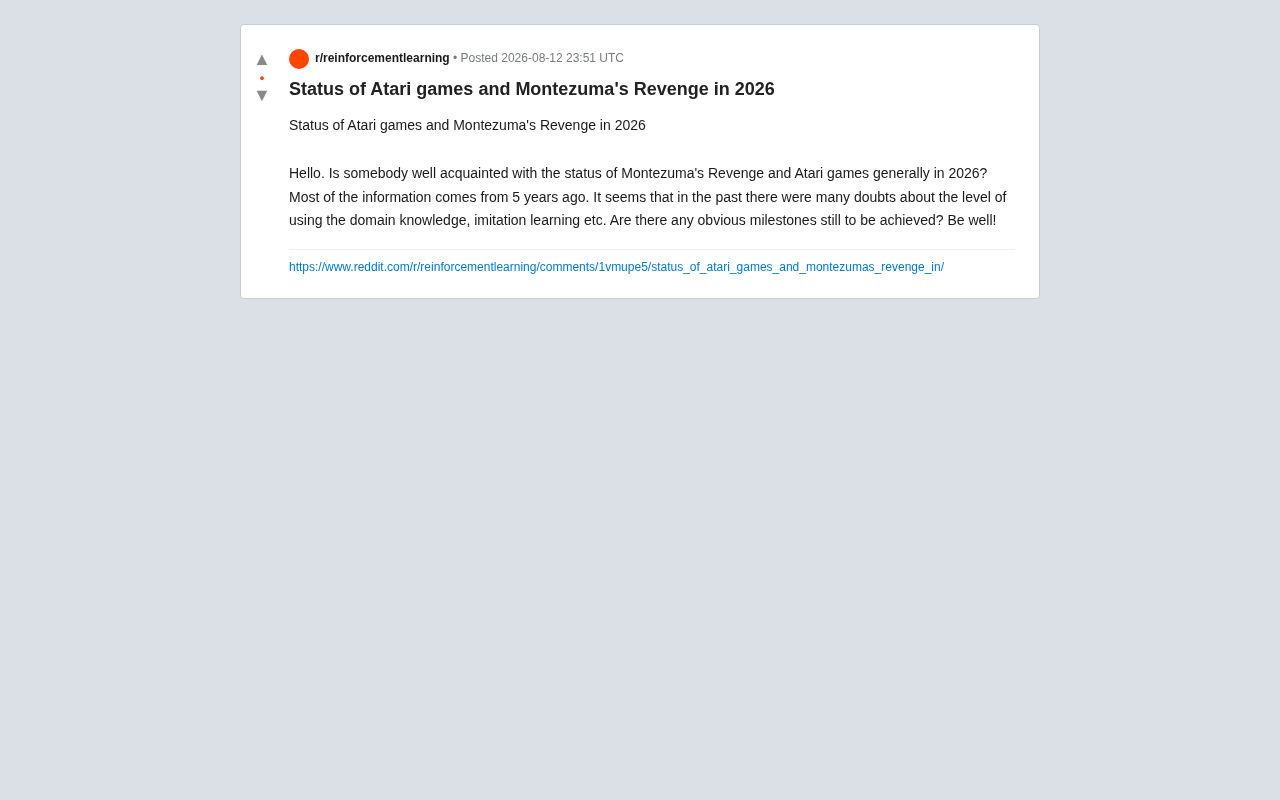
Recently, a thought-provoking question appeared on Reddit's reinforcement learning community: What is the current state of research on Atari games—especially the notoriously difficult Montezuma's Revenge? The poster astutely observed that most information available online still dates back five years, a time when the community was heavily debating whether using domain knowledge, imitation learning, and similar methods constituted "cheating."
This question may seem niche, but it touches on one of the most symbolically significant benchmarks in reinforcement learning (RL). To understand the current landscape, we first need to revisit why this problem mattered so much.
Why Montezuma's Revenge Is So Special
The Ultimate Test of Sparse Rewards
Since DeepMind published its DQN (Deep Q-Network) paper in 2013, the Atari 2600 game suite (typically accessed through ALE, the Arcade Learning Environment) has served as the gold standard for measuring deep reinforcement learning capabilities.
DQN was a landmark algorithm proposed by DeepMind in 2013 that successfully combined deep convolutional neural networks with Q-learning for the first time, learning control policies directly from raw pixel input. Its key innovations included Experience Replay—storing interaction data in a buffer for random sampling to break temporal correlations—and a Target Network—using a delayed-update network to compute target values for training stability. ALE (Arcade Learning Environment) is a research platform built on the Stella emulator that wraps Atari 2600 ROM games into a standardized RL interface, providing uniform state representations (210×160 pixel RGB images) and action spaces (up to 18 discrete actions), enabling fair comparison of different algorithms under identical conditions. ALE includes over 50 games covering a broad difficulty spectrum from simple reflex tasks to complex planning challenges.
DQN achieved or even surpassed human-level performance on most games like Breakout and Space Invaders, stunning the academic community.
However, a few games became insurmountable walls for the algorithm, and Montezuma's Revenge was the most famous among them. Its core challenge lies in extremely sparse rewards: the agent must execute a long sequence of precise actions—climbing ladders, jumping over chasms, dodging skulls, picking up keys, opening doors—before receiving any positive feedback.
The sparse reward problem is one of the most fundamental challenges in reinforcement learning. In the standard RL framework, agents learn through trial-and-error, relying on reward signals from the environment to update their policies. When rewards are dense (such as continuous speed feedback in racing games), gradient signals are abundant and learning is relatively easy. But when rewards are extremely sparse, the agent receives zero reward at the vast majority of timesteps, policy gradients nearly vanish, and value functions cannot propagate effectively. Take Montezuma's Revenge as an example: from the start of the game to obtaining the first key, the agent must execute approximately hundreds of precise actions. Assuming 18 possible actions per step, the probability of a random policy finding the correct sequence is approximately 18 to the negative power of several hundred—an astronomically impossible number. This problem is highly analogous to real-world tasks like robotic manipulation (e.g., assembling parts) and autonomous driving (e.g., successful parking), giving its solutions broad practical applicability.
For traditional RL algorithms that rely on random exploration, the probability of stumbling upon this entire action sequence by chance is essentially zero. Early DQN scored a persistent 0 on this game, making it the field's ultimate litmus test.
Synonymous with the Exploration Problem
For this reason, Montezuma's Revenge gradually evolved from a game into a synonym for the "hard exploration problem." Any algorithm claiming to solve exploration challenges had to prove itself here. This is also the source of the controversy the poster mentioned regarding "domain knowledge" and "imitation learning"—researchers debated whether an algorithm that relies on human demonstrations or game-specific prior knowledge has truly solved the exploration problem.
Key Milestones from Five Years Ago
The poster's perception that "information is stuck five years in the past" is no illusion, as several decisive breakthroughs for this problem were concentrated between 2018 and 2021.
Go-Explore: A Paradigm Shift
Between 2019 and 2021, the Go-Explore algorithm proposed by Uber AI was the most iconic achievement. Its core idea is "remember promising states, then return to them to continue exploring," using a checkpoint mechanism to prevent forgetting previously explored areas.
Go-Explore's design philosophy stems from insights into two fundamental flaws of traditional exploration methods: detachment and derailment. Detachment means the agent might discover valuable states but subsequently be unable to reach them again; derailment means that during attempts to return to a certain state, stochastic policies cause the agent to drift to irrelevant areas. Go-Explore addresses these through three phases: Phase 1 is "explore until solved," utilizing the simulator's save/load functionality (deterministic restoration) to maintain a cell archive that discretizes the state space into cells, randomly selecting a promising cell each time, directly restoring to that state, and then continuing random exploration from that point; Phase 2 is "robustification," using imitation learning to distill the successful trajectories discovered in Phase 1 into a neural network policy that can perform stably even in stochastic environments. Notably, Phase 1 relies on a deterministic environment assumption, which drew some criticism, but subsequent work demonstrated the method could be extended to stochastic environments through policy-conditioned approaches.
Go-Explore not only achieved an astounding score of over 2 million points on Montezuma's Revenge but also surpassed human expert performance across all Atari games for the first time. The paper was ultimately published in Nature in 2021, effectively drawing a provisional conclusion to this classic challenge.
Intrinsic Motivation and Curiosity-Driven Exploration
Meanwhile, another technical approach was also maturing—intrinsic motivation methods. Algorithms like RND (Random Network Distillation) provide the agent with a "curiosity" signal, encouraging it to actively explore novel states.
Intrinsic motivation methods draw inspiration from developmental psychology—infants actively explore novel objects even without external rewards. In RL, intrinsic motivation is formalized as an additional pseudo-reward that is combined with the environment's extrinsic reward to jointly drive learning. Early methods like ICM (Intrinsic Curiosity Module) used prediction error as the curiosity signal: if the agent's prediction error for a state transition is high, that area is "novel" and worth exploring. However, ICM was easily fooled by random noise in the environment (such as static on a TV screen)—the so-called "noisy-TV problem." RND circumvented this issue through a clever design: it uses a fixed, randomly initialized network as a target and trains a predictor network to fit the target network's output. For frequently visited states, the predictor network achieves accurate fits with low prediction error; for rare states, prediction error is high, generating high intrinsic reward. Since the target network is deterministic, random noise does not cause persistent high prediction errors.
RND achieved breakthroughs on Montezuma's Revenge without relying on human demonstrations.
The success of these two approaches fundamentally addressed the earlier controversy: the exploration problem can indeed be largely solved by automated methods without necessarily injecting human knowledge.
The Current Shift in Research Focus
From "Can It Be Solved" to "How to Solve It Efficiently"
Whether Atari and Montezuma's Revenge can be conquered as open problems—that answer has long been clear. They can be solved. Consequently, the research focus has shifted significantly.
The central question is no longer "can we beat the game" but rather sample efficiency. Highly regarded algorithms like EfficientZero and DreamerV3—model-based reinforcement learning (model-based RL) approaches—aim to achieve high-level performance with minimal environment interactions.
Sample efficiency is a critical metric for RL algorithm practicality—interaction costs in the real world are extremely high (robots can be damaged, autonomous vehicles can cause accidents). Model-based RL improves efficiency by learning a dynamics model of the environment: the agent learns not only from real interactions but also plans by simulating future trajectories in "imagination." EfficientZero (2021) combines MuZero's search framework with self-supervised learning, achieving human median performance on the Atari 100k benchmark for the first time—using only data equivalent to about 2 hours of human gameplay. DreamerV3 (2023) employs a World Model architecture, learning environment dynamics in latent space and optimizing policy through Actor-Critic training on imagined trajectories. It demonstrated strong generality across over 150 tasks in different domains, including being the first to collect diamonds in Minecraft without relying on any human data or curriculum learning.
The field has even established benchmarks like "Atari 100k"—allowing the agent only 100,000 interaction steps (approximately equivalent to 2 hours of human gameplay). This benchmark, proposed by Kaiser et al. in 2020, imposes strict constraints (only 400K frames allowed) that force algorithms to possess efficient representation learning and planning capabilities rather than simply accumulating compute.
The Rise of Generalist Agents
Another important trend is generality. DeepMind's Gato, along with a series of subsequent multi-task/multi-modal agents, attempts to master hundreds of tasks including Atari with a single model. In this context, the significance of conquering any single game has diminished, replaced by the ambition of "one model to play them all."
The concept of a Generalist Agent represents a paradigm shift from "narrow-domain expert" to "all-around player." DeepMind's Gato (2022) is a Transformer-based multi-modal, multi-task model that unifies 604 tasks—including text generation, image captioning, robot control, and Atari games—by encoding them all as token sequences processed by a single set of network weights. While Gato did not achieve specialist-level performance on any single task, it proved the feasibility of unified architectures.
Additionally, with the convergence of large language models (LLMs) and decision intelligence, researchers are beginning to explore using LLMs as high-level planners to provide semantically-guided exploration for sparse reward tasks. This injects entirely new perspectives into old problems. For example, Voyager (2023) uses GPT-4 to generate a skill library and exploration objectives in code form for a Minecraft agent; ELLM converts LLM semantic knowledge into intrinsic reward signals, guiding agents to prioritize exploring semantically meaningful states in sparse reward environments. This hybrid architecture of "LLM as planner/reward designer + RL as low-level controller" is becoming the mainstream approach for solving complex, long-horizon tasks.
Unachieved Milestones and Future Directions
As for whether there are still clearly unachieved milestones, the answer is yes—but the goals have changed:
- Extreme sample efficiency: Reaching human-level performance under the Atari 100k constraint or even stricter budgets still has enormous room for improvement. Current best algorithms still perform far below humans on certain hard-exploration games, indicating that the combination of efficient representation learning and planning still needs breakthroughs.
- Zero-shot generalization: Can trained agents transfer to entirely unseen new games or rule variants? This involves meta-learning and foundation model applications in decision-making, requiring agents to possess abstract reasoning and rapid adaptation capabilities.
- Prior-free universal exploration: Exploration algorithms that are entirely independent of any game-specific knowledge or demonstration data still have suboptimal efficiency. Despite progress from methods like RND, in more complex environments (such as tasks requiring multi-step logical reasoning), pure curiosity-driven exploration remains insufficient.
- Interpretability and robustness: Can agent decision processes be understood? Can they resist environmental perturbations? Research shows that current deep RL policies are extremely sensitive to small perturbations in observation space (similar to adversarial example attacks), which severely limits their deployment in safety-critical domains.
Conclusion
The story of Montezuma's Revenge is a microcosm of deep reinforcement learning's development. It went from being a seemingly insurmountable mountain to being conquered by methods like Go-Explore and RND, and has now receded to serve as a "reference coordinate" for measuring algorithmic efficiency and generality rather than an "ultimate challenge."
For researchers entering this field today, rather than fixating on "whether it can be beaten," it's more productive to focus on cutting-edge questions: how to build truly general decision intelligence with less data, stronger generalization capabilities, and fewer human priors. This is the real lesson this classic challenge leaves us.
Related articles

What Is Vibe Coding? The Ideals and Realities of AI Programming
A deep dive into Vibe Coding: its meaning, how it works, and real-world experience. From Andrej Karpathy's concept to developer community feedback on AI programming tools' benefits and risks.

nanoGPT Speedrun Techniques: How Delayed Untying Solves the Sparse Gradient Problem in Embedding Layers
Deep dive into the Delayed Untying technique in nanoGPT speedruns: why tying embed and lm_head weights early then untying later solves both sparse gradients and limited expressiveness.
Real-World Coding Test Across Four AI Models: DeepSeek V4 Flash Unexpectedly Takes the Crown
Real-world coding test comparing DeepSeek V4 Flash, V4 Pro, Grok 4.6, and more. The lightweight Flash model unexpectedly beats flagships in speed and first-pass success rate.