The State of Self-Hosted Email in 2026: Behind the Hacker News Discussion
Self-hosted email in 2026 is technically feasible but ecologically marginal, with core challenges in IP reputation and operations.
The article analyzes a Hacker News question about the state of self-hosted mail servers in 2026. The original post had limited traction, with only 6 points and 2 comments, reflecting a stable community consensus. The core appeal of self-hosted email lies in data sovereignty and cost control, but the barriers are equally obvious: IP reputation management, anti-spam combat, DNS configuration such as SPF/DKIM/DMARC, and ongoing operations are all unavoidable. The article notes that mainstream cloud email services have established scale advantages in deliverability, security, and compliance, and that self-hosted solutions appear more often in privacy-sensitive scenarios or tech enthusiast experiments. The conclusion: technically still feasible, ecologically marginal, and better suited to teams with dedicated operations resources or strong technical capabilities.
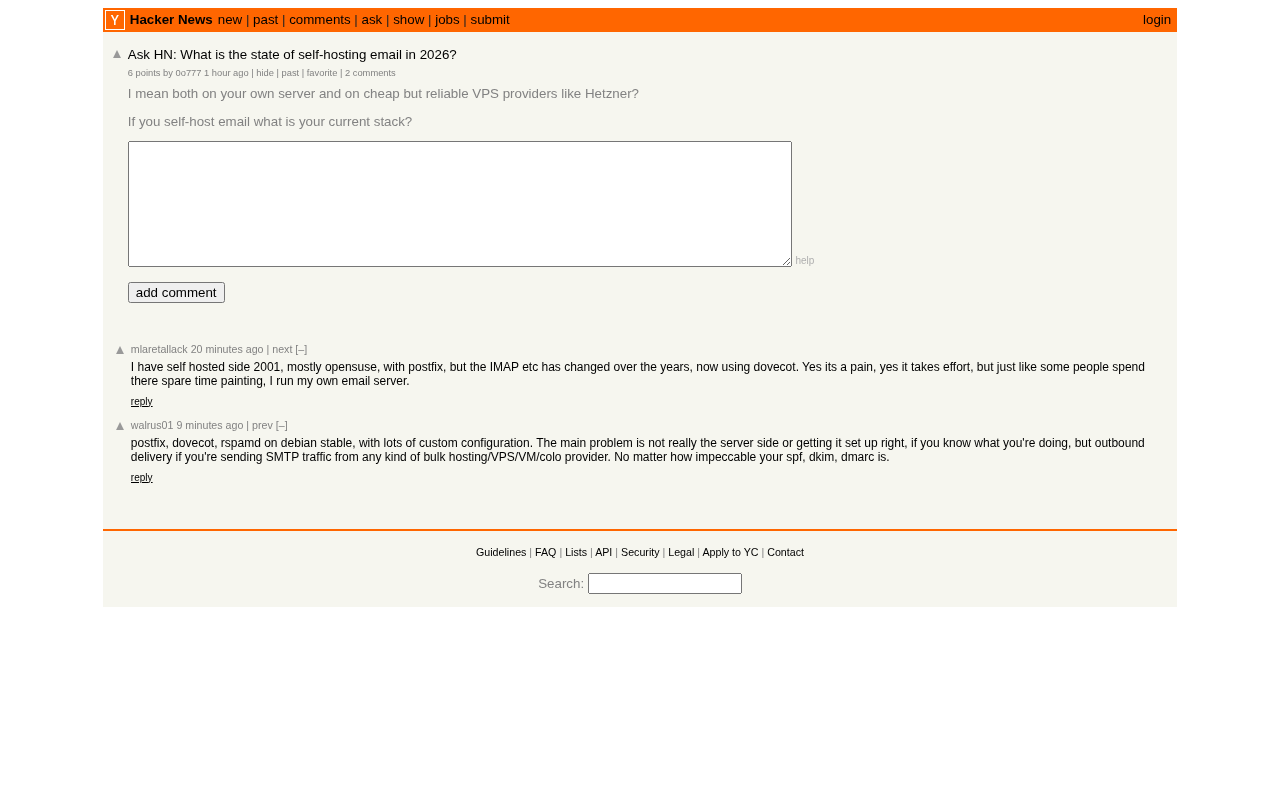
On Hacker News, a post titled "Ask HN: What is the state of self-hosting email in 2026?" sparked discussion. The post itself has only 6 points and 2 comments, but the question touches on a long-standing pain point: in an era where cloud email services are highly mature, how much practical relevance does self-hosted email still have?
The Appeal and Barriers of Self-Hosted Email
The core appeal of self-hosted email lies in data sovereignty and cost control. Enterprises or individuals can fully control their email data and avoid depending on third-party providers' policy changes. At the same time, for teams with some technical capability, self-hosting can eliminate per-user billing costs. But the barriers are equally obvious: IP reputation, anti-spam policies, DNS configuration (SPF, DKIM, DMARC), and ongoing operations and maintenance are all unavoidable.
The original post only raises the question without elaborating on technical details, but the interaction in the comments suggests continued community interest in this topic.
SPF, DKIM, and DMARC are three complementary email authentication mechanisms, often collectively called the "email authentication trio." SPF (Sender Policy Framework) declares through TXT records in DNS which IPs are authorized to send mail on behalf of a domain, and recipients use this to determine whether the sending IP is authorized; DKIM (DomainKeys Identified Mail) uses a private key to sign the email header and body, and recipients verify the signature using a public key in DNS to ensure the content has not been tampered with in transit; DMARC (Domain-based Message Authentication, Reporting and Conformance) builds on SPF and DKIM, telling recipients how to handle failures in either check (such as quarantine or reject), and requires a reporting mechanism so senders can monitor spoofing. None of the three can be omitted: SPF alone cannot prevent content tampering, and DKIM alone cannot govern the handling of unsigned mail. A self-hosted mail server must fully configure all three records, otherwise outgoing mail is highly likely to be flagged as suspicious or even outright rejected by providers such as Gmail and Outlook.
The Reality in 2026: Cloud Services Dominate, Self-Hosting Becomes Niche
Although the post title specifies 2026, the source material does not provide specific data on technological developments for that year. Based on industry common sense, mainstream cloud email services have established scale advantages in deliverability, security protection, and compliance. Self-hosted email appears more often in scenarios with strong data privacy needs, or as experimental projects for tech enthusiasts. The post's mere 2 comments also indicate that this topic has not generated large-scale discussion on Hacker News, possibly reflecting that the community's consensus on self-hosted email has stabilized: feasible, but no longer a hot emerging issue.
Key Challenges of Self-Hosted Email
- IP reputation management: New IPs are often flagged as suspicious by mainstream email providers and need to go through a warm-up process.
- Anti-spam combat: Self-hosted systems need to maintain their own filtering rules, otherwise they can easily become relays for spam.
- Keeping up with protocols and standards: Standards in the email ecosystem (such as tightening DMARC policies) continue to change, and self-hosted solutions need to keep pace.
- Operations and maintenance costs: Troubleshooting, log monitoring, backup and recovery, and more place ongoing demands on a team's technical capabilities.
These challenges are not insurmountable, but they mean self-hosted email is better suited to teams with dedicated operations resources or strong technical capabilities.
IP warming is an unavoidable operational step when self-hosting a mail server. Newly assigned IP addresses have no history of sending mail, so mainstream email providers treat them as potential spam sources, requiring reputation to be built gradually: starting with a few dozen low-complaint emails per day, ramping up volume over several weeks, while closely monitoring bounce rates, complaint rates, and spam trap hits. If sending volume spikes in a short period or many user complaints are received, IP reputation can be quickly damaged, and in severe cases the entire network segment may be blacklisted. The warm-up process is especially unfriendly to individual users, since personal sending volume is inherently limited, making it hard to accumulate enough positive reputation signals. In addition, the choice between shared and dedicated IPs also affects warm-up strategy: shared IPs may inherit others' poor records, while dedicated IPs must start from zero.
Who Still Self-Hosts Email?
Based on common patterns in community discussions, practitioners of self-hosted email fall roughly into a few categories: privacy-focused individual users, development teams needing customized email processing workflows, and geek organizations that treat email systems as part of their infrastructure. For ordinary enterprises, hosted email services usually have an advantage in total cost of ownership.
Conclusion
The state of self-hosted email in 2026 can be summarized as: still technically feasible, but increasingly marginal in the ecosystem. This question on Hacker News itself is more like a routine confirmation of an old topic than a revelation of a new trend. The source material is limited, so no more specific trend judgment can be given.
Note: This article is based on the original Hacker News post and limited comments. The original post did not provide detailed technical data, and some analysis is common-sense industry inference.
One-line Summary
Self-hosted email in 2026 is technically feasible but ecologically marginal, with core challenges in IP reputation and operations.
Paragraph Summary
The article analyzes a Hacker News question about the state of self-hosted mail servers in 2026. The original post had limited traction, with only 6 points and 2 comments, reflecting that the community has reached a stable consensus on the topic. The core appeal of self-hosted email lies in data sovereignty and cost control, but the barriers are equally obvious: IP reputation management, anti-spam combat, DNS configuration such as SPF/DKIM/DMARC, and ongoing operations are all unavoidable. The article notes that mainstream cloud email services have established scale advantages in deliverability, security, and compliance, and that self-hosted solutions appear more often in privacy-sensitive scenarios or tech enthusiast experiments. The conclusion: technically still feasible, ecologically marginal, and better suited to teams with dedicated operations resources or strong technical capabilities.
Related articles

English Version of 'Thank You for Your Love' Gains Traction on Bilibili: A Cross-Cultural Rendition of a Classic Love Song
The English version of 'Thank You for Your Love,' titled 'I'll give you all my love,' trends on Bilibili with rewritten lyrics about giving all your love. This article analyzes its emotional expression, cross-cultural adaptation strategy, and differences from the Chinese original.

Claude Code vs Cursor vs GitHub Copilot: How to Choose Among the Three Major AI Coding Tools
A clear explanation of Claude Code, Cursor, and GitHub Copilot through the lens of 'degree of delegation': Copilot embeds in your editor for autocomplete, Cursor is an AI-first full editor with multi-file batch editing, and Claude Code executes tasks end-to-end in the terminal. Includes selection advice.

Behind the Viral Dynamic Comic Commentary: Deconstructing the Narrative of Family Finance and Emotional Conflict
Deconstructing a Bilibili dynamic comic episode on family financial conflict: how dense dialogue and emotional hooks retain viewers, and where AI script generation falls short in narrative coherence.