The Tech Behind a Single Food Order: How Swiggy Delivers Your Meal

How Swiggy's backend — APIs, dispatch algorithms, real-time tracking, and microservices — delivers your food order.
Using Swiggy as a case study, this article breaks down the full backend journey from tapping "Place Order" to doorstep delivery. The process spans API validation, restaurant inventory checks, real-time rider dispatch optimization, and multi-service order tracking. Rider dispatch is framed as a dynamic optimization problem and a core technical differentiator, while real-time tracking demands high-frequency communication across location, status, and ETA microservices. The entire system packages extraordinary engineering complexity into a seamless user experience.
When you tap "Place Order" on a food delivery app, it feels like a simple click. Behind the scenes, however, it triggers an intricate chain of technical processes. The order flow at Swiggy — one of India's largest food delivery platforms — offers a compelling window into how modern delivery systems are architected. This article breaks down the complete backend journey from order placement to doorstep delivery.
Placing an Order: The API Call Behind One Tap
The process begins the moment a user places an order. When you finalize your cart and tap "Place Order," the app sends your order details to Swiggy's backend via an API. This request is far more than a simple "I want this meal" — it packages restaurant information, item details, delivery address, and payment data into a structured payload.
This step sets the quality of input for everything that follows. The API serves as the bridge between client and server, handling data formatting, authentication, and routing. What feels like a one-tap experience to the user is, under the hood, a structured data transmission and validation process.
Matching the Restaurant: Inventory Check and Order Confirmation
Once the backend receives the request, its first task is to locate the restaurant and verify that your selected items are actually available. This involves real-time inventory and menu status checks — if a dish is sold out, the system needs to intercept the order before it goes through.
Once validation passes, the order is pushed to the restaurant's order management system, the merchant confirms it, and the kitchen begins preparing the food. From an engineering perspective, this introduces a critical state synchronization challenge: the restaurant, the platform, and the user all need to agree on the "order accepted" state. Any desync between these parties leads to a degraded experience.
Dispatching a Rider: A Real-Time Optimization Problem
While the restaurant prepares the food, a separate system kicks into gear — finding the right delivery partner for the order. The dispatch system weighs multiple factors: the rider's current location, availability, and estimated time of arrival at the restaurant.

This is a classic real-time optimization problem. The platform must efficiently match hundreds or thousands of riders against a continuous stream of incoming orders, minimizing delivery time while balancing rider efficiency and overall fleet capacity. Dispatch algorithms are often among the most closely guarded technical advantages a food delivery platform has. Once the best candidate is identified, the order is formally assigned to that rider.
Academically, this class of problem is a variant of the Dynamic Vehicle Routing Problem (DVRP). Unlike traditional logistics, food delivery dispatch deals with continuously shifting variables — order arrival times, rider positions, and restaurant prep times are all dynamic. Systems must make decisions in milliseconds. In practice, platforms use greedy algorithms, genetic algorithms, or reinforcement learning models to approximate optimal solutions — computing exact optima is too expensive for real-time use. Platforms also implement "order batching" logic, allowing a single rider to handle multiple deliveries along a sensible route, improving overall fleet utilization. This is why your order sometimes shares a "ride" with another customer's.
Real-Time Tracking: Orchestrating Multiple Backend Services
Order tracking is described as "the most interesting part" in the original video — and that's a defensible claim from an engineering standpoint. After placing an order, the app continuously receives updates: restaurant prep progress, the rider's live location, and an estimated time of arrival.
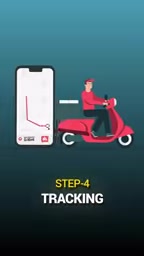
To users, this looks like a smooth progress bar. On the backend, it's the result of uninterrupted communication between multiple services. A location service, an order status service, and an ETA calculation service continuously exchange data, which is then pushed to the user interface in real time. Low latency is a hard requirement here — if the rider icon on the map lags by a few minutes, the user experience degrades noticeably.
Real-time location tracking presents two key engineering challenges: choosing the right communication protocol and controlling data update frequency. Traditional HTTP requests follow a request-response model, requiring the client to poll repeatedly for updates — generating a flood of redundant requests. Modern food delivery apps typically use WebSocket or Server-Sent Events (SSE) for persistent connections, allowing the server to push updates to the client proactively. Riders report their GPS coordinates every few seconds; the platform recalculates ETAs in real time and broadcasts updates to users. During peak hours, location data writes alone can reach millions per second, so these systems typically rely on time-series databases or message queues like Kafka to handle high-concurrency writes, with downstream services consuming and processing the data.
Delivery: The Final Step in a Microservices Ecosystem
In the final step, the rider arrives at the restaurant, picks up the order, follows the planned route to your address, completes the handoff, and the app displays "Order Delivered."

The loop is now closed. Looking back at the full journey, a single food delivery order sequentially engages API communication, the restaurant's order management system, the rider dispatch algorithm, real-time location tracking, and status synchronization — all operating as microservices. Each handles its own domain, yet they're tightly coupled through interfaces to deliver what feels like a seamless, effortless experience to the user.
Microservices architecture refers to the practice of decomposing a large application into small, independently deployable services, each responsible for a single business capability and communicating via lightweight APIs or message buses. Compared to monolithic architectures, microservices allow individual components to scale independently — during peak meal times, the dispatch service can spin up additional instances without redeploying the entire system. The tradeoff is the inherent complexity of distributed systems: network latency, cross-service data consistency, and distributed tracing all become harder to manage. Food delivery platforms are quintessential beneficiaries of microservices architecture, because modules like payments, dispatch, and tracking have vastly different traffic profiles and scaling requirements that a monolith would struggle to handle efficiently.
Takeaway: The Hidden Technical Complexity
The value of breaking down this flow lies in transforming an everyday action into a technical map. For an ordinary user, placing a food order is a single tap. For an engineer, it's a coordinated performance involving APIs, distributed services, geolocation systems, dispatch algorithms, and real-time communication.
The competition among modern food delivery platforms is surface-level about speed and price — but at a deeper level, it's about the stability and efficiency of the underlying technical ecosystem. Understanding this chain not only builds appreciation for the engineering investment behind everyday services, but also gives developers building real-time transaction and dispatch systems a clear and concrete reference architecture.
Related articles

@ai-sdk/vue 3.0.306 Patch Release Syncs with [email protected] Update
@ai-sdk/vue 3.0.306 released, synced with [email protected]. A routine patch release for the Vercel AI SDK ecosystem with no public API changes; the Vue adapter layer stays version-aligned with the core package.

Gemini 4 Argon API Launches: The Era of Million-Token Output Begins
Google launches Gemini 4 Argon with sparse MoE architecture, up to 1M output tokens, and a 68.90% Vals Index score, available across API, AI Studio, and the Gemini app.

DukaanAI: Turning Product Photos into Inventory Lists with Open-Source AI
DukaanAI is an AI inventory tool for small retailers that turns product photos into inventory entries using the open-source Gemma 3 model, with local inference, editable fields, and CSV export.