The Tech Worker Movement: A Book Documenting Protest and Backlash

MIT doctoral student JS Tan co-authors a book documenting the rise of the tech worker movement and employer backlash.
MIT doctoral student JS Tan, as both participant and researcher, co-authors a new book tracing the rise of the tech worker protest wave and employer backlash. It notes tech employees shifted from silent high earners to a group willing to pressure employers, driven by skill-based bargaining power, product ethics anxiety, and social media mobilization. Employers counter by reasserting authority and limiting discussion, exposing open culture as rhetoric. Lacking unions, high turnover, and fragmented interests form the movement's ceiling. The book fills a gap in tech labor research, though its dual identity brings methodological tension.
From Code to Resistance: The Rise of the Tech Worker Movement
The tech industry has long been seen as synonymous with high pay, freedom, and innovation. Yet beneath this glossy image, tensions in labor relations are accumulating. MIT doctoral student JS Tan (SM '22), drawing on his dual identity as both participant and researcher, has co-authored a new book that systematically traces the rise of the tech worker protest wave—and the employer backlash that followed.
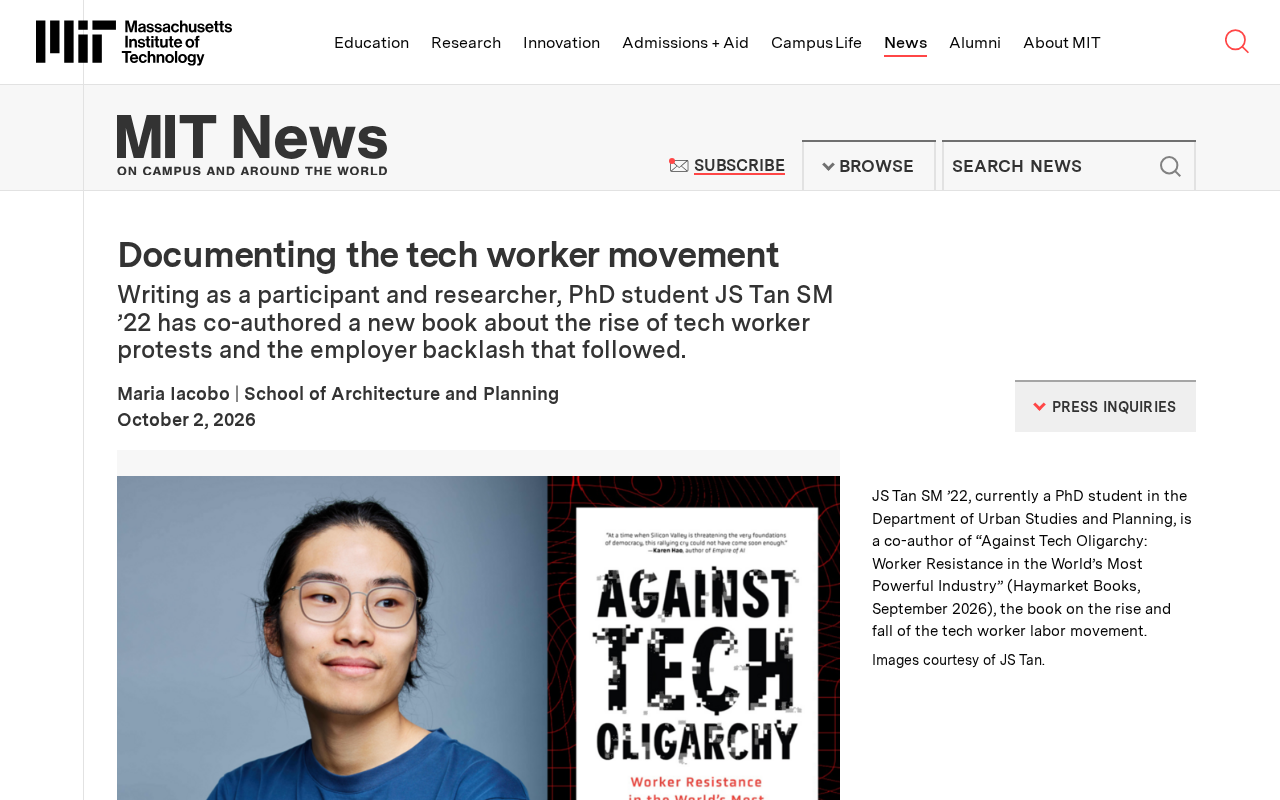
What makes this book distinctive is the author's position. JS Tan is not a detached academic observer, but someone who has personally taken part in the actions he writes about. This "insider–researcher" identity allows him both to capture the emotions and organizational logic within the movement and to analyze its structural causes through an academic framework. For readers interested in labor relations in the tech industry, labor movements, and social movements, this is a rare record that combines experiential texture with theoretical ambition.
Why Protests Happen at Tech Companies
The eruption of the tech worker movement was no accident. Over the past decade or so, tech company employees have repeatedly spoken out publicly on corporate policy, product ethics, and political issues. From opposing the use of technology for controversial purposes, to protesting inadequate handling of workplace discrimination and sexual harassment, to taking stances on immigration policy and climate issues, tech employees have gradually transformed from "silent high earners" into a group willing to pressure their employers.
Several forces drive this shift. First, tech workers possess relatively scarce skills, giving them stronger bargaining power in the labor market and making the opportunity cost of protesting relatively manageable. Second, tech companies' products have broad social impact, making it easier for employees to link their work to public ethics and generating moral anxiety about whether they are complicit in harm. Third, social media makes internal mobilization highly efficient—a single open letter or internal channel can rapidly build consensus.
JS Tan and his co-authors clearly attempt to answer: how do these scattered protests converge into a "movement," rather than remaining isolated incidents?
The tech worker movement is a relatively recent concept, referring to tech company employees pressuring employers through collective action, with demands spanning product ethics, workplace equality, immigration, and climate policy. Its key difference from traditional union movements is that actions often do not rely on formal unions as organizational vehicles, but instead draw on lightweight mobilization tools such as internal mailing lists, Slack channels, open letters, and petitions, exhibiting a "issue-driven, temporarily assembled" character. Such movements erupted in concentrated fashion around 2018—for example, Google employees protesting the company's involvement in a controversial defense project, and Amazon employees opposing the sale of facial recognition technology to law enforcement agencies.
Understanding this phenomenon also requires distinguishing between "employee voice" and "employee organizing." The former is individuals or small groups expressing dissent; the latter involves sustained collective coordination and representation mechanisms. The tech worker movement is worth studying separately precisely because it sits in the ambiguous zone between the two: it features highly visible public protests while lacking stable organizational forms. This also explains why scholars pay attention to whether it can evolve from "events" into a "movement."
Employer Backlash and the Movement's Ceiling
As the movement rose, pushback at the employer level followed. The book focuses on how this "backlash" unfolded. Although tech companies present themselves as open cultures, when facing organized employee pressure they often employ multiple tactics: reasserting management's ultimate decision-making authority, restricting the scope of internal discussion, adjusting performance evaluations, and even using dismissal as a deterrent.
This backlash reveals a core contradiction: the "openness" tech companies champion is more cultural rhetoric than power-sharing. When employees try to convert cultural voice into substantive influence, the boundaries are redrawn. JS Tan's participant observation makes this part of the narrative more persuasive—he records not only events, but also the confusion, frustration, and reassessment of movement participants when they encounter backlash.
The book also touches on a broader question: where is the ceiling of the tech worker movement? In an industry lacking traditional union structures, with high employee mobility and pronounced interest fragmentation, the movement's sustainability and degree of institutionalization remain persistent challenges. A successful protest does not necessarily translate into a long-term negotiation mechanism, and employer backlash may raise the cost of future mobilization.
The "movement's ceiling" corresponds in labor studies to the problem of institutionalization. For a social movement to persist long-term, it usually needs to transform sporadic collective action into stable negotiation mechanisms, such as union contracts, labor-management committees, or formal grievance channels. The U.S. tech industry has long been in a "de-unionized" state, with extremely low national union coverage, making it difficult for tech employees to obtain legal protection for collective bargaining.
Moreover, the tech industry's structural features further raise the threshold for institutionalization: high employee turnover undermines the stability of long-term organizing; roles and interests are highly fragmented, with enormous differences in demands among engineers, content moderators, and contract workers; and equity compensation and performance culture bind individual gains to company stock prices, dampening motives for collective confrontation. Together these factors constitute the movement's "structural ceiling"—even when a single protest succeeds, it is difficult to sediment into a lasting power structure.
The Academic Value of a Participatory Record
Placed within a larger body of literature, the book's contribution lies in filling an empirical gap in labor research on the tech industry. Traditional labor sociology focuses more on manual labor sectors such as manufacturing and logistics, while the tech industry—due to its high pay and "knowledge worker" label—is often excluded from narratives of labor movements. JS Tan's work reminds us that knowledge workers also encounter unequal labor-management power and also attempt organized responses.
As a co-author, JS Tan's doctoral training provides methodological support for the book; as a participant, he can access firsthand material that interviews and surveys cannot reach. This dual identity also carries tension: participants may struggle to fully detach, while researchers may over-theorize. How the book handles this tension will determine its long-term place in academic and public discussion.
Participant observation is a classic research method in anthropology and sociology, requiring researchers to immerse themselves in the group being studied over an extended period, gaining through personal participation details that interviews and surveys cannot capture—including emotions, unwritten rules, on-the-spot decisions, and informal networks.
But this method also carries the classic risk of "going native": researchers may lose analytical distance through deep identification with the studied group, or conversely simplify actors' real experiences through academic frameworks. To mitigate this tension, scholars are usually advised to explicitly disclose their own positions and cross-validate with diverse sources of material. JS Tan's "participant–researcher" dual identity sits on the extension of this methodological tradition, and both its value and limitations must be assessed within this context.
Significance for the Industry and Readers
For tech practitioners, this book offers a mirror: is your company culture truly open, or carefully managed openness? For managers, it is a risk warning: ignoring employees' ethical demands and organizing tendencies may bring unexpected conflict costs. For researchers and policymakers, it is a signal—labor relations in the tech industry are becoming more contentious and require more nuanced institutional responses.
Whether the tech worker movement will move toward more lasting organizational forms remains undetermined. But JS Tan and his co-authors' book at least makes it possible for this still-unfolding history to be seriously recorded.
One-line Summary
MIT doctoral student JS Tan, as both participant and researcher, co-authors a book documenting the rise of the tech worker movement and employer backlash.
Paragraph Summary
MIT doctoral student JS Tan, drawing on his dual identity as participant and researcher, co-authors a new book systematically tracing the rise of the tech worker protest wave and employer backlash. The article notes that tech employees have shifted from silent high earners to a group willing to apply pressure, driven by three forces: skill-based bargaining power, product ethics anxiety, and efficient social media mobilization. Employers counter by reasserting decision-making authority, restricting discussion, adjusting evaluations, and even dismissing workers, exposing tech companies' open culture as rhetoric rather than power-sharing. The lack of union structures, high employee turnover, and interest fragmentation constitute the movement's sustainability ceiling. The book fills an empirical gap in tech industry labor research, though its dual identity also brings methodological tension.
Related articles

Chain of Thought Isn't Just for AI: How Humans Can Use CoT to Improve Thinking Quality
Chain of Thought isn't just a prompt trick for large models. Starting from a Hacker News discussion, this article analyzes why CoT works for human thinking too, breaks down actionable ways to transfer it, and highlights the key differences between human CoT and machine CoT.
Cloudflare Teams Up with OpenAI: Closi…
Cloudflare Teams Up with OpenAI: Closing the Loop from Vulnerability Discovery to Defense with AI
Cloudflare uses OpenAI Daybreak to investigate security vulnerabilities and generate reviewable remediation plans, while developers use Codex to boost coding efficiency and quality.

Orca Multi-Agent Orchestration in Practice: A Guide to Parallel Collaboration with Claude and Codex
Orca is Stable AI's free open-source agent workbench supporting 34 agents like Claude Code and Codex in parallel. Learn its Git worktree isolation, multi-model orchestration, and mobile management.