The Technical Challenges of Developing a Linux GPU Driver for the M4 Mac Mini in One Month
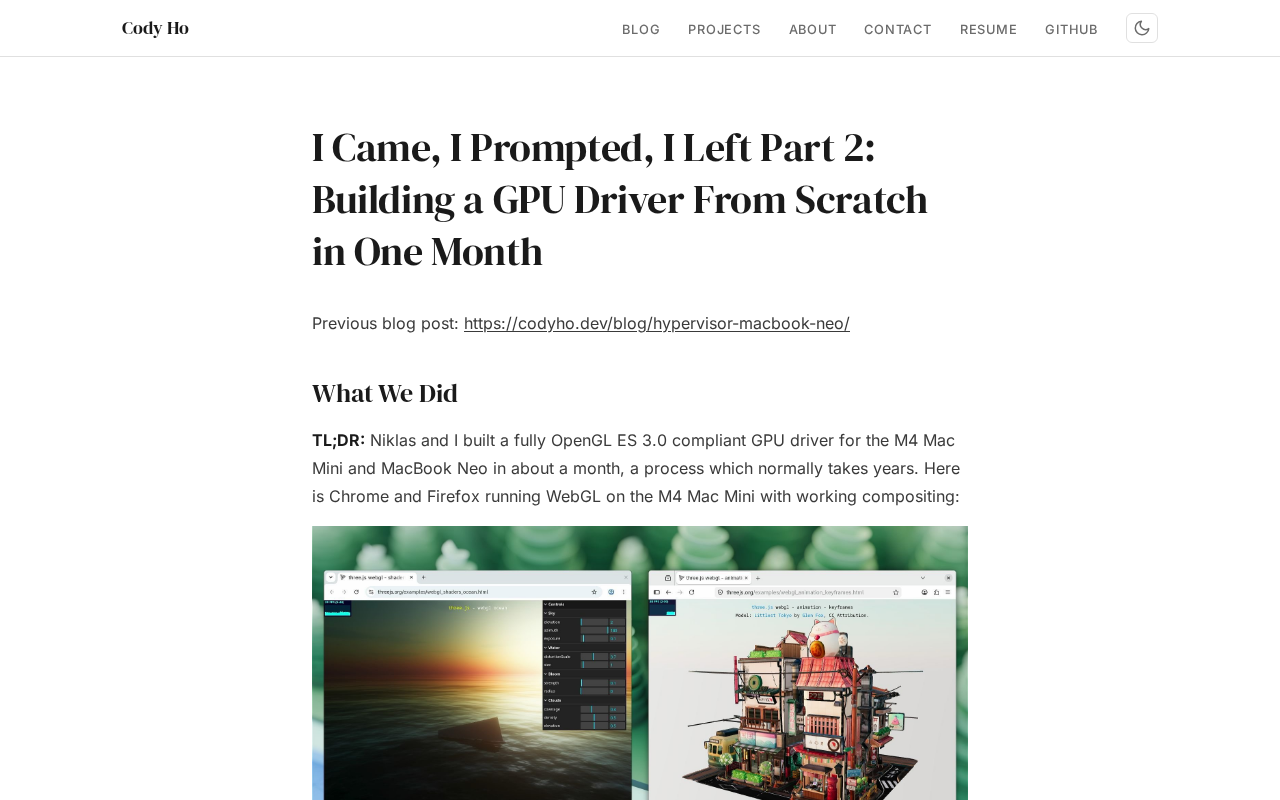
A developer built a Linux GPU driver for the M4 Mac Mini in one month, showcasing the power of open-source reverse engineering.
Developer Cody Ho spent one month building a Linux GPU driver for the M4 Mac Mini, sparking widespread discussion on Hacker News. Apple's GPU uses a closed TBDR architecture with no public documentation, requiring reverse engineering of macOS behavior to reconstruct firmware protocols, memory management, and instruction sets. Progress was possible largely thanks to years of groundwork by the Asahi Linux team. The core challenges span three areas: reverse engineering the black-box firmware communication protocol, address mapping and page table management under a unified memory architecture, and integrating with the Mesa userspace graphics stack for OpenGL/Vulkan support. The case highlights how open-source community collaboration is essential for cracking closed hardware.
Apple Silicon has come a long way from M1 to M4, earning widespread recognition for its impressive performance-per-watt ratio. For the Linux community, however, unlocking the full potential of these chips outside macOS — particularly GPU graphics acceleration — has always been a tough nut to crack. Developer Cody Ho recently shared on his blog his experience building a Linux GPU driver for the M4 Mac Mini in just one month. The post garnered 262 upvotes and 158 comments on Hacker News, reigniting community interest in Apple Silicon reverse engineering.
Why Apple Silicon GPU Drivers Are So Hard to Write
Apple's GPU architecture is fundamentally different from mainstream offerings from AMD, NVIDIA, and Intel. It uses a proprietary Tile-Based Deferred Rendering (TBDR) design optimized for mobile and low-power use cases. While this architecture delivers exceptional energy efficiency, it comes with zero public documentation — the instruction set, memory management model, and firmware communication interface are all completely closed.
For developers who want to drive this GPU on Linux, virtually all information must be extracted through reverse engineering of macOS driver behavior. This is precisely why the Asahi Linux project — led by core contributors like Alyssa Rosenzweig and Asahi Lina — has invested years of effort to gradually achieve OpenGL and partial Vulkan support for M1 and M2 series GPUs. The M4 is a newer chip with an even thinner driver ecosystem, making a ground-up implementation all the more daunting.
What is TBDR? Tile-Based Deferred Rendering divides the screen into small tiles and renders each one independently, deferring the rasterization and shading stages until visibility is determined. Compared to traditional Immediate Mode Rendering (IMR), TBDR dramatically reduces framebuffer read/write bandwidth — intermediate results for each tile can reside entirely in on-chip cache and are only written back to main memory once a tile is complete. This makes it especially advantageous in power-sensitive scenarios like mobile devices and Apple Silicon. However, it also imposes special requirements on the driver: it must precisely manage tile allocation, Hidden Surface Removal ordering, and cross-tile resource dependencies. Any misjudgment leads to rendering artifacts. Compared to other TBDR mobile GPUs like Qualcomm Adreno and ARM Mali, Apple's implementation is entirely closed — no programming manuals or register specifications exist publicly — making the reverse engineering effort far more demanding than comparable projects.
What One Month Really Means
Choosing to tackle GPU driver development within a single month is an ambitious undertaking by any measure. GPU drivers typically involve multiple complex subsystems: command submission, Memory Management Unit (MMU) configuration, firmware loading, and shader compilation. A bug in any one of these can cause a system crash or blank screen.
The fact that meaningful progress was made in such a short time is largely due to the reverse engineering groundwork and open-source codebase accumulated by the Asahi Linux project. Standing on the shoulders of that prior work, the developer could reuse existing firmware interface analyses and kernel DRM (Direct Rendering Manager) framework adaptations, focusing energy on the M4-specific differences. This validates the critical role open-source community collaboration plays in advancing hardware ecosystems — it would be nearly impossible for a solo developer to complete such a complex systems engineering task from scratch in a month.
Core Challenges in Reverse Engineering
Based on the general experience of similar projects, developing GPU drivers for Apple Silicon involves several major hurdles:
The Black Box of Firmware-Hardware Interaction
Apple GPUs depend on a closed-source firmware to operate. A Linux driver must understand how to communicate with this firmware and how to submit rendering tasks. Developers typically capture and analyze the data flow between the driver and hardware on macOS to reverse-engineer the communication protocol format.
A deeper look: Apple GPU firmware communication differs fundamentally from traditional PC GPUs. On x86 platforms, AMD and NVIDIA drivers primarily control hardware through Memory-Mapped I/O (MMIO) register writes. Apple GPUs, by contrast, run a real-time operating system (RTOS) on a GPU coprocessor, and the driver communicates with this firmware asynchronously through message queues in shared memory — similar to a microkernel IPC mechanism. This means reverse engineers must not only understand the GPU's hardware behavior but also reconstruct the message formats, state machine transitions, and synchronization protocols defined by the firmware. The Asahi Linux team primarily intercepted firmware communication data by injecting kernel extensions into macOS, combined with static disassembly of the firmware binary, gradually piecing together a complete protocol picture. This process is extremely time-consuming — just the initial mapping of the M1 GPU firmware protocol took several months.
Memory Management Complexity
The GPU needs to share a Unified Memory Architecture (UMA) with the CPU. Correctly mapping address spaces, managing page tables, and preventing out-of-bounds memory accesses are foundational to driver stability. Any mistake can freeze the entire system.
Interfacing with the Graphics API Stack
Having a working low-level driver is only the first step. Getting real applications to run requires hooking into a userspace graphics stack like Mesa to implement OpenGL or Vulkan interfaces. This work is substantial and represents the critical leap from "it boots" to "it's usable."
About Mesa: Mesa is the primary open-source userspace graphics driver framework on Linux, responsible for translating standard graphics APIs like OpenGL, Vulkan, and OpenCL into hardware-specific GPU instructions. Its architecture is split into a frontend (API translation layer) and a backend (hardware-specific compiler and command generator). The Mesa driver backend developed by Asahi Linux for Apple GPUs is called "Asahi," and its shader compiler must translate GLSL/SPIR-V intermediate representations into Apple's proprietary AGX instruction set. Since the AGX instruction set also has no official documentation, the compiler was developed through reverse analysis of Metal shader compiler output from macOS. Currently, Asahi Mesa implements OpenGL 2.1 and partial OpenGL 3.x support, with Vulkan support under active development — though it is still far from passing the full Vulkan Conformance Test Suite (CTS). This is why, even after the kernel driver is functional, it takes considerably more time before users can smoothly run 3D applications.
Community Response and Significance
The article sparked lively discussion on Hacker News, with 158 comments ranging from questions about technical details to broader debates about the future of Apple Silicon on Linux. Many developers argued that the value of this work goes beyond running Linux on Mac hardware — it advances the open understanding of closed hardware and gives users more freedom of choice.
Apple Silicon has become a preferred hardware platform for many developers due to its performance-per-watt ratio. Being able to run a full Linux desktop environment — including GPU acceleration — on these chips means high-efficiency hardware can break free from OS lock-in and serve a wider range of use cases. From Asahi Linux to individual developer explorations like this one, these efforts collectively paint a picture of a gradually maturing open-source ecosystem for Apple Silicon.
Lessons for Developers
This case offers several takeaways for developers working in hardware reverse engineering and driver development: leveraging existing open-source work can dramatically shorten development timelines; hardware reverse engineering requires systematic traffic capture and patient protocol reconstruction; and even the most closed hardware can be opened up with sufficient community collaboration.
For users who care about Linux hardware compatibility, this kind of progress signals growing hope for a more complete Linux experience on Apple Silicon devices. While production-grade, stable GPU drivers are still some distance away, every effort like this pushes the ecosystem forward.
Related articles

A Linux Satire Skit and the Real Concerns Behind AI Value Alignment
A Linux satire skit uses absurdist comedy to lampoon AI over-alignment and values rhetoric. This piece unpacks the serious questions it raises about AI safety, anthropomorphization, and usability.

Linux yes Command Explained: Practical Tips for Auto-Answering Prompts and Stress Testing
Complete guide to the Linux yes command: auto-answering pacman/apt prompts, batch deletion with rm -i, CPU stress testing with /dev/null, and custom output strings.

Linux nl Command: A Practical Guide to Adding Line Numbers to Files
A complete guide to the Linux nl command: add line numbers to files with control over numbering range (-b), increment (-i), width (-w), format (-n), separator (-s), and regex filtering.