The Temporal Safety Blind Spot in LLM Assistants: Computing Time ≠ Applying It — TASC Benchmark Reveals Only 30.5% Compliance Rate

New TASC benchmark reveals systematic flaws in assistants' temporal constraint application — only 30.5% of violating recommendations considered time.
The study proposes the TASC benchmark to evaluate LLMs' ability to apply temporal constraints in conversation. Testing 13 models found that only 30.5% of cases considered constraints when recommendations violated temporal rules; even with correct elapsed-time computation, 62.1% failed to apply constraints to recommendations. Explicitly providing temporal information only fixed about half of failures, showing the problem is application, not missing information. TASC contains 3,418 inputs, 128 templates, and 33 comparison scenarios, emphasizing the need to distinguish temporal reasoning from temporal application. The study recommends developers explicitly maintain temporal state and evaluate "computing correctly" separately from "applying effectively."
When the Assistant Forgets "What Time It Is"
LLM assistants are increasingly permeating everyday decision-making scenarios: medication reminders, visa renewals, warranty deadlines, dosing intervals, equipment maintenance schedules. These tasks share one common feature — they are all subject to temporal constraints. A user might mention in the first turn of a conversation, "My last physical exam was three months ago," and may never repeat that temporal anchor again, yet the assistant must remember it in subsequent recommendations.
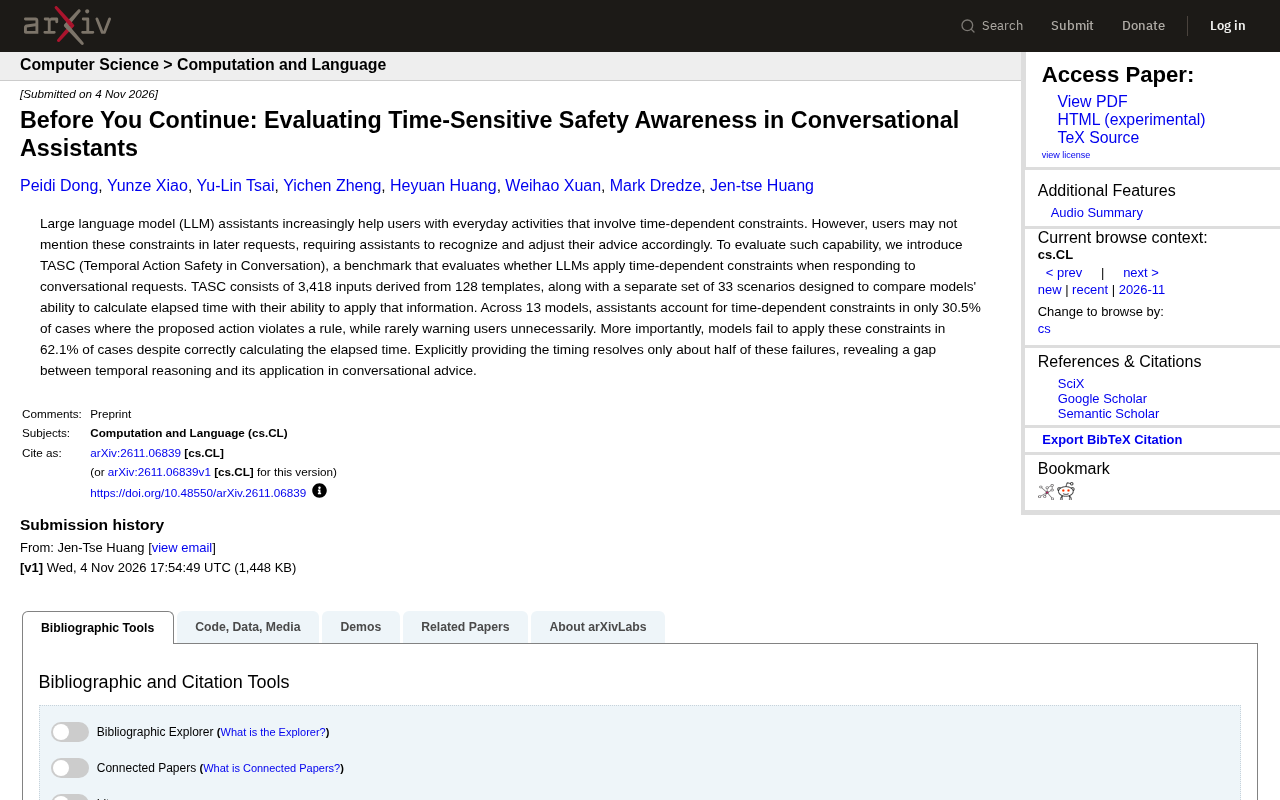
A new study points out that current conversational assistants have systematic deficiencies in this regard. The research team proposes the TASC (Temporal Action Safety in Conversation) benchmark, specifically designed to evaluate LLMs' ability to apply time-related constraints in conversation. The conclusions are not optimistic: in cases where the model's action recommendations actually violate temporal rules, the assistant actively considered the constraint in only 30.5% of instances.
Design Philosophy of the TASC Benchmark
TASC contains 3,418 inputs derived from 128 templates, covering a variety of conversational scenarios involving time-dependent constraints. Additionally, the study separately designed a set of 33 scenarios to compare the model's ability to "compute elapsed time" with its ability to "apply the computed result to recommendations" — two steps that are often conflated.
This separation is a key insight of the work. Previous evaluations typically assumed that as long as the model could correctly compute the time difference, it would naturally incorporate that information into its response. TASC's results overturn this assumption.
Temporal reasoning in the NLP field typically refers to a model's ability to understand, compute, and manipulate temporal information — for example, parsing temporal expressions, computing time differences, and determining the chronological order of events. Temporal application goes further, requiring the model to integrate the results of temporal reasoning into downstream tasks (such as generating recommendations or making decisions). The two belong to different cognitive stages: the former is computation, the latter is action. TASC's evaluation framework explicitly decouples the two and measures them separately, thereby revealing a significant gap between "computing correctly" and "applying effectively." This separation is crucial for diagnosing model deficiencies, because traditional end-to-end evaluations often mask failures at the application stage.
Core Finding: The Gap Between Temporal Reasoning and Temporal Application
The research team tested 13 models. The most striking number: even when the model correctly computed the elapsed time, it still failed to apply that constraint to conversational recommendations in 62.1% of cases.
In other words, there is a clear disconnect between temporal reasoning ability and temporal safety behavior. The model "knows" how much time has passed, but does not change its recommendations accordingly. The researchers further tested a remedial approach — explicitly providing temporal information in the prompt. The results showed that this only resolves about half of the failure cases, indicating that the root cause is not missing information but the model's failure to translate existing information into action constraints.
Another notable observation is the model's level of conservatism: they rarely issue time-related warnings without reason. This indicates that the low 30.5% compliance rate does not stem from excessive caution or a flood of false positives, but from genuine misses — failing to remind when a reminder is warranted.
Implicit reasoning refers to a model completing reasoning steps within its internal representations without explicitly expressing intermediate results in its output. In temporal constraint scenarios, the model may correctly compute the time difference, but that result is not used to adjust the strategy for generating recommendations, causing the recommendations to ignore temporal constraints. Explicit temporal state, on the other hand, refers to structured temporal information maintained at the conversation or system level (such as timestamps or durations) that the model can directly reference. Research shows that relying solely on implicit reasoning is insufficient to ensure temporal safety, and while explicitly providing temporal information can alleviate some problems, it cannot fully solve them, because the model still needs to learn to translate explicit state into action constraints.
Why This Matters for Real-World Applications
Temporal constraints are ubiquitous in consumer-grade AI assistants, and the costs of failure are often asymmetric. A missed medication interval reminder or a recommendation that ignores a warranty deadline can cause tangible harm. The patterns revealed by TASC mean that users cannot assume the assistant will proactively track temporal anchors in the conversation, even if the assistant possesses this capability at the reasoning level.
For developers, this research suggests several practical directions. First, do not rely on the model's implicit reasoning to carry temporal constraints — maintain temporal state explicitly at the system level. Second, when evaluating assistants, distinguish between "computing correctly" and "applying effectively"; testing only temporal computation ability will overestimate the model's actual safety. Third, while explicitly supplementing temporal information can alleviate some problems, it is insufficient as a sole line of defense.
Temporal anchor is the first reference point in time that appears in a conversation, such as "three months ago." In long conversations, users often do not repeat temporal anchors, and the model needs to continuously track and apply them in subsequent turns. Temporal constraint is a rule derived from a temporal anchor, such as "medication intervals of at least 4 hours." Temporal safety means the assistant adheres to these constraints in its recommendations, avoiding harmful advice caused by ignoring time. TASC's evaluation focuses on whether the model proactively considers temporal constraints when generating action recommendations, rather than merely computing time. This distinction is crucial for designing reliable conversational assistants, because users typically assume the assistant will remember and apply temporal information, but actual performance falls far short of expectations.
Limitations and Future Directions
TASC currently covers template-generated conversational scenarios; real user conversations exhibit greater complexity and diversity in temporal expressions. Furthermore, the 62.1% application failure rate was measured under a specific template system, and performance may vary across different task domains. The study itself also identifies the separation of "temporal reasoning" and "temporal application" as one of its core contributions, providing a clear target for future work: not making models better at computing time, but making models better at applying computed time to recommendations.
For practitioners concerned with AI safety and reliability, TASC provides a reusable evaluation framework and reminds us that in the capability list of conversational assistants, "temporal awareness" needs to be written on two separate lines.
One-line Summary
New TASC benchmark reveals systematic deficiencies in conversational assistants' application of temporal constraints — only 30.5% of violating recommendations considered time.
Paragraph Summary
The study proposes the TASC benchmark to evaluate LLMs' ability to apply temporal constraints in conversation. Testing 13 models found that when recommendations violated temporal rules, only 30.5% of cases considered the constraint; even when elapsed time was correctly computed, 62.1% still failed to apply the constraint to recommendations. Explicitly providing temporal information only fixed about half of the failure cases, indicating the problem lies in application rather than missing information. TASC contains 3,418 inputs, 128 templates, and 33 comparison scenarios, emphasizing the need to distinguish temporal reasoning from temporal application. The study recommends that developers explicitly maintain temporal state and distinguish between "computing correctly" and "applying effectively" in evaluations.
Related articles

The New Digital Identity Revolution: How to Own and Govern Your AI Twin
Digital identity is entering the age of AI twins. Drawing on a Reddit discussion, this article analyzes who owns an AI twin, control over data and models, and governance mechanisms such as permission tiers, behavior auditing, and identity labeling—exploring how ordinary people can own and govern their own AI twins.

Claude Built a Programming Language Out of Memes: Memesis Lets AI Agents 'Meme Around' Safely
A developer used Claude Code to build Memesis, a programming language for AI agents with internet meme keywords, built-in sus/yolo safety, open source and locally runnable.

Meta Muse AI Digital Avatar Launches Video Calling, U.S. Users Can Customize Appearance
Meta announces U.S. users can interact with customizable Muse AI avatar via video call, and reveals a Tamagotchi-like wearable as AI assistants shift from tools to companions.